
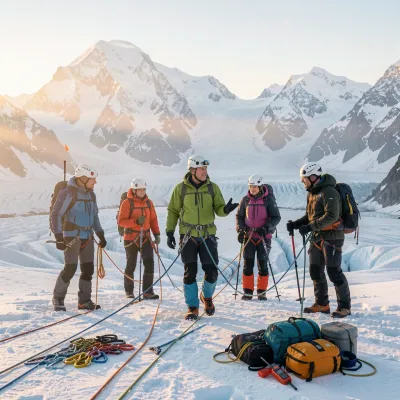
Most books on mountain guiding focus on technique—rope systems, avalanche assessment, navigation. Hannah Jenkins's Guidecraft does cover those, but its real contribution is treating guiding as a profession that demands equal mastery of certification pathways, business infrastructure, and client experience design. The result is a reference that reads less like a climbing manual and more like an operations manual for a high-stakes service business.
What the book is about
Guidecraft spans 25 chapters organized as a sequential roadmap. It opens with a reality check on whether guiding aligns with a reader's aspirations (Chapter 1), then moves through the global certification landscape (Chapters 2–4), the "soft skills" that separate competent guides from exceptional ones (Chapter 5), and the personal experience foundation required before formal training (Chapter 6). The middle third builds the business: entity selection, business planning, legal structures, liability management, insurance, and safety systems (Chapters 7–13). The final third covers client-facing operations—assessment, trip planning, communication, and crafting memorable, sustainable experiences (Chapters 14–16)—before closing with pricing, marketing, branding, networking, hiring, advanced specializations, environmental stewardship, climate adaptation, and profiles of successful operations (Chapters 17–25). The intended reader is anyone serious about a guiding career: aspiring guides evaluating the path, candidates already in certification pipelines, and established guides seeking to professionalize their business.
The certification marathon, not a sprint
Jenkins devotes three chapters to certification bodies (IFMGA, AMGA, ACMG) and the path to certification, making clear that the journey is measured in years, not months. IFMGA certification requires a minimum of 94 training days over three to six years, plus prerequisites like "15 snow/ice routes rated D+ or higher, 15 rock climbing routes of 5c (VI/UIAA) or higher, and 25 ski tours with substantial ascent." The AMGA pathway similarly progresses from Single Pitch Instructor through Rock Guide Course, Advanced Rock Guide Course, and a six-day exam. Crucially, the book frames certification as "not an endpoint but a foundation for lifelong learning and professional credibility," and notes that many reputable services "will not allow someone to work as a lead guide without professional training and certification in their specific terrain." An apprenticeship period—working under a fully certified guide—is presented as indispensable for translating exam skills into daily operational judgment.
Soft skills as professional currency
Chapter 5 argues that technical mastery is merely the entry ticket. The skills that define a guide's reputation and safety record are communication, leadership, decision-making, risk management, client care, problem-solving, patience, and environmental stewardship. Jenkins breaks each down with field-relevant examples: explaining a complex climbing move to a novice requires "breaking down the movement, explaining the body mechanics, perhaps demonstrating it, and then offering encouragement"; leadership means "making well-considered decisions, often under pressure and with incomplete information"; risk management is "a continuous, cyclical process that begins long before the trip and continues until the client is safely back at base." The chapter positions these abilities as teachable, practicable competencies—not innate traits—and links them directly to client retention and referral business.
Business infrastructure for a high-risk profession
Chapters 7 through 13 form a compact MBA for guides. Jenkins walks through entity selection (sole proprietorship, LLC, corporation) with a clear-eyed comparison of liability protection, tax treatment, and administrative burden, recommending the LLC for most independent guides. She then details the permits required for commercial use of public lands—CUAs, Special Use Permits, concession contracts—and warns that "new guiding businesses often face significant barriers to entry, as established companies may already hold the limited permits for popular areas." Liability receives a full chapter dissecting duty of care, negligence, waivers ("not foolproof shields"), and the necessity of professional-liability and general-liability insurance. Safety systems and emergency response planning get their own chapters, with templates for SOPs, risk-assessment matrices, and emergency response plans that "detail how you and your team will react to a range of potential incidents, from minor injuries to full-scale search and rescue operations."
Designing client experiences that last
Client assessment (Chapter 14) is presented as a continuous process starting at the first inquiry, using detailed questionnaires that cover medical history, specific skill logs, fitness regimens, and psychological readiness. Trip planning emphasizes contingency depth: "For every primary plan, develop at least two or three backup plans" with documented turnaround criteria. Chapter 16 moves beyond logistics to experience design—personalization (remembering a client's preferred summit tea), immersive learning (teaching crevasse formation while crossing a glacier), comfort details (proactive layer management, hot drinks), and photography as a value-add. The chapter closes with a sustainability mandate: "An unforgettable experience should not come at the expense of the very environment that makes it possible," embedding Leave No Trace principles into every briefing and debrief.
Guiding in a changing climate
The final chapters look forward. Chapter 22 surveys advanced specializations—high-altitude expedition leadership, adaptive guiding for clients with disabilities, canyoneering, ice climbing—and the technology stack modern guides integrate: satellite internet for remote base camps, drone reconnaissance ("with strict ethical considerations"), AI-driven snowpack models, and wearable client metrics. Chapter 23 makes climate adaptation a core competency: guides must "recognize that historical conditions are no longer reliable predictors" and build "Plan B, C, and D" for volatile weather, retreating glaciers, and permafrost thaw. Chapter 25 frames continuing professional development as non-negotiable—recertification, advanced workshops, mentorship, self-directed accident-report study, and personal climbing—to stay current. The book concludes with a call for business-model innovation: hybrid delivery (online pre-trip clinics), subscription content, data-driven service design, and strategic partnerships that make the guiding enterprise "as nimble and adaptable as a mountaineer navigating a complex route."
Who should read this
Guidecraft is essential reading for anyone actively pursuing or seriously considering professional mountain guiding certification—especially those who recognize that technical competence alone won't sustain a career. It will also benefit early-career guides ready to formalize their business operations and established guides seeking a systems-level audit of their safety, legal, and marketing practices. Recreational climbers looking for technique instruction or trip reports should look elsewhere; this is a professional reference, not a narrative adventure. For its target audience, the book's blend of certification roadmap, regulatory realism, and entrepreneurial toolkit makes it a rare single-volume resource that respects both the craft and the commerce of guiding.
Please log in or create an account to leave a comment.
No comments yet. Be the first to say something.