
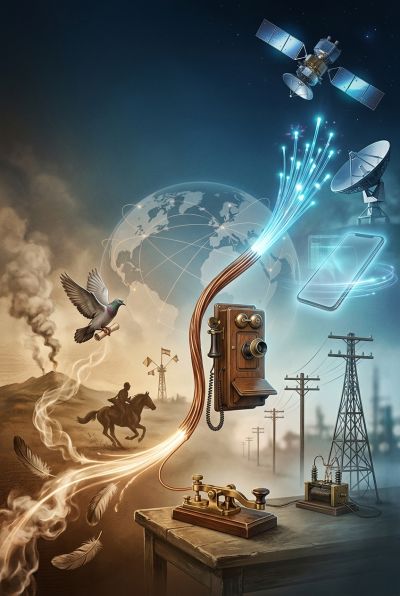
The story of communication is, at its core, the story of humanity's refusal to accept the limits of geography. Robert Montfort's A History of Communications and Telecommunications follows that refusal from the first smoke signals rising above the Great Wall to the quantum satellites now beaming entangled photons across continents. The result is a sprawling, clear-eyed chronicle that treats each breakthrough not as an isolated invention but as a link in a continuous chain of human ingenuity.
What the Book Is About
The book moves chronologically through 25 chapters, beginning with pre-literate signaling systems — smoke, drums, whistled languages — and ending with speculative frontiers like neutrino communication and brain-computer interfaces. Montfort organizes the narrative around pivotal technologies: the Persian Angarium and Roman cursus publicus, the optical telegraph, the electrical telegraph and transatlantic cable, the telephone, radio, television, satellites, the transistor, ARPANET, the World Wide Web, mobile phones, social media, cloud computing, streaming, the Internet of Things, artificial intelligence, and quantum communication. A glossary defines over 100 key terms. The intended reader is anyone who wants to understand how today's hyper-connected world emerged from the "relentless quest to conquer distance" described in the introduction, without assuming prior technical expertise.
The Physical Message Finally Becomes Information
One of the book's strongest through-lines is the gradual separation of the message from its physical carrier. For millennia, "communication was bound by the unforgiving laws of physics" — a clay tablet, a papyrus scroll, a rider on horseback. The optical telegraph of the 1790s, with its giant movable arms atop hilltop towers, was "the first true telecommunications network" because it proved "information could be separated from the physical messenger." Yet it still required clear weather and daylight. The electrical telegraph broke that dependency entirely. When Samuel Morse tapped "What hath God wrought" from Washington to Baltimore in 1844, the book notes, "the electrical revolution in communication had officially begun." Montfort shows how each subsequent leap — telephone, radio, television, internet — further detached meaning from matter, culminating in today's invisible data streams.
Networks Create Their Own Geography
Montfort repeatedly demonstrates that communication networks don't just overlay geography; they rewrite it. The Persian Angarium used relay stations every 10–15 miles so a message could cross the empire in "as little as seven to nine days" instead of three months. The Roman cursus publicus built "a nervous system of the Roman Empire" along its roads. The transatlantic cable, after a decade of failures, finally made it possible for "the price of cotton in Liverpool [to] be known in New York in an instant, creating a truly global financial market." Later, ARPANET's packet-switching architecture — conceived by Paul Baran to survive nuclear attack — created a topology with "no single point of failure." The book traces how each network's architecture reflects the political and economic priorities of its builders, from imperial control to Cold War survivability to commercial openness.
The Mobile Phone Makes Communication Personal
The shift from shared infrastructure to personal device gets careful attention. Martin Cooper's 1973 sidewalk call to his rival at Bell Labs — "Joel, this is Marty. I'm calling you from a cell phone, a real handheld, portable cell phone" — marks the moment the telephone became "not just a phone, but a powerful, connected computer in every pocket." Montfort follows the evolution from 1G analog bricks through 2G digital standards (GSM and CDMA), the BlackBerry's push email, and the iPhone's 2007 debut with its "multi-touch interface that was fluid, intuitive, and felt utterly natural." The App Store then "unleashed a torrent of creativity and turned the iPhone from a powerful but fixed-function device into a true general-purpose computer." By 2010, the smartphone had become "a high-resolution window onto the entirety of the world's information."
AI and Quantum Frontiers Redefine What Communication Means
The final chapters move beyond faster pipes to fundamentally new paradigms. On artificial intelligence, Montfort explains how Large Language Models "learn the statistical patterns of language, absorbing not just vocabulary and grammar, but context and meaning," powering everything from real-time translation to recommendation engines that "shape cultural trends and personal tastes on a massive scale." Quantum communication introduces a different logic entirely: Quantum Key Distribution offers security "rooted not in human cleverness, but in the fundamental nature of reality," because "the very act of observing or measuring a quantum system inevitably disturbs it." The Chinese satellite Micius demonstrated intercontinental QKD in 2017. Even more speculative, the book covers molecular communication ("encoding information onto synthetic molecules") and neutrino beams that could "send a message directly through the Earth," ending with brain-computer interfaces that aim to make "thought itself becomes a form of input."
The Global Network's Unresolved Tensions
Montfort doesn't treat the network as a finished triumph. Chapter 25 lays out four structural challenges: the digital divide ("approximately 2.2 billion people entirely offline"), the "splinternet" of state-controlled firewalls and shutdowns, the algorithmic amplification of misinformation ("false stories… can spread faster and more widely than factual news"), and the dual surveillance of "surveillance capitalism" and the "surveillance state." He also notes countervailing opportunities: remote work, open-source collaboration, citizen science, and the creator economy. The closing argument is blunt: "The silent, invisible web we have woven around our planet is a neutral medium; what it ultimately becomes… depends not on the technology itself, but on the human choices we make."
Who Should Read This
Readers who enjoy sweeping histories of technology — think The Victorian Internet or The Information — will appreciate Montfort's breadth and clarity. The book rewards anyone curious about how specific inventions (the coherer, the Nipkow disc, the SIM card, the quantum repeater) fit into a larger pattern. Specialists may find individual chapters familiar, but the synthesis across 5,000 years is the value. Casual readers should note the density: this is a detailed, chronological survey, not a narrative-driven page-turner. If you want to understand why the world feels both smaller and more fragmented than ever, this history provides the essential context.
Read “A History of Communications and Telecommunications” on MixCache.com →
Please log in or create an account to leave a comment.
No comments yet. Be the first to say something.