
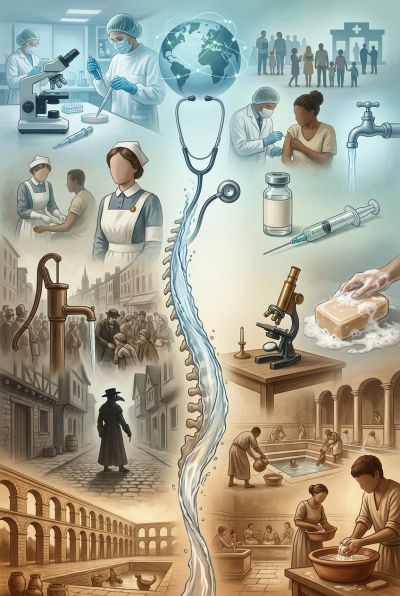
Public health is the rare field whose greatest victories are invisible. When it works, nothing happens—no cholera outbreak, no polio paralysis, no famine. Thomas Laws's Public Health: A History makes that silent shield visible, tracing the ideas, disasters, and hard-won insights that turned collective survival from a matter of luck into a matter of policy.
What the book is about
The book spans twenty-five chapters, moving chronologically from the Indus Valley's covered drains (circa 2600 BCE) to the mRNA platforms that reshaped pandemic response in the 2020s. It is organized as a narrative history rather than a textbook: each chapter anchors a turning point—Roman aqueducts, the Black Death's quarantine innovation, John Snow's Broad Street map, the germ theory revolution, the WHO's founding, smallpox eradication, the tobacco wars, the rise of chronic disease, antimicrobial resistance, and the digital surveillance toolkit—in the people, politics, and accidents that drove change. The intended reader is anyone who wants to understand how the systems protecting daily life came to be, not just what they are. Laws assumes no specialized background but does not oversimplify; he explains concepts like Koch's postulates, the epidemiologic transition, and ring vaccination when they appear.
Engineering health before anyone knew what germs were
The earliest public health measures were feats of civil engineering, not medicine. Chapter 1 details the Indus Valley's grid-planned cities with household latrines connected to covered brick sewers and inspection holes—infrastructure that would not be matched in Europe for millennia. Chapter 2 shows Rome scaling that logic: eleven aqueducts delivering water by gravity across ninety kilometers, the Cloaca Maxima draining the Forum, and public baths serving as hygiene hubs for rich and poor alike. Laws notes the Romans "intuitively grasped the connection between sanitation and survival" despite attributing disease to miasma. Their legal code even forbade burial within city walls, a sanitation measure wrapped in religious taboo. The lesson recurs: effective population-level protection often precedes scientific understanding by centuries.
John Snow and the birth of epidemiology as detective work
Chapter 7 stands as the book's clearest case study in how a single disciplined mind can reframe a crisis. Snow, a Yorkshire physician and Queen Victoria's anesthetist, rejected the miasma orthodoxy because cholera struck the gut, not the lungs, and spared miners breathing different air. His "Grand Experiment" compared death rates between two water companies drawing from different Thames reaches—315 versus 37 deaths per 10,000 households—and his door-to-door mapping of the 1854 Soho outbreak clustered fatalities around the Broad Street pump. When the parish board removed the pump handle on September 8, 1854, the epidemic was already waning, but the act became "a clear, decisive intervention based not on a vague theory about bad smells, but on a specific, evidence-based hypothesis." Snow never saw Vibrio cholerae; he deduced its transmission route through logic, shoe leather, and a map.
Germ theory turns a phantom enemy into a target
Chapters 8 and 9 show how Pasteur, Koch, and Lister transformed public health from environmental cleanup to microbial warfare. Pasteur's swan-neck flasks disproved spontaneous generation; Koch's pure-culture techniques and postulates gave science a standard of proof; Lister's carbolic spray cut surgical mortality from nearly 50 percent to 15 percent. The shift was practical: "The fight was no longer against a mysterious miasma but against a tangible microbe." That tangibility enabled vaccines, antitoxins, and the first public health laboratories—like Hermann Biggs's in New York, which produced diphtheria antitoxin for the poor and cultured cholera from ship passengers. The laboratory became "the nerve center for a host of new public health activities," turning surveillance from guesswork into bacteriological confirmation.
Eradication as a deliberate global project
Chapters 14 and 15 contrast two eradication campaigns. Smallpox succeeded through "surveillance and containment"—ring vaccination around each case—powered by a heat-stable freeze-dried vaccine and the bifurcated needle, which "used only one-quarter of the vaccine required by older methods, effectively quadrupling the world's limited vaccine supply overnight." The last natural case, Ali Maow Maalin in Somalia (1977), was chased down by a 50,000-person vaccination ring. Polio proved harder: the oral vaccine's live virus can revert to virulence in under-immunized populations, creating circulating vaccine-derived poliovirus (cVDPV). The endgame now requires a synchronized switch from oral to injected vaccine. Both campaigns reveal that eradication is not just biology but logistics, trust, and geopolitics—northern Nigeria's 2003 boycott reseeded virus across a dozen countries.
Modern threats: chronic disease, resistance, and the infodemic
The book's final chapters argue that public health's success created its next crisis. By conquering infectious killers, societies lived long enough to face heart disease, cancer, and diabetes—the "epidemiologic transition" documented by the Framingham Heart Study, which coined the term "risk factor" and showed cardiovascular disease was "a preventable condition, intimately linked to the way people lived their lives." Chapter 21 frames obesity as an "obesogenic environment" shaped by agricultural policy (Earl Butz's "fencerow to fencerow" corn surplus), portion distortion, and engineered "bliss point" foods. Chapter 24 warns that antimicrobial resistance is "a slow-motion pandemic" eroding the foundations of modern medicine: without effective antibiotics, "routine surgeries like hip replacements, organ transplants, cancer chemotherapy, the care of premature infants—would become impossibly dangerous." Chapter 23 adds a new vector: the "infodemic," where social media algorithms amplify vaccine misinformation faster than health agencies can correct it, turning communication into a battlefield.
Who should read this
Readers who want a single narrative that connects Roman sewers to mRNA platforms will find this book indispensable. It rewards anyone interested in how science, policy, and infrastructure interact over the long term—students, clinicians, policy analysts, or curious generalists. Those looking for a quick primer or a narrowly focused argument (e.g., only on vaccines or only on equity) may find the chronological sweep too broad. But for understanding why the water from your tap is safe, why your child's vaccines exist, and what the next pandemic response will depend on, Laws has written the definitive one-volume history.
Read “Public Health” on MixCache.com →
Please log in or create an account to leave a comment.
No comments yet. Be the first to say something.