
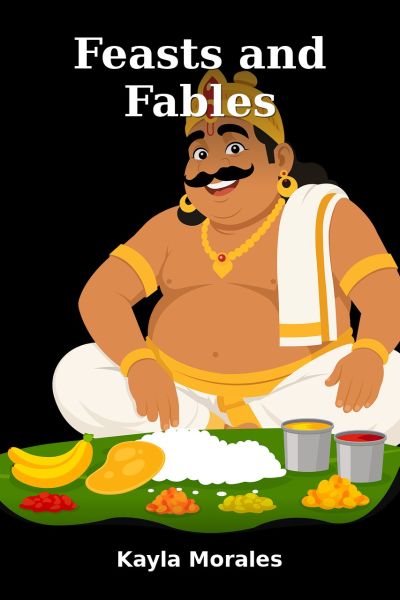
Food has always been more than fuel. Across millennia, the act of gathering around a table has sealed treaties, honored gods, reinforced hierarchies, and sparked revolutions. In Feasts and Fables, Kayla Morales serves up a sweeping, deeply researched narrative that treats every banquet — whether a pharaoh's funerary feast or a Victorian twenty-course spectacle — as a window into the society that produced it. The result is a history book that reads like a travelogue, inviting readers to taste the smoke of a Roman convivium, smell the spices of a Silk Road caravan, and hear the clatter of a microwave in a 21st-century kitchen.
What the Book Is About
Feasts and Fables spans 25 chapters, moving chronologically from the communal fires of prehistory to the algorithm-driven smart kitchens of today. Morales structures the journey around pivotal tables: ancient Egypt's sacred offerings (Chapter 2), Greek symposia where philosophy flowed with diluted wine (Chapter 3), Roman convivia designed as political theater (Chapter 4), the Islamic Golden Age's agricultural and culinary innovations (Chapter 7), Renaissance Italy's codification of manners and the fork (Chapter 11), the Columbian Exchange's radical reshaping of global palates (Chapter 12), French court cuisine's rise to global dominance (Chapter 13), and the industrial, wartime, and postwar transformations that birthed modern convenience food (Chapters 18–20). Later chapters examine migration-driven fusion (Chapter 21), the celebrity-chef phenomenon (Chapter 22), kitchen technology (Chapter 23), sustainability movements (Chapter 24), and food's role in storytelling from myth to Netflix (Chapter 25). The book assumes no specialized knowledge — just curiosity about why we eat what we eat, and what it says about who we are.
The Table as Political Stage
One of the book's strongest through-lines is the way feasts perform power. In ancient Egypt, the pharaoh's banquet "projected power, demonstrating prosperity, and reinforcing the immutable order of the cosmos, with the pharaoh at its center" (Chapter 2). Roman convivia turned seating charts into status maps: "The most important guests placed in positions of honor closest to the host" signaled influence in real time (Chapter 4). Versailles took this further — Louis XIV's public Grand Couvert made dining a daily loyalty ritual. Even the French Revolution's "bread of equality," a coarse loaf mandated to replace aristocratic white bread, was political theater baked into daily sustenance (Chapter 16). Morales shows that whether the host is a god-king or a revolutionary committee, the menu is never neutral.
Religion as Menu Planner
Faith doesn't just bless the meal; it writes the grocery list. The Catholic calendar "could collectively amount to more than 150 days a year" of fasting, during which "meat from warm-blooded animals was forbidden" but fish, almond milk, and nut oils were permitted (Chapter 14). This forced creativity: medieval cooks developed "a rich and diverse pescatarian and vegetarian cuisine" that shaped regional foodways long after fast days faded. In the Holy Land, Jewish kosher laws and Christian fast cycles created parallel culinary economies in the same markets (Chapter 8). The Islamic Golden Age's prohibition on alcohol redirected innovation toward sherbet, coffee, and intricate sugar work (Chapter 7). Morales treats dietary law not as restriction but as a generative constraint that produced enduring dishes — from pretzels (shaped like praying arms) to hot cross buns — and entire preservation industries built around Lenten fish demand.
Trade Routes as Flavor Highways
The book makes a compelling case that globalization began at the spice stall. Chapter 5 traces how black pepper from India's Malabar Coast, cinnamon from Sri Lanka, and nutmeg from the Banda Islands moved along the Silk Road and maritime Spice Routes, each handoff adding cost and mystique. The Columbian Exchange (Chapter 12) accelerated this violently: potatoes, tomatoes, chilies, corn, cocoa, and vanilla crossed the Atlantic, while wheat, cattle, and sugarcane went west. Morales notes the bitter underside — sugar's rise "became inextricably linked to the transatlantic slave trade" — but also the creative fusions that emerged: chili peppers rewiring Southeast Asian curries, tomatoes redefining Italian sauces, corn becoming Africa's staple. The chapter on migration and fusion (Chapter 21) brings this into the present, showing how "the children and grandchildren of immigrants, who grew up straddling two cultures" turned adaptation into innovation: Korean tacos, sushi burritos, curried pasta. The modern food truck is just the latest caravan on a very old road.
Technology Rewrites the Kitchen — And the Cook
From the cast-iron range to the immersion circulator, each wave of kitchen tech promises liberation and delivers transformation. Chapter 18 details how canning (perfected for Napoleon's armies) and railroads created national food brands and the first supermarkets. Chapter 23 tracks the microwave's journey from radar byproduct to countertop essential, noting it "fundamentally altering the daily rhythm of meal preparation for millions." The current frontier — smart ovens that preheat via phone, refrigerators that inventory themselves — raises new questions. Morales observes that "reliance on gadgets could diminish the art and intuition of cooking" while also democratizing techniques like sous vide once reserved for three-star restaurants. The tension echoes Mrs. Beeton's 1861 anxiety about "the angel in the house" mastering new appliances: every labor-saving device redefines what "cooking from scratch" means.
Stories We Eat By
The final chapter argues that food's deepest power is narrative. From the "golden apples of the Hesperides" to Oliver Twist's "more gruel," from Tita's emotion-infused quail in Like Water for Chocolate to the ratatouille that unlocks a critic's childhood in Pixar's film, meals in fiction "transcend their role as mere sustenance" to become "a symbol, a catalyst, a character in its own right" (Chapter 25). Morales extends this to Instagram reels and TikTok recipes — today's digital hearth where "food porn" and viral hacks replace oral epic. The insight reframes the whole book: every historical feast described in earlier chapters was also a story its participants told themselves about who they were. The banquet is the original shared universe.
Who Should Read This
Readers who enjoy big-picture histories like Salt or Guns, Germs, and Steel but want the subject served through the lens of the table will find Feasts and Fables satisfying. It rewards the home cook curious about why their pantry holds cumin and chili flakes, the history buff who wants social context alongside dates and battles, and the fiction lover who appreciates how a meal can carry a scene. Pure foodies seeking recipes or restaurant guides should look elsewhere — this is cultural history, not a cookbook. Academics may wish for tighter citations, but the narrative drive and sheer scope make it an engaging gateway. If you've ever wondered why we toast, why dessert comes last, or why your grandmother's holiday table looks the way it does, pull up a chair.
Read “Feasts and Fables” on MixCache.com →
Please log in or create an account to leave a comment.
No comments yet. Be the first to say something.