
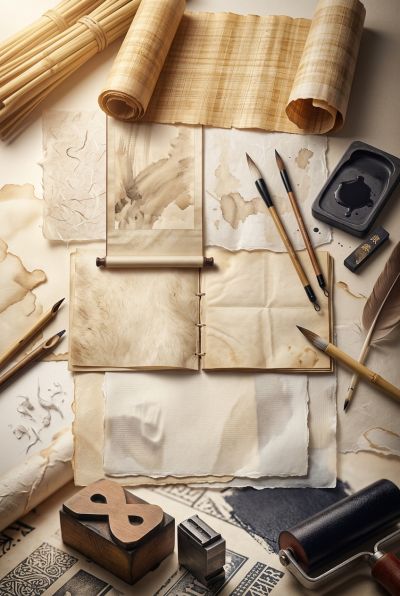
We rarely pause to consider the sheet beneath our pens, the box on our doorstep, or the receipt in our pocket. Yet each represents a link in a chain stretching back to the Nile marshes and forward to conductive inks and biodegradable sensors. David Schmidt's A History of Paper follows that chain across 25 chapters, showing how a material once made from rags and bark became the quiet infrastructure of literacy, commerce, and art — and why it refuses to disappear.
What the Book Is About
The book moves chronologically from pre-paper writing surfaces — clay tablets, oracle bones, palm leaves, wax tablets — through the Egyptian mastery of papyrus, the animal-skin dominance of parchment and vellum, and the Chinese invention of true paper under Cai Lun in 105 AD. It tracks the craft's westward migration along the Silk Road to the Islamic world (Chapter 7), its foothold in Spain and Italy (Chapter 8), and the European mill innovations — watermarks, gelatin sizing, the Hollander beater — that preceded Gutenberg's press (Chapters 9–11). Later chapters cover the rag famine that drove 18th-century fiber experiments (Chapter 13), the Fourdrinier machine and wood-pulp revolution (Chapters 15–16), the explosion of newspapers and packaging (Chapters 17–18), paper's artistic life from origami to watercolor (Chapter 19), its 20th-century ubiquity (Chapter 20), the environmental reckoning (Chapter 21), recycling and sustainable forestry (Chapter 22), the digital-age "paper paradox" (Chapter 23), the cognitive and sensory case for paper's persistence (Chapter 24), and emerging frontiers like printed electronics and lab-on-paper diagnostics (Chapter 25). The tone is scholarly but accessible, aimed at readers who want a single, thorough narrative rather than a specialized monograph.
The Global Relay of Invention
Schmidt resists the lone-genius myth. Paper's spread was a centuries-long relay: Chinese artisans refined mulberry bark and rags into a "felted sheet made from macerated plant fibers" (Chapter 4); Korean and Japanese makers developed hanji and washi using local fibers and formation aids like hibiscus root mucilage (Chapter 5); Sogdian merchants carried both paper and know-how along the Silk Road, leaving traces in the Dunhuang library cave (Chapter 6); and Abbasid officials established mills in Baghdad, Damascus, and Cairo, switching to linen rags and water-powered trip-hammers (Chapter 7). Each culture adapted the process to its own materials and needs. The book makes clear that "the westward spread of papermaking was a more gradual process, facilitated by the extensive commercial and cultural interactions along the Silk Road" (Chapter 6), not a single battle-day transfer.
The Rag Famine and the Machine That Changed Everything
By the 17th century Europe's mills were starving for linen rags. Governments banned exports; ragpickers became essential urban figures. The breakthrough came from the Netherlands: the Hollander beater, whose rotating metal-barred roll "could reportedly prepare as much pulp in a few hours as a battery of stampers could in a day or more" (Chapter 13). It cut fibers shorter than stampers did, sparking quality debates, but its speed was undeniable. Still, rags remained the bottleneck until Nicholas-Louis Robert's 1798 concept for a continuous web on a moving wire belt — refined by Bryan Donkin and financed by the Fourdrinier brothers — produced the first Fourdrinier machine. "A single machine could produce a continuous web of paper, hundreds or even thousands of feet long, at a speed and volume that dwarfed the output of even the largest hand-mould operation" (Chapter 15). John Dickinson's rival cylinder mould soon followed. Mechanization had arrived, but the fiber crisis only deepened.
Wood Pulp and the Birth of Mass Media
The 1840s brought Friedrich Gottlob Keller's wood-grinding machine, yielding cheap groundwood pulp for newspapers. Chemical processes — soda, sulphite, and finally Carl Dahl's kraft (sulphate) method — delivered stronger, whiter fibers. "Wood was vastly more abundant and cheaper than rags, freeing the paper industry from its centuries-old constraint" (Chapter 16). The price collapse enabled the penny press: Benjamin Day's New York Sun at one cent, the Daily Telegraph at a penny after Britain repealed stamp duties. Rotary presses and Linotype machines fed on wide rolls of newsprint. "The sheer volume of paper consumed by this daily habit was staggering" (Chapter 17). Meanwhile, packaging exploded — flat-bottomed bags, corrugated boxes, branded cartons — and currency paper gained watermarks, silk threads, and guilloché patterns to foil counterfeiters (Chapter 18). Paper became infrastructure, not just a surface.
The Digital Paradox and Paper's Quiet Persistence
The "paperless office" forecast of the 1970s backfired initially. "In a rather ironic twist, the initial decades of the computer revolution often led not to a decrease, but to a paradoxical *increase* in paper consumption in many offices" (Chapter 23). Email and word processors generated drafts people still wanted to hold. Yet specific categories — memos, manuals, checks, encyclopedias, phone directories, maps — did migrate online. Newspaper print circulation plunged; e-books surged then plateaued. Schmidt notes the "hybrid workflows" where documents are drafted digitally, printed for annotation, then scanned back. Chapter 24 catalogs paper's enduring qualities: tactile engagement that "can aid comprehension and memory," zero-power readability, archival stability (acid-free sheets last centuries), and the emotional weight of letters, drawings, and diaries. These aren't nostalgia; they're functional advantages digital media hasn't fully replicated.
Future-Proofing an Ancient Material
The final chapter reads like a research briefing. Conductive inks — silver nanoparticles, graphene, conductive polymers — turn paper into circuits, antennas, and displays. "Researchers are exploring ways to seamlessly integrate electronics directly onto or into paper substrates" (Chapter 25). Capillary action makes paper ideal for "lab-on-paper" diagnostic strips that detect pathogens or pollutants at pennies per test. Alternative fibers — agricultural residues (wheat straw, bagasse), algae, bacterial cellulose — could ease forest pressure. Mills chase closed-loop water systems, TCF bleaching, and energy self-sufficiency via black-liquor recovery. Super-hydrophobic coatings, flame retardants without halogens, and nanofiber reinforcement expand packaging and construction uses. Paper batteries and catalytic paper hint at energy and environmental roles. The book closes with a circular-economy vision: paper replacing single-use plastics, certified forests sequestering carbon, and the material serving as a "slow tech" counterpoint to screen fatigue.
Who Should Read This
Readers who enjoy big-picture histories of technology — think The Information or The Box — will appreciate the scope and the way Schmidt connects material constraints to cultural shifts. Historians of science, book arts enthusiasts, packaging designers, and sustainability professionals will find relevant detail in specific chapters. The book is less suited for someone wanting a quick overview; its 25-chapter depth demands patience. But for anyone curious about how a sheet of fibers became civilization's "most essential medium" and where it might go next, this is the comprehensive, clear-eyed guide.
Read “A History of Paper” on MixCache.com →
Please log in or create an account to leave a comment.
No comments yet. Be the first to say something.