
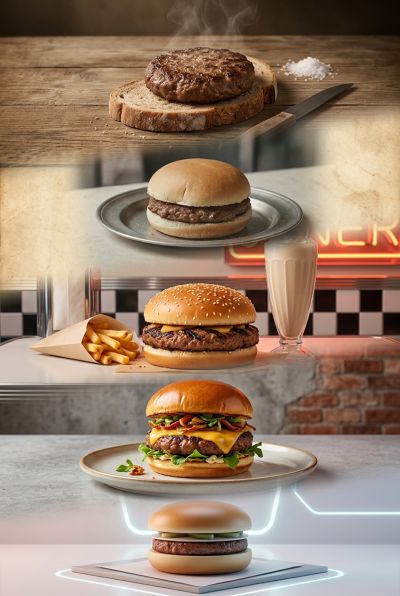
The hamburger is so ubiquitous it's easy to forget it has a history at all — much less one that spans Roman cookbooks, Mongol conquests, and Silicon Valley bioreactors. Alex Bugeja's The History of Hamburgers unpacks that sprawling story with the rigor of a food historian and the narrative drive of a journalist who knows a good yarn when he sees one. The result is a book that treats its subject not as a punchline but as a lens on migration, industrialization, and the messy business of feeding a hungry world.
What the book is about
Organized chronologically across 25 chapters, the book moves from the Isicia Omentata of ancient Rome through the Hamburg steak's migration to America, the fairground birth of the sandwich, the rise of White Castle and the fast-food giants, regional variations, cultural touchstones, and the current frontiers of plant-based and cultivated meat. Bugeja writes for a general audience — no specialized knowledge required — but he doesn't dumb down the science, economics, or cultural analysis. Each chapter functions as a self-contained essay while building toward a broader argument: the hamburger's endurance comes from its infinite adaptability, a "universal culinary grammar that could be spoken in any number of local dialects."
Ancient roots and the long road to Hamburg
Bugeja refuses to start the story in 19th-century Germany. Chapter 1 opens with the Roman Apicius cookbook's Isicia Omentata — minced meat mixed with pine nuts, pepper, wine, and garum, wrapped in caul fat and grilled — and the Mongol horsemen who allegedly tenderized raw mutton under their saddles (a legend Bugeja carefully debunks: "the meat — impregnated with horse sweat and dirt — would have been largely inedible"). The more plausible lineage runs through Russian steak tartare to the port city of Hamburg, where German cooks applied heat to the raw preparation, creating a cooked patty served with gravy and potatoes — eaten with knife and fork, not hands. Chapter 2 details how the Hamburg-America Line likely served this dish to millions of emigrants, turning a regional specialty into transatlantic cargo.
The fairground invention myths: everyone claims the first bun
Chapters 4 and 5 form the book's most entertaining section, laying out the competing origin stories for the hamburger sandwich — all set at county fairs. There's 15-year-old Charlie Nagreen in Seymour, Wisconsin (1885), flattening meatballs between bread so fairgoers could walk and eat; the Menches brothers in Hamburg, New York (also 1885), substituting beef for pork and seasoning with coffee and brown sugar; Fletcher Davis of Athens, Texas, debuting his mustard-and-Bermuda-onion version at the 1904 St. Louis World's Fair; Louis Lassen in New Haven (1900), serving ground steak trimmings on toast to a hurried customer; and Oscar Weber Bilby in Oklahoma (1891), whose wife baked the first purpose-made yeast bun. Bugeja doesn't crown a winner. Instead he argues the hamburger was "less a single 'eureka' moment and more a process of gradual refinement and independent discovery" — convergent evolution driven by the fairground's demand for portability.
White Castle, the Speedee System, and the architecture of trust
Chapter 6 gives White Castle its due as the company that "performed a culinary rescue mission." In the wake of Upton Sinclair's The Jungle, ground beef was widely distrusted; White Castle countered with radical transparency — spotless white porcelain exteriors, stainless steel interiors, open kitchens, uniformed employees, and a 1930s feeding study where a medical student ate nothing but sliders for 13 weeks. Chapter 9 then details how the McDonald brothers, frustrated by their own successful drive-in's inefficiency, chalked a tennis-court blueprint of a new kitchen and invented the "Speedee Service System" — hyper-specialized labor, 30-second service, a nine-item menu. Ray Kroc saw the scalable machine behind the method, bought the brothers out, and built an empire on "Quality, Service, Cleanliness, and Value." Chapter 10 contrasts Burger King's flank attack: the flame-broiler (born when the Insta-Broiler kept breaking), the Whopper's size, and the "Have It Your Way" customization pledge that positioned Burger King as the anti-assembly-line alternative.
Glocalization: how the burger learned to speak local languages
Chapter 11 is a masterclass in adaptation. McDonald's didn't just export the American menu; it negotiated with local tastes. In the Netherlands, the McKroket (a ragout-filled croquette burger). In India, no beef or pork — the Maharaja Mac uses chicken, the McAloo Tikki a spiced potato-pea patty. In Japan, Den Fujita placed the first outlet in Tokyo's upscale Ginza department store, marketing the burger as aspirational modernity: "If we eat hamburgers and potatoes for a thousand years, we will become taller, our skin will become white, and our hair will be blonde." The 1990 Moscow opening becomes a Cold War set piece — 38,000 people queuing in subzero temperatures for a Big Mac, a "tangible sign of the Cold War's thaw." Bugeja also notes the backlash: José Bové dismantling a Millau McDonald's with tractors in 1999, the burger as "la malbouffe" and symbol of corporate imperialism.
The science of the patty and the lab-grown future
Chapter 17 reads like a culinary physics textbook made readable. Bugeja breaks down the 80/20 lean-to-fat ratio ("the golden ratio"), the necessity of keeping meat and grinder near-frozen to prevent fat smearing, the thumb-dimple trick to counter the "burger bulge," the Maillard reaction's flavor alchemy above 300°F, and the critical rest period that lets muscle fibers reabsorb juices. Chapter 24 then pivots to the frontier: Mark Post's €330,000 cultured burger in 2013 ("intense... close to meat, but not as juicy"), the race to replace fetal bovine serum with plant-based growth media, 3D-printing muscle and fat layers via "edible ink," and Air Protein's NASA-inspired microbes that turn CO₂, nitrogen, and water into protein flour. The takeaway: "No matter how sustainable, ethical, or technologically marvelous a burger may be, it will ultimately fail if it cannot satisfy the simple, primal craving for a hot, juicy, and flavorful hamburger."
Who should read this
This book rewards readers who like their food history with context — people who want to know not just who put the first patty on a bun, but why the bun mattered, how the grill changed the suburb, and what the burger's next century might look like. It's less suited for anyone seeking a recipe collection or a narrow academic treatise; Bugeja's strength is synthesis across disciplines. If you've ever wondered why a White Castle slider tastes different from a diner smash burger, or how a sandwich became a geopolitical symbol, this is the single volume that connects those dots without ever losing the flavor.
Read “The History of Hamburgers” on MixCache.com →
Please log in or create an account to leave a comment.
No comments yet. Be the first to say something.