
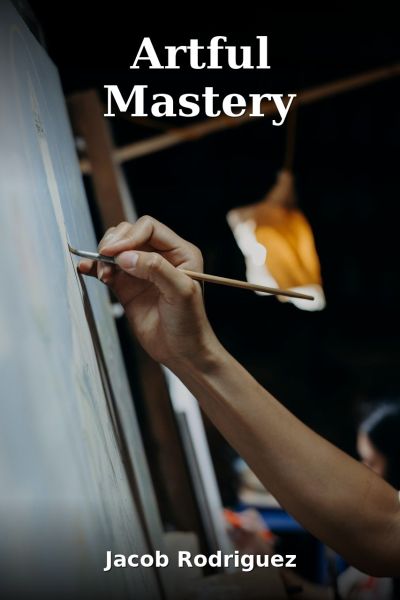
Most painting books choose a lane: they're either technical manuals, historical surveys, or motivational guides. Jacob Rodriguez's Artful Mastery refuses to pick just one. Across 25 chapters, it moves from the inner game of curiosity and perseverance through the granular mechanics of pigment bias and glazing mediums, then out again into interviews with working artists and a closing argument for artistic legacy. The result is a reference that feels less like a course and more like a studio companion you'd keep within arm's reach for years.
What the book is about
Artful Mastery is structured as a progressive journey for both aspiring and experienced painters. The first five chapters lay groundwork: mindset (Chapter 1), tools and surfaces (Chapter 2), the visual grammar of line, shape, and value (Chapter 3), color theory and harmony (Chapter 4), and compositional principles like the Rule of Thirds and Golden Ratio (Chapter 5). Chapters 6 through 9 survey major stylistic territories—realism, Impressionism, abstraction, and mixed media—while Chapter 10 devotes 30-plus pages to the distinct personalities of watercolor, acrylic, and oil. The middle section (Chapters 11–20) tackles the creative pipeline: ideation, sketching, the stages of a painting, complex narrative composition, advanced color mixing, texture techniques (impasto, glazing, sgraffito), light and shadow, perspective, experimental methods, and digital integration. The final five chapters shift to synthesis: historical masterwork analysis (Chapter 21), conversations with three contemporary painters (Chapter 22), overcoming blocks (Chapter 23), psychology and flow (Chapter 24), and sustaining a lifelong practice (Chapter 25). The intended reader is someone who wants both a systematic skill-build and a philosophical framework—someone willing to do the exercises but also think about why they paint.
The mindset-technique feedback loop
Rodriguez argues that technical proficiency and psychological orientation are inseparable. Chapter 1 opens with Leonardo dissecting cadavers and Michelangelo battling marble to illustrate that "true artistry is born from a deep, often obsessive, inquiry into the world around them and an iron will to bring their unique observations to life." This isn't decorative; the book returns to the idea in Chapter 23, where perfectionism is identified as a primary cause of creative block, and again in Chapter 24, where flow state is framed as something you cultivate through "minimizing distractions and setting aside dedicated, uninterrupted studio time." The practical payoff appears in exercises like blind contour drawing (Chapter 3) and timed sketching (Chapter 6), which are explicitly designed to quiet the internal critic. By the time you reach Chapter 24's "stream of consciousness painting exercise," the through-line is clear: the book treats mindset not as a preamble but as a skill you practice alongside color mixing.
A medium-agnostic color education
Chapter 10, "Decoding Watercolor, Acrylic, and Oil Painting Techniques," stands out for refusing to favor one medium. Instead, it compares them on the same axes: transparency vs. opacity, drying time, layering logic, and the role of mediums. The section on watercolor explains why "areas of pure white in a watercolor painting are often achieved by simply leaving the paper unpainted, a technique known as 'preserving the whites,'" while the oil section details the "fat over lean" principle to prevent cracking. Acrylic gets equal weight for its chameleon range—"thinned with water or a flow improver, they can create luminous, transparent washes akin to watercolors" or "achieve the rich impasto and textured brushstrokes typically associated with oil paints." Later, Chapter 15 builds on this with a color-bias chart exercise using warm and cool versions of each primary, and Chapter 16 shows how impasto and glazing behave differently across mediums. A reader who works in only one medium still gains a comparative vocabulary; a mixed-media painter gets a cheat sheet for material compatibility.
Historical analysis as reverse engineering
Chapter 21 doesn't just name-drop masters; it dissects specific paintings to extract reusable strategies. The analysis of Leonardo's Mona Lisa isolates sfumato as "extremely fine, gradual transitions between light and shadow" built through "meticulous layering of incredibly thin, almost transparent glazes." Caravaggio's The Calling of Saint Matthew becomes a case study in using "a single, raking beam of light" as a narrative device. Vermeer's pearl demonstrates "subtle reflections and refractions of light within the pearl, creating tiny, distinct highlights and shadow areas that give it a palpable three-dimensionality." Each deconstruction ends with a direct takeaway: "For your own practice, this demonstrates the immense power of patience and delicate layering" or "This analysis underscores the power of keen observation and the meticulous rendering of subtle light effects." The chapter closes with five concrete exercises—value studies from masterworks, palette deconstruction, compositional diagramming, technique emulation, and emotional response analysis—turning art history into a laboratory.
Contemporary voices that contradict each other productively
Chapter 22 interviews three painters whose processes barely overlap, and the book is better for it. Eleanor Vance works on ten-foot canvases with "up to twenty or thirty layers" of acrylic glaze, embracing "happy accidents" and starting from "a feeling, a memory of light." Marcus Thorne spends days on charcoal drawings and uses a gridding method to transfer "a solid blueprint before I even think about color," then exploits oil's slow drying for "incredibly subtle transitions." Sofia Rodriguez begins with "a loose abstract underpainting, almost like a chaotic background," then layers collage, modeling paste, and deliberately clashing colors—"sometimes that tension is exactly what the piece needs." All three use digital tools differently: Vance not at all, Thorne for reference management, Rodriguez for compositional planning and AI-generated background ideas. The chapter doesn't harmonize them; it lets the friction show that there is no single "right" workflow, only the one that serves your voice.
Digital integration without replacement anxiety
Chapter 20 frames digital tools as "augment[ing], rather than replace[ing], traditional methods." The most practical sections cover digital underpainting—"create a detailed digital rendering... print onto canvas... then proceed to paint over this digital base with traditional oil, acrylic, or watercolor"—and projection mapping for large-scale work. The AI discussion is notably grounded: "An AI might generate a hundred variations of a concept in minutes, providing endless inspiration for compositions, color palettes, or thematic elements that an artist can then develop further with traditional painting techniques." Rodriguez suggests using text-to-image generators as "a collaborative brainstorming tool," not a shortcut. The exercises—digital sketching on a tablet, photo editing for compositional studies, building a digital palette to guide physical mixing, and prompting AI for inspiration—are all optional entry points. The tone is calm: "They enhance and extend the artist's capabilities but do not replace the fundamental skills of observation, drawing, color theory, and composition."
Who should read this
Painters who want a single volume that respects both the craft and the interior life of making will get the most from Artful Mastery. It suits the self-directed learner who appreciates historical context, enjoys structured exercises, and doesn't mind a book that asks them to switch between a value study of a Caravaggio and a mindfulness breathing exercise before the next canvas. Readers looking for a narrowly focused atelier manual, a pure technique encyclopedia, or a step-by-step project book may find the scope diluted. But for the artist building a practice they intend to sustain for decades, the breadth is the point.
Read “Artful Mastery” on MixCache.com →
Please log in or create an account to leave a comment.
No comments yet. Be the first to say something.