
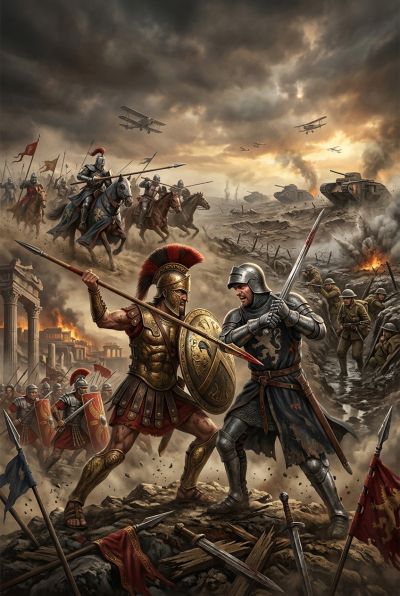
Two and a half millennia separate the hoplites who charged across the plain of Marathon from the dive-bomber pilots who turned the tide at Midway, yet the thread connecting them is unmistakable. Clash of Titans traces that thread through twenty-five engagements, arguing that battles are not mere footnotes to diplomacy but the violent hinges on which civilizations turn. The result is a panoramic survey that respects both the commander's map and the soldier's trench.
What the book is about
The volume moves chronologically from 490 BC to 1968, devoting one chapter to each battle. The selection spans continents and eras: Greek phalanxes, Roman legions, Mongol-style cavalry (at Poltava the Swedes face Russian regulars), Napoleonic corps, industrialized trench lines, carrier task forces, and the jungle ambushes of Vietnam. Each chapter follows a consistent architecture — strategic context, opposing forces and commanders, a blow-by-blow narrative, and an assessment of consequences that reach far beyond the battlefield. The prose is accessible but grounded in primary sources; Herodotus, Livy, Caesar, and modern official histories are woven into the narrative without academic jargon. The intended reader is the curious generalist who wants a single-volume overview, though military-history enthusiasts will appreciate the tactical detail and the glossary of terms like tercio, caracole, and kessel.
The evolution of combat: from phalanxes to panzer divisions
One of the book's clearest through-lines is the technological arms race and the doctrinal adaptations it forces. The introduction frames it as a "deadly dance between innovation and adaptation," and the chapters bear that out. At Marathon the Persian cavalry vanishes and Miltiades thins his center to strengthen his wings — a tactical response to terrain and enemy composition. Two millennia later at Kursk, the Soviets build eight defensive belts, lay nearly a million mines, and concentrate over six thousand anti-tank guns to absorb the German Panther and Tiger tanks. The text notes that "the entire salient was a layered trap, a gigantic sponge designed to soak up the kinetic energy of the German Blitzkrieg and grind it to a halt." Between those endpoints we see the longbow at Agincourt, the trace italienne at Vienna, the creeping barrage at Verdun, and the carrier air group at Midway. Bugeja consistently shows that a weapon alone decides nothing; it is the integration of weapon, formation, and logistics that shifts the balance.
Commanders and the weight of decision
Great captains appear throughout, but the book avoids hero-worship by placing their choices in the fog of war. At Gaugamela, Alexander refuses a night attack — "I will not steal my victory" — then pivots his Companion Cavalry into the gap his own oblique advance created. At Cannae, Hannibal's convex center becomes a concave trap only because his Libyan veterans wheel inward on command. At Waterloo, Ney launches unsupported cavalry charges against squares because he misreads a tactical withdrawal as rout. The Stalingrad chapter contrasts Paulus's obedience to Hitler's stand-fast order with Chuikov's "hug the enemy" doctrine that neutralized German air superiority. Even in the Tet Offensive, Le Duan's gamble on a "General Uprising" fails militarily but succeeds psychologically because Westmoreland and Johnson had staked their credibility on "light at the end of the tunnel." These portraits illustrate the book's argument that leadership is "a unique combination of intellect, intuition, charisma, and ruthlessness" exercised with incomplete information.
The soldier's view: courage in the killing ground
For every named general there are thousands of unnamed men, and Bugeja returns repeatedly to their experience. The Thermopylae chapter describes the final stand on Kolonos hill where Spartans and Thespians "fought with their bare hands and teeth, a final, primal act of defiance." At Agincourt, English archers abandon bows for mallets and daggers, "swarming around the floundering French nobles" trapped in mud. The Verdun chapter quotes Pétain's order — "Courage... On les aura!" — and then details the noria rotation that cycled divisions through "the hell of the front lines" for a few weeks at a time. In the Stalingrad chapter, life expectancy for a reinforcement is "often measured in hours," and the Rattenkrieg reduces combat to "sharpened spades, knives, and bare hands in the dark, choking dust." These passages ground the strategic analysis in visceral reality, reminding the reader that every maneuver on a map represents exhaustion, fear, and mutilation.
Battles as political earthquakes
The subtitle promises conflicts that "Shaped Nations, Defined Empires, and Changed the Course of Civilization," and the aftermath sections deliver. Salamis preserves "the nascent concepts of democracy and individual freedom that would become foundational to Western civilization." Alesia ends organized Gallic resistance and positions Caesar to cross the Rubicon. Yorktown breaks British political will; Lord North reportedly cries, "Oh God! It is all over!" The Tet Offensive, though a tactical disaster for Hanoi, shatters American public opinion: Cronkite's editorial prompts Johnson's withdrawal announcement. Bugeja argues that "a battle's true importance lies in its consequences, in the profound and lasting impact it has on the societies that wage it and on the world at large," and the case studies bear that out — borders, dynasties, and ideologies all shift in the wake of these fights.
When technology meets terrain
A recurring sub-theme is the way ground and weather amplify or negate hardware. The mud at Agincourt turns French plate armor into a liability; the rain at Waterloo delays Napoleon's artillery and bogs down cavalry. At the Teutoburg Forest, Varus's column stretches twenty kilometers through "dark woods, tangled undergrowth, and treacherous bogs," rendering the legion's discipline useless. In the Ardennes-style salient at Kursk, the spring thaw turns the steppe into "a sea of impassable mud," forcing a delay that lets the Soviets dig deeper. At Midway, a lone destroyer's wake — spotted by McClusky at the edge of fuel range — leads the dive bombers to the Japanese carriers. The book treats geography not as backdrop but as an active participant, a constraint that planners ignore at their peril.
Who should read this
Readers who want a single, well-structured narrative that connects Marathon to the Tet Offensive will find the book rewarding. It serves as both a reference — dip into any chapter for a clear, sourced account — and a continuous argument about the interplay of technology, leadership, and human endurance. Those seeking deep historiographical debate or novel archival discoveries should look elsewhere; Bugeja synthesizes established scholarship rather than advancing controversial theses. For the general reader, the student, or the military-history buff who wants a reliable overview with vivid detail and a consistent analytical lens, Clash of Titans is a substantial, worthwhile addition to the shelf.
Read “Clash of Titans: The Greatest Battles in History” on MixCache.com →
Please log in or create an account to leave a comment.
No comments yet. Be the first to say something.