
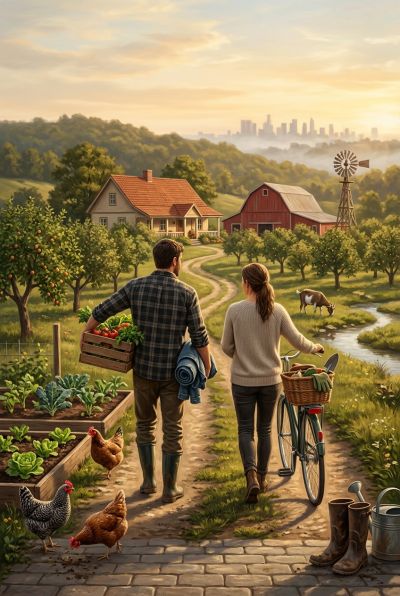
You've seen the fantasy: a wraparound porch, golden-hour light, a basket of perfect heirloom tomatoes, and a life of peaceful self-sufficiency. Alex Bugeja has seen it too—and he's here to tell you that the porch sag means rotted posts, the tomatoes cost thirty-two dollars a pound, and your new boss is a tyrant called the weather. Life On A Farm doesn't try to talk you out of the dream; it vaccinates you against the shock of reality so you can build something sturdier in its place.
What the book is about
Structured as a 25-chapter journey from daydream to first-anniversary survival, the book moves chronologically through the major milestones a city transplant will face. Early chapters tackle motivation and real estate ("The Charming Fixer-Upper: A Polite Term for a Money Pit"), middle sections cover the daily grind of animals, fencing, weather, and DIY repairs, and later chapters address the social fabric, economics, and emotional recalibration of rural life. Bugeja writes for the total novice—someone who thinks a "herd" is what you do with children at a mall—assuming no prior knowledge of livestock, carpentry, or rural etiquette. The tone is deliberately humorous and slightly cynical, but the practical advice is specific: how to read a hay analysis, why chicken wire won't stop a raccoon, what a proper H-brace looks like, and how to calculate whether your "free" eggs actually cost four dollars apiece.
The fantasy gets a forensic autopsy
Bugeja doesn't just poke holes in the pastoral dream; he dissects it with a pathologist's precision. The Introduction contrasts the "soft, pastoral hues" of the daydream—"a charmingly rustic farmhouse, a wraparound porch, and a rocking chair that doesn't squeak unless it's a cinematically appropriate squeak"—with the 4:37 a.m. reality of a guinea fowl shriek, a goat on the car roof, and cows eating the neighbor's petunias. Chapter One forces a "skills audit" that reveals urban competencies ("expertly navigating rush-hour traffic") are useless, while Chapter Three translates real-estate euphemisms: "character" means "decades of neglect," "good bones" means "the timber frame is still standing," and "updated electrical" often means one outlet replaced in 1982. The book insists you confront these gaps before signing a deed, not after.
Animals arrive as a gateway drug, not a hobby
Chapter Five, "Chickens: The Gateway Animal to Full-Blown Farm Madness," captures the slippery slope perfectly. It starts with six chicks from the feed store—"a cardboard box full of six peeping fluffballs"—and introduces "Chicken Math," the irrational logic that turns six hens into twenty because you suddenly need blue eggs, chocolate-brown eggs, and a Silkie that looks like a powder puff. Bugeja details the true cost: a coop that's a "fortress," waterers fouled within minutes, a pecking order that turns integration into diplomacy, and the moment you realize each egg costs nine dollars. The pattern repeats with goats ("escape artists"), sheep ("perpetually worried middle managers"), and pigs ("highly intelligent and remarkably clean when given the chance"), each species bringing its own infrastructure, vet bills, and behavioral quirks.
Rural social life runs on a different protocol
Chapter Six ("The Secret Language of Farmers: Grunts, Nods, and Weather Complaints") and Chapter Twenty-One ("The Farmer's Wave") decode the low-bandwidth, high-stakes communication that governs country relationships. The "One-Finger Lift" off the steering wheel—"a gesture so subtle, so ingrained, that it appears to be an involuntary reflex"—is the baseline acknowledgment; withholding it earns the "Stare-Through," a social excommunication that means the neighbor with the snowplow won't answer your call in January. Weather complaints are not small talk but coded financial reports: "We could sure use a rain" translates to "my corn is stressed, my pond is low, I'm worrying about buying hay." The feed store, post office, and diner function as intelligence hubs where "a casual remark made at the diner at 7 a.m. will have circulated through the entire county by noon." Participation isn't optional; it's the insurance policy.
The economics are brutally honest—and liberating
Chapter Nineteen reframes the hobby farm as an "anti-business" designed to "convert money into manure, with a by-product of personal satisfaction and sore muscles." Bugeja walks through the tractor trap (new vs. forty-year-old diesel rebuild), the feed bill that "makes a mockery of your dream of 'free food,'" and the farmers' market reality: "after subtracting the stall fee and the cost of gas, you have earned a princely wage of three dollars and fifty cents per hour." The tax exemption for agricultural land becomes a bizarre paperwork exercise—"meticulously documenting your seventy-five dollars in farmers' market sales... as a piece of evidence for the tax assessor." The takeaway isn't to quit; it's to fund the life with an off-farm job and redefine profit as "the taste of a tomato still warm from the sun" and "the peace of watching a sunset over a field that you own."
Competence emerges from chaos, not checklists
By Chapter Twenty-Four ("Are We Having Fun Yet? Learning to Embrace the Chaos"), the to-do list has become "a cruel joke" shredded by 9 a.m. emergencies. Bugeja describes the shift from proactive planning to ER-style triage: "The question is no longer, 'What do I want to do today?' It is, 'What will cause the biggest disaster if I don't do it right now?'" The "Holy Trinity of rural engineering"—duct tape, baling twine, and penetrating oil—becomes a legitimate repair philosophy: "A repair is considered a success if the object in question simply resumes its primary function. Aesthetics are irrelevant." Chapter Twenty-Five's diagnostic checklist confirms the transformation: you judge status by fence-post quality, your hands are a "roadmap" of calluses and ingrained dirt, "sleeping in" means 6:30 a.m., and the city now feels like "a foreign country." The payoff isn't perfection; it's the quiet certainty that "you can handle it."
Who should read this
This book is for anyone seriously contemplating a move from city to country who wants the unvarnished truth before they spend a down payment. It's equally valuable for the partner who needs to understand what they're signing up for, and for the armchair dreamer who enjoys vicarious competence porn with a side of dark humor. Readers looking for a romantic escape, a step-by-step construction manual, or a business plan for profitable market gardening will be frustrated—Bugeja explicitly warns against treating the farm as a business. But if you want a field guide that respects your intelligence, makes you laugh at the inevitable disasters, and leaves you feeling that the mud, the money, and the 4 a.m. goat rescue might actually be worth it, this is the one to pack.
Read “Life On A Farm” on MixCache.com →
Please log in or create an account to leave a comment.
No comments yet. Be the first to say something.