
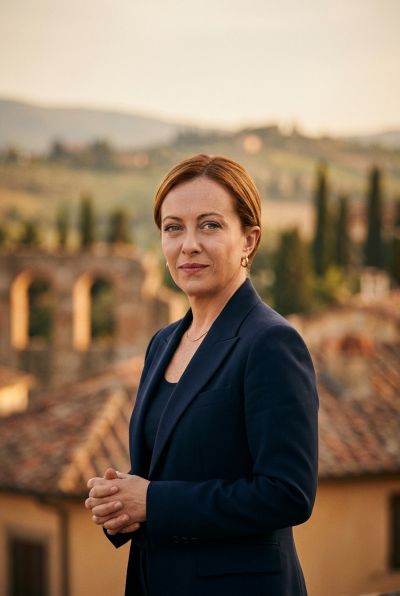
Giorgia Meloni's rise from a teenage activist in Rome's Garbatella district to Italy's first female prime minister is one of contemporary European politics' most striking trajectories. This biography by Alex Bugeja doesn't just recount the climb; it dissects the personal wounds, ideological shifts, and strategic calculations that produced a leader who has reshaped Italy's right and forced Europe to recalibrate. The result is a portrait that refuses both hagiography and condemnation, instead mapping how a politician forged in opposition learned to govern without losing her edge.
What the Book Is About
The book spans twenty-five chapters, moving chronologically from Meloni's childhood in the 1970s through her first year and a half as prime minister. Bugeja structures the narrative around three intertwined arcs: the biographical (family rupture, the absent father, the matriarchal household), the partisan (the MSI-to-National Alliance transition, the split with Berlusconi, the founding of Fratelli d'Italia), and the governmental (coalition management, economic policy, migration, foreign affairs). The prose is journalistic but deeply sourced, drawing on Meloni's autobiography, parliamentary records, and contemporary reportage. It assumes a reader who follows European politics but doesn't require specialized knowledge of Italian party history; key figures and electoral laws are explained as they appear. The tone is analytical rather than polemical, which is notable given how polarizing its subject remains.
The Wound That Became a Weapon
Bugeja returns repeatedly to the formative rupture: Francesco Meloni's abandonment of his wife and two daughters, his later arrest for drug trafficking, and Giorgia's vow at age eleven never to speak to him again. The author argues this isn't mere biographical color but the "foundational myth of her political persona." Chapter One details how the move to Garbatella—a left-wing stronghold—made the young Meloni an outsider in her own neighborhood, while bullying over her weight hardened a resolve she later channeled into politics. The matriarchal household (mother Anna writing romance novels under a pen name, sister Arianna as protector) becomes the template for the "traditional family" she champions politically, even as her own upbringing deviated from it. As Bugeja writes, "Her emphasis on the 'traditional family' can be seen not just as a political position, but as a deeply personal reaction to the instability of her own upbringing—an idealization of what she never had."
From Militancy to Mainstream: The Fiuggi Turn and Beyond
Chapters Two and Three trace Meloni's political education inside the Movimento Sociale Italiano's youth wing, the Fronte della Gioventù. The 1992 mafia murders of judges Falcone and Borsellino catalyzed her entry; the MSI's distance from the Tangentopoli corruption scandals made it a home for anti-establishment anger. The 1995 Fiuggi congress, where Gianfranco Fini dissolved the MSI into Alleanza Nazionale, was Meloni's first lesson in strategic reinvention. She sided with Fini over the hardline Rauti faction, embracing a "national-conservative" platform while retaining the tricolor flame logo. Bugeja shows how this duality—public condemnation of fascism's racial laws, private reverence for the "patriotic tradition"—became a template Meloni would refine for decades. Her rise through provincial councils, Youth Action leadership, and finally the Chamber of Deputies (becoming its youngest vice president at twenty-nine) reads as a masterclass in institutional apprenticeship.
The "Io Sono Giorgia" Moment and the Alchemy of Virality
Chapter Nine zeroes in on the October 2019 Piazza San Giovanni rally where Meloni delivered the declaration that became a cultural phenomenon: "I am Giorgia! I am a woman! I am a mother! I am Italian! I am Christian! You will not take that away from me!" Bugeja dissects the speech's architecture—each clause a shield against a perceived assault on identity—and the ironic twist that followed. Two Milanese DJs, Mem & J, remixed the audio into a disco track intended as mockery; it went viral, earned a gold disc, and broadcast her slogan to millions who would never watch a political rally. Meloni embraced the meme, titling her 2021 autobiography after it. The episode illustrates Bugeja's broader argument: Meloni's communication genius lies in fusing the personal and the political into a brand that is "impervious to certain kinds of criticism" because "to attack her... was to attack womanhood, motherhood, Italy, and Christianity itself."
Governing in Two Registers: The Dual-Track Strategy
Once in Palazzo Chigi, Meloni deployed what Bugeja calls a "bifurcated" communication style. For international audiences—Brussels, Washington, financial markets—she projected sober Atlanticist pragmatism: supporting Ukraine, exiting China's Belt and Road, appointing the market-reassuring Giancarlo Giorgetti as economy minister. Domestically, she remained the tribune of "God, homeland, family," passing the "anti-rave decree," restricting registration of same-sex parents' children, and banning lab-grown meat. Chapter Sixteen details the first 100 days: the energy-shield budget, the Ocean Viking standoff with France, the "Giorgia's Notes" video series bypassing hostile press. Chapter Seventeen reveals the tension when populist impulse clashed with fiscal reality—Salvini's surprise bank windfall tax tanked shares and forced a humiliating U-turn within twenty-four hours. The duality is not seamless, but Bugeja argues it has so far held, giving Meloni "a prolonged political honeymoon" and high approval ratings.
The Mattei Plan and the Limits of Sovereignist Foreign Policy
Chapters Twenty and Twenty-One explore Meloni's signature international project: the "Mattei Plan," named for ENI's founder, which seeks to reposition Italy as Europe's energy gateway to Africa while linking investment to migration control. The Tunisia deal—brokered alongside von der Leyen and Rutte—exemplifies the approach: over a billion euros in EU aid for a crackdown on departures. Yet Bugeja documents the immediate backfire: a surge in arrivals, the Lampedusa crisis of September 2023 (12,000 migrants in three days), and the controversial Albania protocol to offshore asylum processing. The plan's "unstated, but central, condition is to serve as Europe's gatekeepers," and its success hinges on African partners accepting that role. Meanwhile, Meloni's staunch Ukraine stance—christened a "cornerstone" during the Berlusconi audio leak crisis—has made her a G7 hawk, culminating in the June 2024 Puglia summit's $50 billion loan backed by frozen Russian assets. The paradox is clear: the most nationalist leader in postwar Italy has become the most reliable Atlanticist, because "the most effective way to pursue a nationalist agenda at home was to be a consummate internationalist abroad."
Who Should Read This
Readers seeking a clear-eyed, chronological anatomy of Meloni's political formation and first premiership will find this book indispensable. It rewards those interested in European right-wing realignment, the mechanics of coalition governance, and the interplay between biography and ideology in populist leadership. Political junkies will appreciate the granular detail on Italian electoral law, parliamentary procedure, and EU budget negotiations. General readers may find the density of party acronyms and ministerial reshuffles heavy going in the middle chapters. Those looking for a deep dive into policy implementation—healthcare, education, judicial reform—will need to look elsewhere; the focus stays squarely on the high-stakes files that define Meloni's brand. For anyone trying to understand how a politician from the neo-fascist margins became a normalized European stateswoman without abandoning her core slogan, this is the definitive English-language account to date.
Read “Giorgia Meloni” on MixCache.com →
Please log in or create an account to leave a comment.
No comments yet. Be the first to say something.