
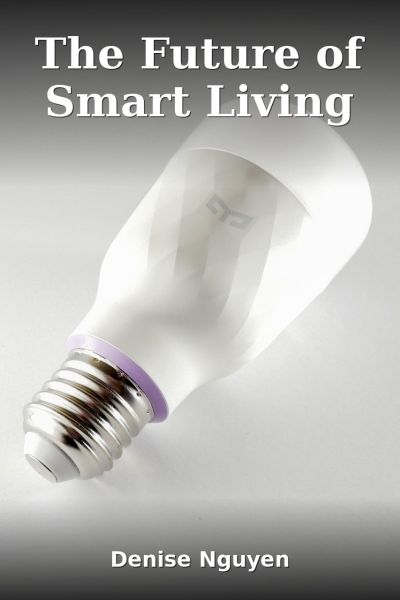
The smart home category is crowded with product reviews and setup tutorials, but fewer resources explain how the pieces fit together into something that genuinely thinks alongside you. Denise Nguyen's The Future of Smart Living takes a different approach: it treats the smart home as an ecosystem of interconnected systems — networking, energy, security, AI — rather than a shopping list. The result is a book that helps you decide what kind of intelligence you actually want in your walls, and what it will take to sustain it.
What the book is about
Structured across 25 chapters, the book moves from foundations to frontiers. Early chapters define the smart home landscape, unpack the Internet of Things, and explain how artificial intelligence becomes the "brain" that turns remote control into anticipation. The middle section walks through specific domains — lighting, voice, appliances, entertainment, multi-room control, locks, cameras, sensors, and biometric access — with practical detail on installation, integration, and daily use. A substantial energy arc follows: smart thermostats, whole-home monitoring, smart-grid integration, solar and battery storage, and a philosophy of sustainable living. Closing chapters examine 5G, advanced AI prediction, privacy frameworks, the digital divide, and a final call to start small and grow deliberately. The intended reader spans curious beginners and experienced enthusiasts; technical concepts are explained without jargon, but the depth rewards those who want to understand protocols, data flows, and system architecture.
From remote control to anticipatory intelligence
The book's opening argument reframes what "smart" means. Chapter 1 draws a sharp line: "A true smart home goes far beyond remote control. It's about creating an interconnected ecosystem where devices communicate with each other and, crucially, with the inhabitants." Chapter 2 expands this through the Internet of Things, describing how sensors, embedded processors, and cloud platforms let devices "talk" to each other in real time — a security system that correlates motion, contact, and camera data to trigger lights and alarms together. Chapter 3 positions AI as the differentiator: a thermostat that doesn't just hold a setpoint but "learns your preferred temperature settings at different times of the day and adjusts automatically, even taking into account factors like occupancy and weather forecasts." The progression from timer to rule-based automation to machine-learning prediction runs through the entire book as its central spine.
The connectivity puzzle and Matter's promise
Chapter 4 is one of the most practically valuable sections for anyone who has ever bought a device that wouldn't pair with their hub. It surveys Wi-Fi, Bluetooth, Zigbee, Z-Wave, Thread, and the newcomer Matter, explaining each protocol's sweet spot: Wi-Fi for bandwidth, Bluetooth for proximity, Zigbee and Z-Wave for low-power mesh, Thread for IP-based mesh without a separate gateway. The chapter doesn't just list specs — it explains why a battery-powered door sensor shouldn't use Wi-Fi and why a 4K camera can't run on Zigbee. Matter emerges as the "unifying layer" built atop these transports, promising that "you should be able to buy any Matter-certified device, regardless of the brand, and know that it will work with your existing smart home system." For readers planning purchases, this chapter alone can prevent expensive compatibility mistakes.
Energy as a through-line, not an afterthought
Rather than relegating sustainability to a single chapter, the book weaves energy intelligence through five consecutive chapters (16–20). Chapter 16 details how smart thermostats use learning schedules, geofencing, and utility demand-response programs to cut waste. Chapter 17 introduces whole-home energy monitoring with circuit-level disaggregation — "non-intrusive load monitoring (NILM)" that identifies each appliance by its electrical fingerprint. Chapter 18 scales up to the smart grid: two-way communication, distributed generation, vehicle-to-grid, and the role of smart inverters. Chapter 19 gets concrete on residential solar, battery sizing, smart inverters, and the emerging "virtual power plant" model where aggregated home batteries sell grid services. Chapter 20 broadens to water conservation, waste reduction, indoor air quality, and circular-economy design principles. Together they make the case that energy visibility and automation are not optional add-ons but the financial and environmental justification for the whole endeavor.
Security that watches, listens, and learns
The security chapters (11–15) present a layered model: smart locks with keypads, fingerprints, and phone control (Ch. 11); cameras with person/pet/vehicle discrimination, color night vision, and edge processing (Ch. 12); environmental sensors for water, smoke, CO, glass-break, and air quality (Ch. 13); professional monitoring that verifies alarms via video before dispatching first responders (Ch. 14); and biometric access — face, iris, voice, even gait and heartbeat — as the emerging endpoint (Ch. 15). Chapter 23 then confronts the privacy cost: "The smart home isn't just a collection of individual devices; it's a complex ecosystem of interconnected sensors, cameras, and microphones, constantly collecting data about our lives." The book balances enthusiasm with caution, recommending 2FA, VLAN segmentation, VPN use, and careful privacy-policy reading. It also notes the bias risk in facial recognition trained on unrepresentative datasets — a rare ethical note in this genre.
Who gets left out? The digital divide question
Chapter 24 stands out for addressing a topic most smart-home books ignore: equitable access. It identifies three barriers — device and subscription cost, broadband availability (especially rural), and digital literacy — and argues that as smart tech becomes infrastructure for energy, health, and safety, exclusion deepens inequality. The chapter surveys policy levers (subsidies, universal broadband, open-source platforms like Home Assistant), community training models, and inclusive design principles (voice control, high-contrast UI, simple onboarding). It's a sobering counterpoint to the optimism of earlier chapters and a reminder that "the future of the smart home should be one where everyone can participate and benefit, regardless of their income, location, age, or ability."
Who should read this
This book suits homeowners planning a renovation or new build who want a systems-level view before buying, renters looking for portable, non-wired upgrades, and technically curious readers who enjoy understanding protocols and data flows. It's less ideal for someone who only wants a quick-start guide for a single Echo or Hue bulb — the breadth can feel overwhelming if your scope is narrow. For anyone willing to think in ecosystems, though, it's a thorough, grounded map of where the technology stands today and where the standards, grids, and algorithms are heading next.
Read “The Future of Smart Living” on MixCache.com →
Please log in or create an account to leave a comment.
No comments yet. Be the first to say something.