
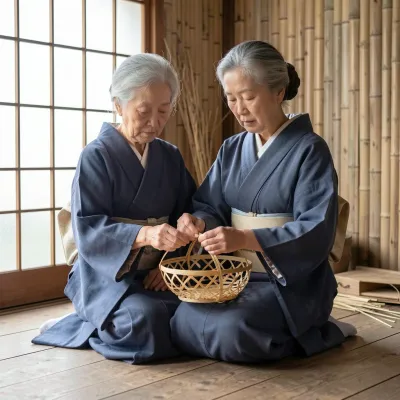
In a world of mass-produced uniformity, Japanese bamboo basketry offers a quiet counter-narrative: a craft where every strip bears the mark of human hands, where imperfection is celebrated, and where a single culm can become a vessel for centuries of cultural memory. Jack Reed's The Lost Craft of Japanese Bamboo Basketry maps this territory with unusual thoroughness, moving from the botanical specifics of bamboo species to the philosophical underpinnings of wabi-sabi and onward to the global art market that now embraces these works.
What the book is about
The book unfolds across 25 chapters that progress logically from cultural context to technical practice to historical trajectory and contemporary relevance. Early chapters establish bamboo's symbolic weight in Japanese life — its presence in New Year's kadomatsu, its role in the Tale of the Bamboo Cutter, its use in tea ceremony utensils — before diving into the material itself: harvesting rituals, curing methods like hinuki (scorching over flame), and the painstaking refinement of strips through habatori (width uniformity) and senbiki (thickness uniformity). Middle chapters catalog weaving patterns from basic hira-ami and asa-no-ha to advanced mutsume-ami and yotsume-ami, then explore shaping, regional styles (Beppu, Suruga, Kyoto, Sado Island), handle integration, natural finishes, and embedded symbolism. The final third traces the craft's near-disappearance under industrialization, its rescue through the Living National Treasure system and institutional support, and its current flourishing as fine art. The intended reader is broad: collectors seeking connoisseurship, aspiring weavers needing technical grounding, design enthusiasts drawn to sustainable materials, and anyone curious about how a "humble plant" becomes "a vessel of quiet wisdom."
The philosophy that shapes every strip
Reed makes clear that wabi-sabi is not decorative gloss but structural logic. Chapter 3 explains how the aesthetic — rooted in Zen austerity and tea master Sen no Rikyū's preference for "local, often rough-hewn, and seemingly imperfect objects" — dictates material choices, weaving decisions, and finishing approaches. Artisans favor bamboo with "interesting variations in color or texture rather than those that are perfectly uniform," allow "natural irregularities in the strips to become part of the basket's unique character," and apply finishes that "age gracefully and develop their own unique patina." The result is a craft where "the artisan doesn't impose perfection on the material but collaborates with it." This philosophy also governs the viewer's experience: a basket's beauty deepens through use, its "marks of time — the patina (aji) that develops through use and age — tell a story" of utility and relationship.
A sacred ritual before the first weave
Chapter 4 reveals that basketry begins months or years before weaving, in the bamboo grove during winter harvest. The text describes a process governed by precise ecological knowledge: culms cut "just above the first or second node above ground level" to prevent rot, harvested between midnight and 6 AM when "most of the starch is still in the roots" to deter insects, then cured through methods like hinuki ("scorching the freshly washed bamboo over a high flame, typically around 700°C") or boiling in alkaline solution. The subsequent splitting — where "the blade doesn't cut through the bamboo fibers so much as it pushes them apart, leveraging the natural tendency of bamboo to split cleanly along its length" — demands a "delicate dance of force and control" to keep splits centered through nodes. Reed emphasizes that "the entire process of preparing the bamboo, from harvesting to the final refined strips, can be as time-consuming as the weaving itself," framing this labor as "honoring the bamboo, understanding its essence."
Regional voices in a shared language
Chapter 10 demonstrates that "Japanese bamboo basketry" is a plural noun. Beppu's robust Madake work, born from hot-spring tourism, prizes "technical versatility" across "complex combinations of yotsume-ami, mutsume-ami, gozame-ami." Suruga counters with sensuji — "a thousand lines" of hair-thin strips woven into "intricate, almost lace-like" tea utensils. Kyoto adds lacquer finishes and "restrained forms that allow the beauty of the bamboo and the artistry of the weave to speak for themselves." Sado Island integrates wild grapevine (yamabudo) for "a striking contrast to the smoother bamboo," yielding "an earthy aesthetic" tied to agricultural life. Nagato favors "straightforward designs, strong construction" for daily use, while Ryukyu (Okinawa) blends bamboo with rattan and palm in "vibrant, earthy tones" reflecting subtropical trade networks. These are not mere stylistic quirks; each emerges from "local resources, cultural needs, and the individual genius of local artisans."
From anonymous craft to Living National Treasure
Chapters 14, 15, and 21 trace a remarkable status shift. Edo-period artisans like Hayakawa Shōkosai I broke convention by "engraving his name on his pieces, a practice not common among Edo period craftsmen," signaling bamboo's elevation from utility to art. The Meiji and Taisho eras saw Iizuka Rōkansai "challenge the conventional notion of bamboo baskets as purely functional objects, transforming them into sculptural forms." Post-war decline — driven by plastic competition, lost patronage, and a broken apprenticeship pipeline — nearly erased the tradition. The 1955 Living National Treasure system reversed the slide: Iizuka Shōkansai's 1982 designation "solidifying its place within the pantheon of Japanese fine arts." Landmark exhibitions like "Modern Masters of Bamboo" (Asian Art Museum, 2000) and gallery representation in New York and London completed the institutional journey. Reed notes that "the visual impact of monumental bamboo sculptures in such settings often left a lasting impression, challenging viewers' preconceived notions and sparking new conversations about material and form."
Contemporary innovation rooted in tradition
Chapters 17 and 18 show today's artists using inherited technique as springboard, not cage. Tanabe Chikuunsai IV builds "monumental sculptural installations" from "thousands of intricately woven bamboo strips" that "coil and flow through exhibition spaces," while Fujinuma Noboru crafts "geometric sculptures" exploring "the interplay of light and shadow." Ōki Toshie introduces "a feminine sensibility" through "fine strips to create intricate, almost textile-like surfaces." These artists maintain "meticulous craftsmanship" while expanding scale, abandoning vessel forms for pure sculpture, and integrating CAD for visualization. Yet they still "embrace the natural skin of the bamboo," work with "the subtle variations in natural bamboo to create nuanced visual effects," and honor wabi-sabi through "a nuanced engagement... filtered through a modern lens." The craft's future, Reed suggests, lies in this tension: "bridging tradition and modernity... transforming the familiar into something unexpectedly new."
Who should read this
This book rewards readers who want depth over survey. Collectors will value the connoisseurship chapters on signatures, patina, regional markers, and condition assessment. Aspiring weavers gain a technical encyclopedia — though hands-on workshops remain essential for tacit skills like knife control and tension management. Designers and architects will find a masterclass in sustainable materiality and form-language. General readers interested in Japanese cultural history receive a coherent narrative linking Jomon archaeology to contemporary art markets. Casual browsers seeking pretty pictures or quick DIY projects should look elsewhere; Reed's prose is informative but dense, and the book's 25-chapter architecture demands sustained attention. For anyone willing to follow the strips from forest to gallery, The Lost Craft of Japanese Bamboo Basketry delivers a rare thing: a craft history that feels alive in the hands.
Read “The Lost Craft of Japanese Bamboo Basketry” on MixCache.com →
Please log in or create an account to leave a comment.
No comments yet. Be the first to say something.