
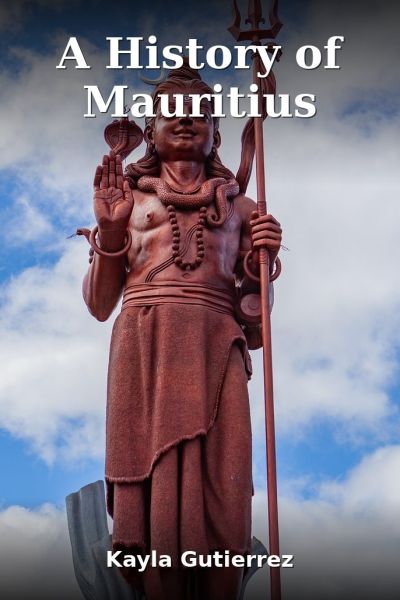
Few island nations pack as much global history into such a small landmass as Mauritius. Kayla Gutierrez's A History of Mauritius delivers a sweeping 25-chapter narrative that moves fluidly across four centuries, connecting the extinction of the dodo to the rise of a modern financial hub without losing sight of the human stories caught between empires. The result is a history that feels less like a parade of governors and treaties than a study in how populations adapt, resist, and remake themselves under successive waves of colonization and migration.
What the Book Is About
The book follows a clear chronological structure across 25 chapters, beginning with pre-European Arab and Malay maritime knowledge (Chapter 1) and concluding with contemporary Mauritius as a "resilient, multicultural democracy" facing 21st-century climate and inequality challenges (Chapter 25). Gutierrez organizes the narrative around three colonial eras — Dutch (1598–1710), French as Isle de France (1715–1810), and British (1810–1968) — then tracks the post-independence trajectory through economic diversification, the 1992 transition to a republic, and present-day governance. The work assumes no prior knowledge of the region but rewards readers familiar with Indian Ocean history by connecting Mauritius to broader patterns of European rivalry, plantation capitalism, and decolonization. Its 25 chapters function as discrete but linked essays, each tackling a specific phase: environmental transformation, the making of Port Louis, abolition and apprenticeship, the "Great Experiment" of indentured labor, political awakening, and the negotiated path to sovereignty.
An Ecology Undone: The Dodo as Harbinger
The book's environmental thread begins immediately. Chapter 1 establishes Mauritius as "an ecological marvel, a vibrant laboratory of evolution where species had developed in isolation over millennia." Chapter 6 then details how Dutch settlement triggered "a perfect storm for the vulnerable native fauna" — hunting, introduced rats, pigs, and monkeys, and forest clearance for ebony. The dodo's extinction (likely by the 1690s) becomes more than a curiosity; it signals the irreversible restructuring of an ecosystem that had no defenses against human arrival. Gutierrez notes that "newly discovered manuscripts from the Dutch period have provided some insights into the diverse, and now largely lost, fauna of 17th-century Mauritius," including the Mauritian blue pigeon and raven parrot. This ecological lens recurs: later chapters link deforestation for sugar to soil erosion and cyclone vulnerability, framing environmental degradation as a continuous colonial legacy rather than a discrete event.
Three Colonial Layers, One Legal Hybrid
Few colonies changed hands as cleanly as Mauritius, yet each power left distinct institutional sediment. The Dutch named the island (Chapter 3) and introduced sugarcane and enslaved labor but abandoned it after cyclones, droughts, and rat infestations made the venture unprofitable (Chapter 5). The French transformed it into Isle de France, building Port Louis into a naval base under Mahé de La Bourdonnais (Chapter 8) and entrenching a Code Noir–regulated plantation economy (Chapter 9). The 1810 British conquest (Chapter 12) brought a striking concession: Article 8 of the capitulation guaranteed inhabitants would "preserve their religion, laws, and customs." Chapter 13 shows how this created a durable Franco-British legal hybrid — French civil and commercial codes persisted while British criminal procedure and evidence law were grafted on. The result is a jurisdiction where "contracts, property ownership, family law, and inheritance were still subject to French legal principles" two centuries later, a rarity in the former British Empire that still shapes Mauritius's offshore finance appeal.
From Chattel to Contract: The Labor Transition That Remade the Island
The book's most consequential demographic shift unfolds across Chapters 14–16. The 1833 Slavery Abolition Act introduced a six-year "apprenticeship" that Gutierrez describes as "little more than a modified form of forced labor." When it ended in 1839, formerly enslaved people left plantations en masse, creating a labor crisis planters solved by importing over half a million indentured workers from India between 1834 and the early 1900s. Chapter 15's account of the Aapravasi Ghat immigration depot — now a UNESCO site — and the voyage conditions "mirroring in many ways the horrific 'Middle Passage'" makes clear this was no benign transition. Yet Chapter 16 documents how these laborers, speaking Bhojpuri, Tamil, Telugu, and Marathi, forged a new Indo-Mauritian identity: building temples, celebrating Diwali and Eid, and eventually forming the island's demographic majority. The Creole population (descendants of enslaved Africans) and later Chinese traders added further layers, creating the "mosaic of lives" Chapter 18 examines through language, religion, and the persistent stratification of land ownership.
Negotiated Sovereignty: Independence Without Revolution
Mauritius achieved independence through constitutional conference rather than armed struggle, and Gutierrez gives the negotiations their due. Chapter 19 traces the political awakening from Gandhi's 1901 visit through the 1936 founding of the Labour Party and the pivotal 1947 constitution that expanded the electorate from 11,000 to nearly 72,000 by requiring only that voters "could write their name in one of the island's languages." Chapter 20 details the 1965 Lancaster House conference and the 1967 election that became a de facto referendum on independence, with the Independence Party coalition (Labour, IFB, CAM) winning a majority against the PMSD's pro-association platform. Chapter 21 captures the March 12, 1968 ceremony — Union Jack lowered, four-striped flag raised, "Motherland" anthem debuting — while noting the communal unrest that accompanied the transition. Chapter 24 then covers the 1992 shift to a republic, passed with a three-quarters parliamentary majority, replacing the British monarch with a Mauritian president elected by the National Assembly. The Westminster framework endured, but the symbolic break completed what Gutierrez calls "the logical conclusion of their sovereign status."
Contemporary Mauritius: Success Story with Fault Lines
The final chapter brings the history into the present, positioning Mauritius as an "African success story" that diversified from sugar into textiles, tourism, financial services, and ICT — the so-called "Mauritius Miracle." Yet Gutierrez refuses a triumphalist close. She identifies persistent "socioeconomic inequalities" across communities, high youth unemployment, an aging population, and the existential threats facing a Small Island Developing State: rising seas, coral reef collapse, water stress, and biodiversity loss that echoes the dodo's fate. The political system, while stable, faces scrutiny over the "best loser" electoral mechanism, political dynasties, and corruption allegations. The book ends by framing Mauritius as "a nation shaped by its layered history" where "the echoes of Dutch, French, and British colonization, the suffering of slavery, and the transformative arrival of indentured laborers resonate in the vibrant multicultural society of today" — a society still negotiating what equitable development looks like on a warming island.
Who Should Read This
Readers interested in Indian Ocean history, comparative colonialism, or the mechanics of postcolonial state-building will find this a thorough, well-structured single-volume reference. Its chapter-by-chapter clarity makes it useful for students and researchers needing a reliable chronological backbone, while the thematic threads — environmental history, legal pluralism, labor migration, democratic consolidation — offer entry points for specialists. General readers seeking a tropical travelogue or character-driven narrative may find the institutional focus dry; Gutierrez prioritizes structural forces over individual biography. But for anyone trying to understand how a remote volcanic island became one of Africa's most stable and prosperous democracies — and what vulnerabilities persist beneath the surface — this history delivers the necessary context without simplification.
Read “A History of Mauritius” on MixCache.com →
Please log in or create an account to leave a comment.
No comments yet. Be the first to say something.