
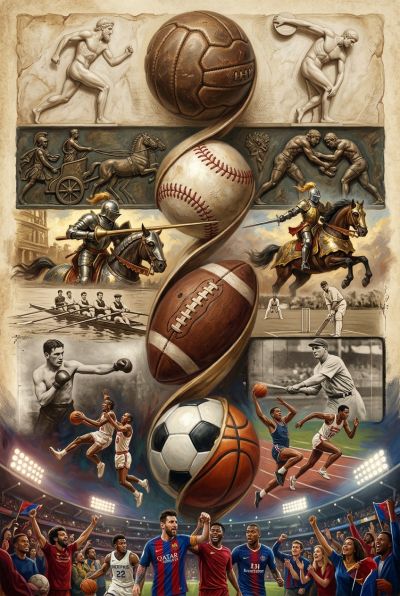
What begins as a footrace to a cave becomes a global industry worth billions, yet the fundamental drama remains unchanged. John Miller's A History of Sports follows this thread across millennia, showing how each era reshapes play to fit its spiritual, social, and political needs. The result is less a catalogue of games than a parallel history of humanity told through its contests.
What the book is about
Organized chronologically across 25 chapters, the book moves from Paleolithic cave paintings of wrestlers (7000 BCE) to AI-driven performance analytics and climate-threatened Winter Olympics. Miller structures the narrative around pivotal transformations: the Greek invention of the agon (noble contest), the Roman pivot to spectacle (panem et circenses), the medieval class divide between jousting knights and folk football, the 19th-century British codification of rules and "muscular Christianity," and the 20th-century explosion of media, money, and political theater. The scope is deliberately global — Chapter 6 devotes serious space to Indigenous traditions like the Mesoamerican ballgame Pitz, North American lacrosse (tewaaraton), Polynesian surfing (heʻe nalu), and Central Asian Buzkashi. Later chapters examine women's exclusion and inclusion (Chapters 11, 21), racial barriers (Chapter 15), the Paralympic movement (Chapter 22), esports (Chapter 23), and the athlete as global brand (Chapter 24). The intended reader is anyone who watches, plays, or wonders about sport and wants to understand why it commands such cultural weight — no specialized knowledge required.
From survival to sacred ritual: the deep origins of competition
The book's opening chapters argue that sport's "wellspring" lies in skills that once meant life or death. Chapter 1 draws a direct line from the hunt to the javelin throw, noting that "the first sporting arenas were the forests and plains of the Stone Age, and the first athletes were the hunters whose prowess meant the difference between feast and famine." Evidence ranges from 15,000-year-old French cave paintings of wrestlers to the Epic of Gilgamesh's account of a formalized wrestling match ending in "mutual respect and friendship" rather than death. In Egypt, the Beni Hasan tombs (c. 2055–1650 BCE) contain over 400 painted wrestling pairs — effectively "one of the world's first great sporting manuals." The Mesoamerican ballgame Pitz, played for over three millennia, fused athleticism with cosmology: the court was "a portal to the underworld," and major games often ended in human sacrifice. These examples establish a pattern: what a society calls sport reveals its priorities, whether religious (Greece), political (Rome), or communal (medieval villages).
The British blueprint that standardized the world's games
Chapter 7 identifies a single, exportable model forged in Victorian public schools: standardized rules, governing bodies, and the ideal of "muscular Christianity." Dr. Thomas Arnold at Rugby School made team games "a laboratory for the soul" teaching boys to "subordinate individual vanity to the collective good." The 1863 meeting at the Freemasons' Tavern that split football into association (soccer) and rugby codes becomes the book's defining schism — Blackheath's delegate stormed out rather than accept a ban on "hacking the front of the leg." This codification template (rules + association + knockout cup) then spread via empire: British railway workers introduced football to Argentina; Charles Miller, a Brazilian-educated Scot, brought it to São Paulo with "two footballs, a pump, and a copy of the Hampshire FA rulebook." The Marylebone Cricket Club, the Amateur Athletic Club, and Henley Royal Regatta each became guardians of their sport's laws, often embedding class exclusion — the 1866 amateur definition explicitly barred "any mechanic, artisan or labourer." Miller shows how this blueprint made sport globally legible while carrying Victorian biases into the 21st century.
Stadiums as political stages: fascism, Cold War, and boycotts
Two chapters stand out for their analysis of sport as statecraft. Chapter 14 details Mussolini's 1934 World Cup — "an elaborate two-week advertisement for fascism" where the official poster showed a player giving the fascist salute — and Hitler's 1936 Berlin Olympics, which introduced the torch relay ("a brilliant piece of political theater") and Leni Riefenstahl's Olympia. Jesse Owens's four gold medals publicly "refuted Hitler's poisonous ideology," yet the Nazis still topped the medal table and projected "an image of a respectable, powerful, and peaceful Germany." Chapter 16 extends this into the Cold War, where the medal count became "a definitive scorecard in the ideological struggle." The Soviet "state amateur" system (athletes nominally soldiers or factory workers but training full-time) clashed with Western amateur ideals, producing flashpoints like the 1956 "Blood in the Water" water polo match after the Hungarian Revolution, the 1972 basketball final's triple reset, and the 1980 "Miracle on Ice." The tit-for-tat 1980/1984 boycotts represent, in Miller's view, "the nadir of the Olympic ideal" — the Games "had become so thoroughly politicized that the two superpowers simply refused to play."
The long, uneven fight for inclusion
Chapters 11, 15, 21, and 22 trace exclusion and resistance across gender, race, and disability. The 19th-century medical consensus held that women's "vital force" was finite and reproduction would be damaged by exertion — a pseudoscientific barrier reinforced by corsets and bustles. Lawn tennis and the safety bicycle offered early footholds; Senda Berenson adapted basketball in 1892 with three-zone courts to minimize "unladylike" contact. The 1920s produced stars like Suzanne Lenglen (who abandoned corsets for "shorter, pleated silk skirts"), Gertrude Ederle (who beat the men's Channel record by nearly two hours), and Babe Didrikson (who won the 1932 Olympic javelin and hurdles but was "awarded the silver medal because of her jumping technique"). The 1921 FA ban on women's football — "quite unsuitable for females" — lasted 50 years. Chapter 15 follows racial barriers from Jack Johnson (whose 1910 victory over Jeffries "sparked race riots") through Joe Louis (whose 1938 knockout of Schmeling became "a global referendum on fascism and democracy") to Jackie Robinson's 1947 integration of MLB ("the guts not to fight back") and the 1968 Black Power salute. Chapter 22 tracks the Paralympic movement from Dr. Ludwig Guttmann's 1948 Stoke Mandeville archery contest for spinal-injury veterans — "the prize was simply the act of participation itself" — to the 2012 London "Meet the Superhumans" campaign that reframed Paralympians "not as objects of pity, but as powerful, tough competitors."
Commercialization, technology, and the quantified athlete
The final third of the book examines how money and science remade sport. Chapter 17 credits television with rewiring the fan experience: Roone Arledge's Wide World of Sports ("the thrill of victory... and the agony of defeat"), instant replay (first used Army-Navy 1963), and Monday Night Football's three-man booth turned games into prime-time spectacles. Chapter 19 details the scientific revolution — interval training (Zatopek), carbohydrate loading (1960s Scandinavian muscle biopsies), Gatorade (1965 Florida heat solution), Tartan Track (1968 Mexico City), and the LZR Racer suit that produced 23 of 25 swimming world records in 2008 before being banned as "technological doping." Chapter 20 exposes the corruption that followed the revenue explosion: the IOC Salt Lake City bid scandal, FIFA's 2015 Zürich arrests ("over $150 million in bribes"), Tim Donaghy's NBA betting, and Lance Armstrong's "most sophisticated, professionalized and successful doping program." Chapter 24 describes the modern athlete as "a multinational corporation in their own right" — Beckham's brand flexibility, Ronaldo's social-media empire, LeBron's billionaire portfolio. Chapter 25 looks ahead: AI-driven tactical analysis, climate-driven venue loss (half of Winter Olympic hosts may be unreliable by 2050), and the tension between "the magic circle" of pure contest and the commercial machinery surrounding it.
Who should read this
Readers who enjoy sweeping cultural histories like Sapiens or The Sports Gene will appreciate Miller's ability to connect a Neolithic cave painting to a modern esports tournament without losing the human thread. The book rewards anyone curious about why sport matters — not just who won, but what the winning meant. Casual fans may find the early chapters on ancient and medieval sport slower going than the media-saturated 20th-century sections, but the payoff is a framework for understanding today's headlines (NIL deals, trans-athlete policies, Saudi sports investment) as the latest iterations of patterns millennia old. If you want a statistic-heavy almanac or a celebratory greatest-hits reel, this isn't it. If you want to see sport as a mirror of who we are — "our bodies, our spirits, our communities, and our ceaseless drive to test ourselves and connect with others" — it's an essential read.
Read “A History of Sports” on MixCache.com →
Please log in or create an account to leave a comment.
No comments yet. Be the first to say something.