
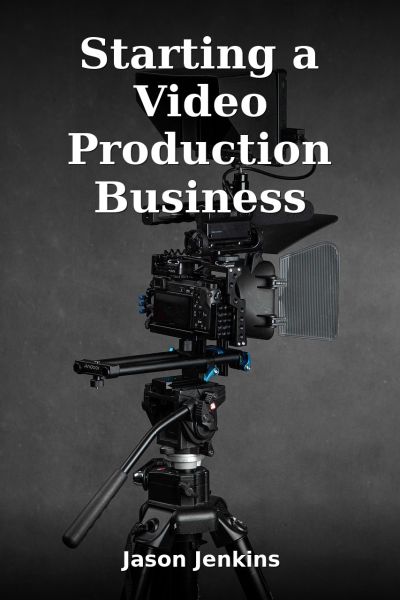
Most guides for aspiring video producers stop at technique — how to light, how to edit, how to tell a story. Jason Jenkins assumes you already know your craft, or are willing to learn it, and instead builds a roadmap for the business architecture that turns that craft into a livelihood. The result is a unusually complete operating manual for an industry where creative talent and commercial discipline rarely share the same page.
What the book is about
Starting a Video Production Business moves chronologically from idea to enterprise. Its 25 chapters are grouped into four loose phases: foundation (niche, skills, business plan, legal structure), compliance (permits, contracts, copyright, privacy), operations (equipment, renting vs. buying, core tech, software workflows, team assembly, freelancers, on-set management), and growth (financial planning, pricing, insurance, branding, digital marketing, client acquisition, government/corporate contracts, deliverables management, trend navigation, scaling). The writing addresses a reader who has technical competence but needs the commercial scaffolding — incorporation, insurance, pricing models, proposal writing, and repeatable workflows — that separates a freelancer from a company.
Niche as strategy, not limitation
Chapter One reframes specialization as a business lever rather than a creative constraint. Jenkins writes, "Without a clear niche, you're just another vendor shouting your wares into the crowd, hoping someone notices. With a defined specialization, however, you become the go-to expert for a particular need, and clients actively seek you out." The chapter surveys eleven distinct niches — marketing videos, wedding/event, documentaries, interviews, vlogs, educational, drone, music videos, corporate, product/testimonial, live streaming, and short-form — and explains how each demands different gear, workflows, client relationships, and pricing. The takeaway: choose a niche where your skills, interest, and market demand intersect, then let that choice drive every subsequent purchase and hire.
The rent-versus-buy calculus
Chapter Ten offers one of the book's most immediately actionable frameworks. Instead of a blanket recommendation, Jenkins maps a blended approach: buy core, frequently used, slowly depreciating items (primary camera body, versatile lenses, essential audio, basic lighting, tripods, storage) and rent specialized, high-end, or infrequent gear (cinema cameras, tilt-shift lenses, large lighting packages, motion-control rigs, backup bodies for big shoots). He quantifies the tipping point: "If you find yourself consistently renting the same piece of equipment for every single project, the daily or weekly rental fees can quickly add up, eventually exceeding the purchase price of the gear." The chapter also reminds readers to factor delivery fees, insurance surcharges, and consumables into rental budgets — costs that often go uncounted in back-of-envelope math.
Contracts as creative infrastructure
Chapters Six and Seven treat legal documents not as defensive paperwork but as the infrastructure that lets creativity proceed without friction. The Scope of Work section must specify video length, style, shooting days, locations, deliverables, and — crucially — "the agreed-upon number of revisions for each stage (e.g., one major revision for the rough cut, two minor revisions for the fine cut)." Intellectual property clauses should assign copyright of the final edited video to the client upon full payment while retaining rights to raw footage and project files unless separately negotiated. Jenkins also details the two licenses required for commercial music use: a synchronization license from the publisher and a master-use license from the record label, noting that "these can be costly and complex to obtain, so they are usually reserved for high-budget productions." A work-for-hire agreement with every freelancer and subcontractor closes the ownership loop.
Pricing models that protect margin
Chapter Seventeen dissects four models — hourly, day rate, project-based flat fee, and tiered packages — and ties each to project definition clarity. Flat fees, the preferred model for defined scopes, demand meticulous estimation: "If you underestimate the time or resources required, your profit margin can quickly erode, or you might end up working for free." The chapter provides concrete benchmarks: a 60-second marketing video averages $2,966; a 2-minute video starts around $5,000; corporate projects range $5,000–$20,000; high-end commercials reach $20,000–$100,000+. A 10–15% contingency fund and a clear revision policy (with hourly overage rates) are presented as non-negotiable margin guards. Jenkins also notes regional variance: "Metropolitan areas, for example, often have production costs that are 30-50% higher than those in less urbanized areas."
Scaling through diversification and systems
The final chapter moves beyond survival to intentional growth. Jenkins lists seven diversification avenues: live streaming, photography, social media management, video marketing consulting, equipment rentals, workshops/training, and — for companies with original content — advertising revenue, sponsorships, licensing, memberships, OTT distribution, and e-commerce. He pairs each with the operational prerequisite: standardized workflows, AI automation for repetitive post tasks ("color correction, background noise removal, transcription, and scene detection"), and multi-platform deliverable templates. The chapter closes with a reminder that "remaining stagnant in the dynamic world of video production is a recipe for obsolescence," positioning continuous learning as a business function, not a personal hobby.
Who should read this
This book serves the technically capable videographer ready to build a company rather than a client list. It will feel elementary to anyone already running a multi-person production firm with established legal, financial, and sales systems. But for the solo operator or small partnership crossing from freelance to formal business — incorporating, insuring, writing proposals, hiring freelancers, chasing government RFPs — it consolidates months of fragmented research into a single, sequenced reference. Readers who want deep creative craft instruction should look elsewhere; Jenkins explicitly states, "We're not here to teach you the intricacies of three-point lighting or the nuances of color grading." What you get instead is the scaffolding that lets that craft pay rent.
Read “Starting a Video Production Business” on MixCache.com →
Please log in or create an account to leave a comment.
No comments yet. Be the first to say something.