
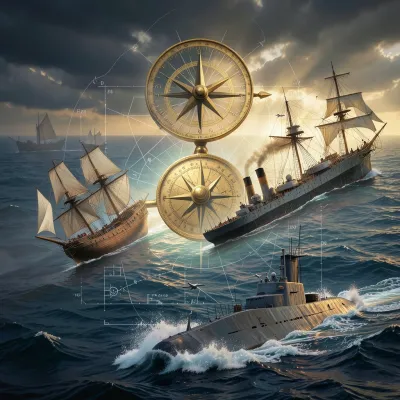
Few books manage to make the humble container ship feel as strategically vital as a nuclear submarine, but Marilyn Morris's Oceanic Command does exactly that. Across 25 chapters, she argues that the fundamental problems of naval warfare—controlling sea space, protecting commerce, projecting power ashore—have remained remarkably stable even as the tools have transformed from bronze rams to cyber weapons.
What the Book Is About
Oceanic Command is a single-volume chronological survey of naval warfare from antiquity to the 2020s, written for general readers who want a coherent framework rather than a collection of battle narratives. The book proceeds era by era: oared warships in the Mediterranean (Chapters 1–3), the Indian Ocean monsoon system (Chapter 4), the gunpowder transition in the Mediterranean and Atlantic (Chapters 5–7), piracy and commerce protection (Chapter 8), the industrial revolution at sea (Chapters 9–10), the Mahan vs. Jeune École debate (Chapter 11), the dreadnought age (Chapter 12), the world wars (Chapters 13–17), the Cold War nuclear revolution (Chapters 18–19), littoral operations and maritime law (Chapters 20–22), the carrier strike group as a networked system (Chapter 23), and 21st-century A2/AD, cyber, and uncrewed systems (Chapters 24–25). Morris explicitly avoids a Western-only lens; Chapter 4 on dhows, junks, and monsoons and Chapter 21 on tankers and containers give equal weight to Asian shipbuilding traditions and the commercial infrastructure that underpins modern sea power. The intended reader is someone comfortable with nonfiction who wants to understand why navies are built the way they are, not just what ships fought where.
The Trireme as a System, Not a Ship
Chapter 1 reframes the Greek trireme not as a heroic artifact but as a "weaponized motion" whose effectiveness depended on an entire ecosystem: "shipyards along coasts and river mouths stockpile timber, pitch, and flax… harbors are dredged, moles built, and watchtowers raised to extend the eye of the state beyond the coastline, while granaries and wells are established on islands to feed crews who might be weeks from home." Morris emphasizes that Athens turned the trireme into a civic institution—funded by silver, rowed by citizens, administered by public records—so that "the construction of a single trireme may involve carpenters, foremen, and inspectors working to templates stored in public records." The lesson recurs throughout the book: a warship is only as effective as the logistics, finance, and training that keep it at sea.
Two Competing Theories That Still Shape Fleets
Chapter 11 distills the late-19th-century clash between France's Jeune École and Alfred Thayer Mahan into a tension that persists in modern procurement. The Jeune École argued that "large, expensive fleets were becoming vulnerable to cheap weapons in the hands of clever commanders" and advocated commerce raiding by small, fast craft. Mahan countered that "command of the sea was rarely won through pinpricks or attrition but through the concentration of force in the hands of a fleet capable of defeating its opposite number in a decisive engagement." Morris shows how navies have never fully resolved this: the Cold War combined Mahanian ballistic-missile submarines with Jeune École–style attack submarines, and today's carrier strike groups coexist with swarms of cheap drones. The chapter closes by noting that "both schools… agreed on the fundamental importance of the sea itself… They diverged on how best to achieve those ends, with one favoring the scalpel and the other the hammer."
Logistics as a Weapon: The Battle of the Atlantic and the Container Revolution
Two chapters separated by decades make the same point. Chapter 17 demonstrates that the Battle of the Atlantic was won not by a single convoy battle but by "the capacity to organize, adapt, and sustain a system that could withstand punishment and continue to function." Liberty ships—"not pretty or fast but that could be welded together quickly and float with remarkable stubbornness even when holed"—turned industrial output into a strategic asset. Chapter 21 then traces how standardized containers turned ports into "choreographed hubs" and made the maritime commons "more visible and more mysterious than anything that had come before." A single container ship carries "enough goods to fill a fairground of stalls, yet the contents are invisible behind steel doors." Morris argues that modern sea denial doesn't require sinking ships; "the container revolution had made it possible to choke an economy by targeting a handful of key nodes."
The Carrier Strike Group as a Networked Organism
Chapter 23 dissects the carrier strike group (CSG) not as a big ship with escorts but as a "constellation" that "had to mesh with the precision of a watch even as it roamed across thousands of miles of unruly ocean." The CSG fuses "satellites, radars, sonars, electronic warfare systems, and aerial reconnaissance into a single operational picture" while its logistics tail—"supply ships maneuvering alongside combatants to transfer pallets, fuel hoses, and ammunition"—enables weeks on station. Morris notes the group's dual role: "A carrier arriving off a tense coastline could calm allies and concentrate minds, while its absence could be read as hesitation or overstretch." The chapter makes clear that the CSG's survival now depends as much on cyber resilience and space-based sensing as on armor or fighters.
Climate, Algorithms, and the Persistent Churn
The final chapter refuses a tidy forecast. Instead, Morris describes sea power entering "a phase in which influence would be measured in data flows and carbon loads as much as in hull counts and missile tubes." The Arctic is becoming "a navigable frontier for a longer slice of each year," forcing navies to treat "seawalls and pumps… as strategic assets on par with missile silos." Artificial intelligence appears in sensor fusion and routing, but "the real world stubbornly insisted on remaining analog at crucial moments, with salt in the connectors and chaos in the command net." Uncrewed systems are moving from novelty to standard inventory, yet "the legal and ethical frameworks governing these systems lagged behind their capabilities." Great-power competition plays out across "digital corridors through which data and targeting information flowed, turning submarine cables and satellite links into strategic assets as vital as any strait or canal." The book ends where it began: "mastery of the ocean was incremental, contested, and never complete."
Who Should Read This
Readers who want a single framework linking Salamis to the South China Sea will find the book rewarding. It serves professionals needing a refresher on how logistics, law, and technology interact, and generalists who appreciate seeing piracy, containerization, and cyber warfare treated as parts of one continuum. Pure battle enthusiasts may find the operational narratives abbreviated—Midway gets a few pages, Jutland a paragraph—in favor of systemic analysis. Anyone allergic to economics or legal history should know those threads run through every chapter. For the reader willing to accept that "sea power is not simply a question of how large a fleet can be built, but of how well it can be organized, sustained, and employed," Oceanic Command delivers a coherent, well-sourced argument that the trireme's lessons still apply to drone swarms.
Please log in or create an account to leave a comment.
No comments yet. Be the first to say something.