
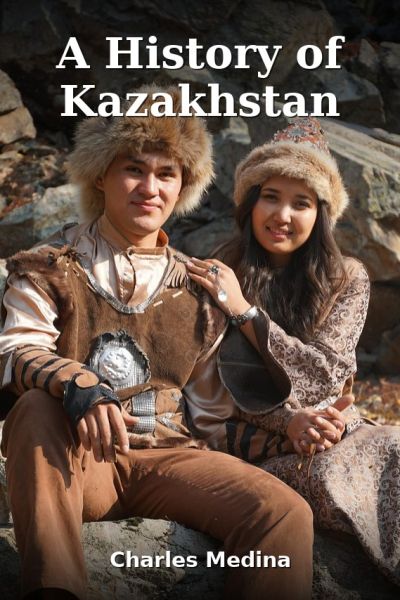
The vast territory now called Kazakhstan has been a corridor, a crucible, and a collision zone for millennia. Charles Medina's A History of Kazakhstan treats this expanse not as a backwater but as the "heartland and crucial crossroads of Eurasia," following its story from Lower Paleolithic hunters to the 2022 protests that shook Almaty. The book's 25 chapters move chronologically but never mechanically; each era builds on the last, showing how ancient pastoral adaptations, imperial ambitions, and environmental catastrophes echo into the present.
What the book is about
The work spans from roughly one million years ago — when early hominins left stone tools at Ushbulaq — to the post-Soviet "New Kazakhstan" of the 2020s. It is organized into three broad arcs: the deep past of steppe peoples and empires (Chapters 1–14), the formation and trials of the Kazakh Khanate and its Zhuz confederations (Chapters 15–18), and the colonial, Soviet, and independent periods (Chapters 19–25). Medina writes for a general reader but does not flatten complexity; he names specific archaeological cultures (Botai, Andronovo, Saka), political structures (the Ten Arrows, the White Horde), and policy disasters (Goloshchyokin's "Little October"). The intended audience is anyone who wants to understand how a nomadic pastoral society navigated, absorbed, and survived the great powers that surrounded it — and how that history informs Kazakhstan's current multi-vector foreign policy and internal reforms.
The horse that changed everything
Few books give the domestication of the horse its due as a world-historical pivot, but Medina devotes Chapter 2 to the Botai culture (c. 3700–3100 BCE) and the evidence that makes northern Kazakhstan a primary center of this revolution. He details the "bit wear" on horse teeth, the mare's milk lipids preserved in pottery, and the corrals that suggest herd management — not merely hunting. "The horse, once a source of meat and perhaps a companion in the hunt, was on its way to becoming an engine of history," he writes. This early mastery underpins every subsequent steppe polity, from the Andronovo charioteers to the Mongol armies that later conquered the region. The thread is never lost; even the Kazakh Khanate's military strength and the Dzungars' firepower advantage are traced back to this foundational relationship.
Silk Road cities as laboratories of coexistence
Chapters 7 and 9 reveal southern Kazakhstan's oasis cities — Suyab, Taraz, Otrar — as something more than caravan stops. They were "true crucibles of cultural exchange" where Buddhist temples, Nestorian churches, Manichaean meeting houses, and Tengrist shrines stood side by side. Medina notes that "commercial pragmatism often outweighed doctrinal exclusivity" and that rulers "found it politically expedient to patronize multiple religions" to attract merchants. The 751 Battle of Talas, fought near Taraz, becomes a case study in unintended consequences: Chinese papermakers captured by Arab forces transmitted their craft westward, revolutionizing Islamic scholarship and eventually European literacy. The cities' cosmopolitanism was not a modern ideal but a practical necessity, and their decline under later conquests marks a loss of that pluralistic capacity.
The Zhuz system: governance built for mobility
Chapter 16 offers one of the book's clearest analytical contributions: an explanation of the three Zhuzes (Senior, Middle, Junior) not as static administrative units but as "a largely organic grouping that reflected geographical realities, tribal affiliations, and shared economic interests." Medina describes the nested kinship structure — tribe (ru), clan (uru), sub-clan (ata), and the memorized genealogy (shezhire) that regulated marriage, pasture rights, and mutual obligation. Leadership combined Chinggisid legitimacy (the aq-süyek or "white bone" aristocracy) with earned authority: biys as judges of customary law (adat), batyrs as military heroes, and kurultais as deliberative assemblies. This system allowed both autonomy and confederation, explaining why the Kazakh Khanate could fracture under pressure yet reconstitute — a resilience that puzzled Russian administrators and Soviet planners alike.
The Dzungar wars as existential forge
The "Aktaban Shubyryndy, Alqakol Sulama" — the "Great Barefoot Flight" and "Soreness of Alqakol" — occupies Chapter 17 as the defining trauma of the early 18th century. Medina does not shy from the scale: Dzungar armies with firearms and artillery swept the steppes, depopulating Zhetysu, enslaving thousands, and forcing mass flight into China and the northern steppes. Estimates of a third to forty percent of the Kazakh population lost. Yet the catastrophe also produced the Ordabasy assembly of 1726, where leaders from all three Zhuzes attempted unified resistance, and elevated batyrs like Bogenbay and Kabanbay into lasting national symbols. The trauma "fostered a stronger sense of pan-Kazakh identity, transcending purely tribal or Zhuz-based loyalties" and compelled the Kazakhs to seek Russian protection — a decision that traded one existential threat for another.
Soviet Kazakhstan: laboratory of destruction and creation
Chapters 22–24 form a harrowing sequence: the 1930–33 Asharshylyk famine ("Goloshchyokin genocide") that killed perhaps 1–2 million; the Gulag archipelago (Karlag, Steplag, ALZHIR) that turned the republic into a "prison of nations"; the 1940s deportations of Koreans, Volga Germans, Chechens, and others; the Semipalatinsk nuclear test site's radioactive legacy; and the Aral Sea's engineered desiccation. Yet Medina also documents the Virgin Lands Campaign's demographic transformation, the wartime industrial evacuation that seeded Kazakhstan's manufacturing base, and the slow cultural thaw under Kunaev that allowed poets like Olzhas Suleimenov to probe Turkic history. The 1986 Jeltoqsan protests and the 1989 Nevada-Semipalatinsk movement emerge not as sudden awakenings but as the culmination of decades of suppressed memory and environmental grief. The book's final chapter carries these threads into the 2022 "Bloody January" uprising and Tokayev's constitutional reforms, asking whether the "New Kazakhstan" can finally reconcile the state with the society it governs.
Who should read this
Readers seeking a single-volume framework for Central Asian history will find this indispensable — especially those who have encountered the region only through Russian or Chinese perspectives. The book rewards patience; its density of names, dates, and tribal confederations demands attention, but the payoff is a structural understanding of how steppe societies organize, adapt, and endure. Specialists may quibble with certain periodizations or the reliance on Persianate and Russian sources for earlier eras, but the synthesis is coherent and the arguments traceable. Casual readers looking for travelogue or cultural portraiture should look elsewhere; this is political, military, and demographic history written with scholarly rigor and a clear eye for the contingencies that shaped a nation.
Read “A History of Kazakhstan” on MixCache.com →
Please log in or create an account to leave a comment.
No comments yet. Be the first to say something.