
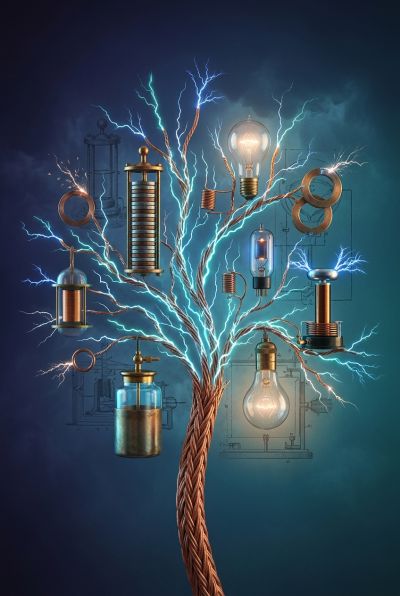
The story of electricity doesn't begin with a lightning bolt or a laboratory breakthrough. It begins with a piece of fossilized tree resin rubbed with fur in ancient Greece, attracting a feather. From that faint crackle of static on amber — elektron — to the smart grids balancing wind farms and electric vehicles today, Dr. Alex Bugeja's Electricity: A Brief History follows a 2,600-year thread of human ingenuity. The book shows how each generation's small insight became the next generation's foundation, turning a divine mystery into the infrastructure of modern life.
What the Book Is About
The book spans 25 chapters, moving chronologically from Thales of Miletus (circa 600 BCE) to the emerging smart grid and fusion research. Each chapter focuses on a pivotal discovery, experiment, or rivalry: Gilbert's De Magnete separating electricity from magnetism, the Leyden jar capturing "the electric fluid," Franklin's kite, Volta's pile, Oersted's compass needle, Faraday's induction, Maxwell's equations, the Battle of the Currents, the electron, the transistor, the integrated circuit, and the modern grid. Bugeja writes for the curious generalist — no equations, minimal jargon — but doesn't shy from technical detail when it illuminates the narrative. The intended reader is someone who wants to understand not just what was discovered, but how and why it mattered at the time.
The Two-Millennium Pause and the Thread That Didn't Break
One of the book's most striking themes is how long the basics lay dormant. Thales noted amber's attraction around 600 BCE; Theophrastus added that tourmaline shared the property around 300 BCE; Pliny the Elder recorded it in the 1st century CE. Then silence. As Bugeja writes, "For the next two millennia, this is where the investigation of electricity effectively ended. The spark of curiosity ignited by Thales failed to catch fire." The intellectual framework of Aristotle — four elements, qualitative not quantitative — had no place for an invisible force acting at a distance. It took William Gilbert in 1600, with his versorium needle and systematic testing of materials, to revive the thread. The book makes clear that scientific progress isn't just about insights; it's about the tools and conceptual categories to pursue them.
The Voltaic Pile as Rosetta Stone
Chapter 7 centers on a device that changed everything: Volta's stack of copper and zinc discs separated by brine-soaked cardboard. Before 1800, electricity was static — a spark, a shock, a moment. The pile delivered "a steady, continuous flow of electric current, something no one had ever seen before." Bugeja calls it "the Rosetta Stone of electricity." Within weeks, Nicholson and Carlisle used it to electrolyze water, discovering hydrogen and oxygen. Davy built a 2,000-cell "Great Battery" and isolated potassium, sodium, calcium, and more. The pile turned electricity from a phenomenon into a tool. This chapter illustrates a recurring pattern: a new source of measurement or energy unlocks an entire continent of science.
Oersted's Twitching Needle and the Circular Force
The 1820 discovery that an electric current deflects a compass needle is famous, but Bugeja's account in Chapter 8 restores its strangeness. Oersted wasn't looking for a sideways force; he expected attraction or repulsion along the wire. When the needle twitched perpendicular to the current, "It was a type of force that no one had ever seen before. All the known forces in the universe... were believed to act in straight lines between objects. Oersted had discovered a force that was fundamentally rotational." This single observation, made during a lecture demonstration, triggered Ampere's mathematical laws, Faraday's induction, and ultimately Maxwell's unification. The book excels at showing how a small anomaly, properly pursued, rewrites the map of physics.
Faraday's Lines of Force and the Birth of Field Theory
Chapter 10 gives Faraday his due as the experimentalist who thought in pictures, not equations. His 1831 breakthrough — that a changing magnetic field induces current, not a static one — came after a decade of failed attempts. The key experiment: an iron ring with two separate coils. Closing the circuit in one coil gave a momentary kick in the other; opening it gave a kick in the opposite direction. Faraday realized "It was not the mere presence of a magnetic field that generated a current; it was the change in the magnetic field." He then visualized space filled with "lines of magnetic force" that wires "cut" to produce current. This field concept, radical in a world of action-at-a-distance, became the substrate for Maxwell's equations and all modern physics.
The Battle of the Currents and the Triumph of Systems Thinking
Chapters 14–16 cover the commercial and technical war between Edison's DC and Westinghouse/Tesla's AC. Bugeja resists the simple hero-villain framing. Edison's DC system was a complete, working ecosystem — generators, meters, sockets, underground conduits — but limited by voltage drop to about a mile. AC's transformer allowed high-voltage transmission over distance, then step-down for safe use. The book details the propaganda war (electrocuting dogs, the electric chair) but emphasizes that the Niagara Falls contract in 1893 settled it: "The power of Niagara Falls would be harnessed and transmitted using Nikola Tesla's polyphase alternating current system." The victory wasn't just technical; it was architectural. AC enabled the interconnected grid — the "largest and most complex machine ever built" — that defines modern electricity.
From Vacuum Tubes to the Transistor: Controlling the Electron
The final third of the book traces the shift from power to information. Chapter 19 shows how the Edison effect (thermionic emission in a light bulb) became Fleming's diode, then De Forest's triode — the first amplifier. "A faint electrical whisper applied to the grid could be used to precisely modulate a powerful shout of current." This enabled radio, long-distance telephony, and the first computers. Chapter 20 details the 1947 Bell Labs breakthrough: Bardeen and Brattain's point-contact transistor, then Shockley's junction transistor. The "tyranny of numbers" — hand-wiring tens of thousands of components — drove Kilby and Noyce to the integrated circuit (Chapter 21). Moore's Law emerged not as physics but as economics. The microprocessor (Intel 4004, 1971) put a CPU on a chip, launching the personal computer revolution.
Who Should Read This
This book suits readers who enjoy narrative histories of science and technology — think The Making of the Atomic Bomb or The Idea Factory but focused on a single force. It rewards patience with technical detail: you'll learn how a commutator works, why a transformer needs AC, what a Cooper pair is. Engineers and physicists will appreciate the accurate, jargon-light explanations; general readers will follow the human stories — Galvani vs. Volta, Edison vs. Westinghouse, Bardeen vs. Shockley. Skip it if you want a textbook with problems, a cultural history of electricity's social impact, or a forward-looking energy policy treatise. The book ends at the smart grid and fusion, but its heart is the past: how we got from a feather jumping to amber to a world where electricity is as invisible and essential as air.
Read “Electricity” on MixCache.com →
Please log in or create an account to leave a comment.
No comments yet. Be the first to say something.