
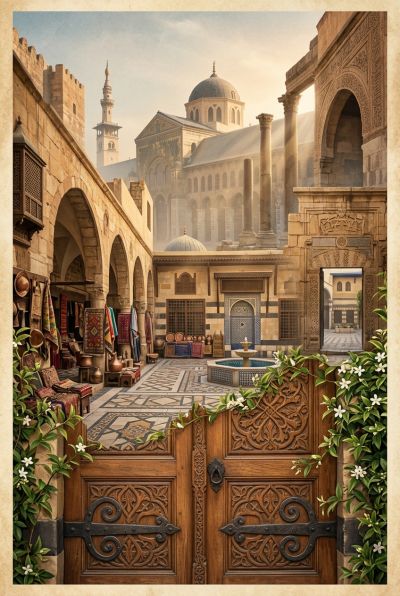
The summer heat over the Ghouta was suffocating, the air thick with dust and the scent of crushed apricots. From the walls of Damascus, the defenders watched a forest of banners unfurl across the western orchards — the golden fleurs-de-lis of France, the black eagle of Germany, the crosses of a dozen lesser lords. Fifty thousand men, the flower of Western chivalry, had come to take the city. Inside, the emir Mu'in al-Din Unur had perhaps a tenth that number, a motley garrison of Turkish professionals, Arab auxiliaries, and armed citizens. The Second Crusade, preached by saints and blessed by popes, had found its target.
The Trap Closes
King Louis VII and Emperor Conrad III had arrived in the Holy Land separately, their armies mauled by hunger, disease, and Turkish arrows in Anatolia. Jerusalem's barons, desperate for a victory to justify the expedition, persuaded them that Damascus — wealthy, strategic, and allegedly weakly held — was the key to securing the Kingdom of Jerusalem's eastern flank. The Crusaders crossed the Jordan in late July 1148 and deployed in the lush gardens west of the city, where water and shade were plentiful and the walls seemed most vulnerable.
Mu'in al-Din Unur, a former slave soldier who had risen to rule Damascus through the chaotic politics of the Burid dynasty, understood the stakes. He had spent years balancing the city's fractious factions, negotiating with Crusaders and Muslim rivals alike. Now he dropped all calculation. He ordered the canals of the Barada diverted, flooding the approaches to the western gates until the Crusaders' siege engines sank axle-deep in mud. He armed the citizens — merchants, artisans, even women and children — and positioned them on the three concentric walls that girded the Old City. The great wooden gates were chained shut; the posterns, hidden sally ports known only to locals, were unbarred for sorties.
The assault began at dawn on July 24. Crusader knights dismounted and advanced on foot behind the cover of mantlets, while archers poured arrows onto the battlements. The defenders replied with mangonels, Greek fire, and a hail of stones and javelins. For four days the fighting raged along the western sector. The Crusaders battered the Gate of the Gardens and the Gate of the Columns, but each breach was sealed by counterattacks streaming from the posterns. A chronicler noted that Damascene women fought alongside the men, hurling tiles and jars of boiling oil from the ramparts. The air rang with the clash of steel and the screams of horses burning in the naphtha-soaked straw the defenders rolled down the glacis.
The Fatal March
On the fourth day, the Crusader leadership made a decision that still puzzles historians. Convinced by local informants — perhaps traitors, perhaps double agents — that the eastern wall was weaker and its gates unguarded, the entire army struck camp and marched around the city to the barren plain facing Bab Sharqi. The move abandoned their water supply, their shade, and their supply lines. The eastern approaches offered no cover, no wells, and a killing field of open ground swept by the city's largest towers.
Unur had anticipated the possibility. Days earlier, he had dispatched a trusted messenger north to Aleppo, to the court of his nominal rival Nur al-Din Zengi. The Zengid ruler, a young prince consumed by the idea of Muslim unity against the Franks, had responded with startling speed. His cavalry, light and hard-riding, now appeared on the hills east of the city, their pennons snapping in the hot wind. They did not attack — they did not need to. Their mere presence severed the Crusaders' line of retreat and threatened their flank.
Panic spread through the Frankish camp. Knights who had boasted of taking Damascus by noon now whispered of encirclement. The local barons of Jerusalem, realizing the expedition was doomed, began packing their baggage. On July 28, barely a week after they had arrived, the Crusader army broke formation and fled south toward the Jordan, harried by Damascene sorties and Zengid horse archers. The Second Crusade's only major offensive in the Levant had collapsed in a week.
After the Dust Settled
The defeat sent shockwaves through Christendom. Bernard of Clairvaux, the crusade's chief apostle, wrote that "the judgment of the Lord is righteous; He has humbled the proud." In Damascus, the victory was celebrated with a ferocity that surprised even the victors. The city's poets composed qasidas comparing the Crusaders to locusts scattered by the wind. The emir Unur, his position unassailable, paraded captured banners through the Straight Street and distributed the abandoned Frankish equipment to his troops.
But the siege's true consequence was strategic, not symbolic. Unur's appeal to Nur al-Din had bound Damascus to the rising Zengid star. Within six years, the city would voluntarily submit to Nur al-Din's rule, becoming the southern anchor of a unified Muslim front that would eventually produce Saladin and the recapture of Jerusalem. The Crusaders never again attempted a full-scale siege of Damascus. They had learned, at terrible cost, that the city's walls were not its only defense — its politics were a weapon, its citizens a garrison, and its alliances could shift faster than a marching army.
Today, the western gardens where the French and German kings pitched their pavilions are buried beneath modern suburbs. The walls that held are largely gone, dismantled by Ottomans and time. But in the old quarter, near the Gate of the Columns, an elderly craftsman still tells visitors that the paving stones there run red with Frankish blood every July, a story his grandfather swore was true. The archaeologists smile and point to the strata: a layer of ash, a concentration of arrowheads, a sudden thickening of the wall's masonry — all dated to the mid-twelfth century. The stones remember what the chronicles record: four days when the world's most powerful armies broke themselves against a city that knew exactly how to survive.
This is one episode in a much longer story. For the full account of the history of Damascus, read “A History of Damascus” by Hugh Newmont on MixCache.com.
Please log in or create an account to leave a comment.
No comments yet. Be the first to say something.