
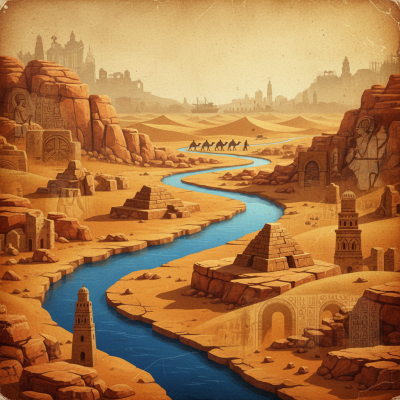
Few books attempt to carry a reader from the pyramid builders of Kerma to the streets of Khartoum in 2023, and fewer still manage to make that five-thousand-year arc feel like a single, coherent argument. Ruben Loughborough's Geschiedenis van Sudan does exactly that, framing Sudan's tormented modern history not as a series of accidents but as the recurring echo of five deep structural forces. The result is a work that respects the complexity of its subject without drowning the reader in it.
What the book is about
The book spans twenty-five chapters plus an introduction and afterword, moving chronologically from the A-Group culture of 3500 BCE through the kingdoms of Kush, Christian Nubia, the Funj Sultanate, the Turco-Egyptian conquest, the Mahdist revolution, the Anglo-Egyptian Condominium, independence, two civil wars, the Bashir era, the 2019 revolution, the 2021 coup, and the catastrophic 2023 war between the SAF and RSF. Loughborough organizes this immense timeline around five interconnected themes announced in the introduction: the central role of the Nile, the struggle over identity, cycles of conflict and resilience, the impact of external intervention, and the unfinished quest for a functioning nation. Each chapter is densely researched yet readable, blending political narrative with social, economic, and cultural detail. The intended reader is someone who wants more than headlines — someone willing to sit with the full, difficult story of a country that, as the afterword puts it, "keeps searching for itself amid profound challenges and enduring hope."
The Nile as protagonist, not just setting
From the opening paragraph, Loughborough makes the Nile an active character: "To speak of Sudan is to speak of the Nile." The river shapes every era — it determines where states form, how trade moves, where armies can campaign, and why the 2023 war erupted in Khartoum at the confluence of the White and Blue Niles. In Chapter 1, the cataracts protect Kerma from Egypt; in Chapter 4, the confluence becomes the site of Khartoum, the colonial capital imposed by Muhammad Ali's son Ismail; in Chapter 16, the 1,600-kilometer heated pipeline carries southern oil north through the desert; in Chapter 23, the bridges linking Khartoum, Omdurman, and Bahri become strategic choke points in urban warfare. The Nile is not background. It is the "central artery" and "silent narrator" that makes Sudan a crossroads between Africa and the Arab world, a fact that becomes the axis of the identity struggle.
Identity as the engine of war
The book's most persistent argument is that Sudan's wars are fundamentally about who gets to define the nation. Chapter 7 shows how the British "Southern Policy" institutionalized the north-south divide, creating "two Sudans within one state" by administering the south through missionaries and English while the north used Arabic and Islamic law. Chapter 9 reveals that independence in 1956 did not resolve this: the new government immediately pursued Arabization and Islamization, replacing Sunday with Friday as the rest day and nationalizing mission schools. The 1955 Torit mutiny — sparked when southern soldiers feared disarmament — began the first civil war before independence was even official. Chapter 11 details how John Garang's SPLA reframed the struggle not as southern secession but as a fight for a "New Sudan" — united, secular, democratic — only to see that vision collapse after his death. The 2011 referendum, described in Chapter 17, produced a 98.83% vote for separation, a "collective roar" that confirmed the failure of the northern elite's monolithic vision. Yet the wars continued in the Nuba Mountains, Blue Nile, and Darfur, proving, as Loughborough writes, that "the 'southern problem' was never only about the south; it was a crisis of a Sudanese state that was at war with its own diversity from its inception."
External intervention as a constant, not an exception
Foreign powers have never been peripheral to Sudan's trajectory. Chapter 4 describes the 1820 Turco-Egyptian invasion as a resource grab — gold, slaves, soldiers — that forged Sudan's first unified administration through "blood and fear." Chapter 6 shows how the 1898 British reconquest was driven less by Gordon's memory than by the "Race for Africa" and fear of French control of the Upper Nile. The Condominium that followed was a "carefully constructed fiction" designed to make a British possession look like joint rule. During the Cold War, Chapter 10 notes Nimeiry's pivot from Soviet alignment to US partnership after the 1971 communist coup attempt. In the 1990s, Chapter 12 documents how Turabi turned Sudan into a hub for Islamist militants, hosting Bin Laden. The 2005 CPA (Chapter 15) existed only because post-9/11 US pressure made peace a condition for sanctions relief. Most recently, Chapter 23 reveals how the 2023 war drew in Egyptian pilots at Merowe airbase, UAE and Saudi backing for rival generals, and Russian interest in Red Sea access. The pattern is clear: Sudan's geography and resources make it a theater for others' ambitions, and its internal elites have consistently instrumentalized foreign support against domestic rivals.
Culture as survival, not decoration
Chapter 24, "Society and Culture: A Tapestry of Traditions," refuses to treat culture as a respite from politics. Loughborough shows how hospitality (diyafa), the extended family, Sufi dhikr ceremonies, the toub and jalabiya, the pentatonic haqiba music, and the Khartoum School of visual art are all "the main text of Sudanese life." The jebena coffee ceremony — beans hand-roasted, pounded in a mortar, brewed in a long-spouted pot, served in three rounds — is "a ritual of friendship and community, a way of taking the time to honor your guest." Women's role in the 2019 revolution is highlighted: the iconic image of Alaa Salah atop a car in a white toub leading chants became "a global symbol of the central role of women in the uprising." Even wrestling in the Nuba Mountains — bodies smeared with ash, villages competing at harvest festivals — embodies "community pride and identity as much as individual skill." These traditions persist despite war, displacement, and dictatorship. They are, the book argues, "the sources of the strength that has enabled people to survive the unsurvivable."
The 2019 revolution and its betrayal as a structural turning point
Chapters 20–22 give the 2019 uprising and its aftermath the detailed, day-by-day treatment they deserve. The spark — a tripling of bread prices in Atbara on December 19, 2018 — ignited protests that the Sudanese Professionals Association (SPA) channeled into a coherent political project: the "Declaration of Freedom and Change" demanding a civilian-led transition. The April 6, 2019 sit-in at the military headquarters became "a city of hope" where "Christians and Muslims, Arabs and Africans, men and women could meet and dream of a shared future." When security forces tried to clear it, regular army soldiers intervened, "placing themselves between the security forces and the protesters" — the moment "the state's monopoly on violence shattered." Bashir fell on April 11, but the Transitional Military Council that replaced him was, in the protesters' words, a "palace coup." The June 3, 2019 massacre by the RSF killed over a hundred, dumped bodies in the Nile, and featured systematic sexual violence. Yet the ensuing civil disobedience campaign paralyzed the country and forced the August 2019 Constitutional Declaration — a fragile power-sharing deal that brought economist Abdalla Hamdok to power. His government achieved real gains: repealing public order laws, removing Sudan from the US terrorism list, signing the 2020 Juba Peace Agreement. But the military retained its economic empire — "hundreds of companies in every sector" — and feared accountability for the June 3 massacre. The October 2021 coup (Chapter 22) ended the transition. Hamdok's brief, coerced return in November 2021 — accepting a deal that "effectively legitimized the coup" — isolated him from the street, whose mantra became "No partnership, no negotiation, no compromise." His January 2022 resignation left the generals in full control, setting the stage for their 2023 war.
Who should read this
This book is for readers who want to understand Sudan on its own terms — not as a headline about famine, coups, or refugees, but as a place with a five-thousand-year history that explains why those headlines keep recurring. It rewards patience: the detail is dense, the cast of characters enormous, and the narrative unflinching about atrocity. Academic specialists will appreciate the synthesis of archaeology, colonial archives, and contemporary reporting; general readers with a serious interest in African history, postcolonial state formation, or the mechanics of revolution and counter-revolution will find it accessible but never simplified. Those looking for a quick overview or a hopeful narrative should look elsewhere. The afterword closes with the Nile still flowing, "a silent witness to a history that is, and always has been, tragically unfinished." Loughborough has given us the map to that unfinished history. What happens next depends, as it always has, on the Sudanese people themselves.
Read “Geschiedenis van Sudan” on MixCache.com →
Please log in or create an account to leave a comment.
No comments yet. Be the first to say something.