
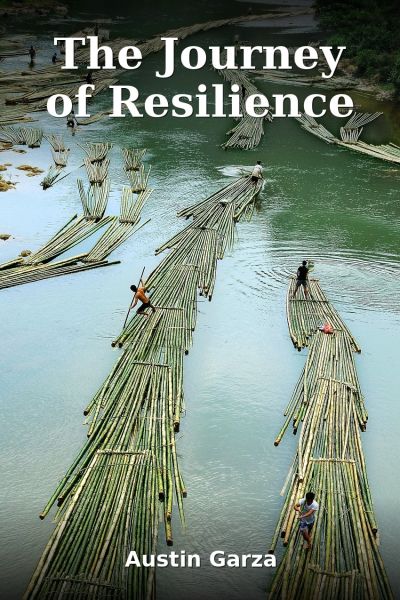
Resilience gets tossed around as a buzzword so often that its depth can be easy to miss. Austin Garza's The Journey of Resilience reclaims the concept, treating it not as a fixed trait but as a dynamic, learnable process that spans psychology, community dynamics, cultural tradition, and our relationship with the natural world. The book's ambition is matched by its structure: 25 chapters that move systematically from internal mindset to collective action, grounding each insight in research, narrative, or both.
What the Book Is About
The book unfolds in five broad arcs. Chapters 1 through 10 examine individual resilience — its definition, the science of stress response, mindset, adaptability, mental toughness, and learning from setbacks. Chapters 11 through 15 shift to community resilience: crisis response, social bonds, collective action, shared healing, and rebuilding after disaster. Chapters 16 through 18 explore cultural roots, focusing on tradition, ritual, and indigenous knowledge systems. Chapters 19 and 20 turn to ecological awareness, arguing that human resilience is inseparable from planetary health. The final five chapters form a practical toolkit covering mindfulness, cognitive restructuring, emotional regulation, supportive networks, and purpose-driven growth. The intended reader is anyone seeking a comprehensive, non-academic synthesis — professionals, community leaders, or individuals navigating personal upheaval — who wants both conceptual frameworks and actionable practices.
Adversity as Catalyst, Not Just Obstacle
Chapter 2 reframes hardship through the lens of post-traumatic growth and antifragility. Garza writes, "The adversity itself doesn't cause growth, but rather it creates a fertile ground for it by disrupting our previous assumptions and forcing us to construct new meanings." The chapter distinguishes between trauma and adversity, acknowledging that growth isn't guaranteed but becomes possible when individuals engage in meaning-making. Stories of Malala Yousafzai and Viktor Frankl in Chapter 6 illustrate this: Frankl's observation that "even in the most dehumanizing circumstances, humans retain the ultimate freedom: the freedom to choose their attitude" becomes a recurring anchor. The book doesn't romanticize suffering; it treats the catalyst metaphor as a call to intentional response.
Community Resilience as Organized Solidarity
The middle section makes a compelling case that collective resilience is more than aggregated individual grit. Chapter 11 introduces social capital — "bonding capital" within tight groups and "bridging capital" across diverse networks — as infrastructure for crisis response. Chapter 13 details mutual aid networks that emerged during the COVID-19 pandemic, describing them as "voluntary, reciprocal exchanges of resources and services for mutual benefit" that emphasize "solidarity, shared responsibility, and empowering participants." Chapter 14 examines healing through shared experience, from spontaneous memorials to structured support groups, noting that "the simple act of saying, 'Me too,' can be profoundly healing." Chapter 15 on rebuilding argues for participatory governance: "True rebuilding is a collaborative effort, empowering those most affected to shape their own recovery."
Indigenous Wisdom as Living Adaptation
Chapters 16 through 18 stand out for treating indigenous knowledge not as heritage but as active resilience strategy. Chapter 18 introduces Gerald Vizenor's concept of "survivance" — "an active sense of presence, a continuous negotiation and articulation of native stories, challenging narratives of victimhood and absence." The Maasai's balance of tradition and modern advocacy, the Inuit's integration of traditional ecological knowledge into climate policy, and the Haudenosaunee Confederacy's consensus-based governance ("considering the impact of decisions on the seventh generation") are presented as sophisticated, time-tested systems. The revival of cultural fire management in Australia and Māori language immersion schools (*kōhanga reo*) demonstrate how ancestral practices address contemporary crises. These chapters resist romanticization by showing adaptation, not stasis.
Ecological Awareness as Foundational Infrastructure
Chapters 19 and 20 argue that resilience cannot be separated from the health of the ecosystems that sustain human communities. Chapter 19 defines ecological awareness as "a recognition that human well-being is inextricably linked to the health and stability of the ecosystems we inhabit" and highlights permaculture, mangrove restoration, and community-led environmental initiatives as forms of "active ecological restoration." Chapter 20 reframes nature as teacher: biodiversity as a model for social diversity, succession after forest fire as a metaphor for post-disaster renewal, and feedback loops as lessons in monitoring thresholds. The writing here is less prescriptive than evocative — "The planet, it turns out, always has the last word" — but the implication is clear: any resilience framework that ignores ecological limits is incomplete.
A Toolkit Grounded in Practice, Not Prescription
The final chapters translate theory into daily habits without lapsing into self-help cliché. Chapter 21 offers a five-step problem-solving framework and a "what if" exercise for adaptability. Chapter 22 details box breathing ("inhale slowly for a count of four, hold your breath for a count of four, exhale slowly for a count of four, and hold for a count of four") alongside sleep hygiene, time boundaries, and cognitive reappraisal. Chapter 23 emphasizes reciprocity in network cultivation: "Resilience is a team sport, and your support system is your winning team." Chapter 24 synthesizes post-traumatic growth domains — appreciation for life, stronger relationships, personal strength, spiritual growth, new possibilities — while Chapter 25 closes with a call to personalize the toolkit: "Don't feel pressured to adopt every single technique mentioned; instead, pick a few that intrigue you and commit to consistent practice."
Who Should Read This
Readers who want a single volume that connects neuroscience to community organizing, indigenous governance to personal journaling, will find the synthesis valuable. The book suits professionals in social work, emergency management, education, or organizational development who need cross-domain perspective. Individuals in transition — career change, health crisis, grief — will appreciate the practical chapters but should know the first half is conceptually dense. Those preferring a purely narrative or purely clinical approach may find the breadth dilutes depth in places. For anyone willing to engage a wide-angle view of resilience as both personal discipline and collective responsibility, this is a substantial, well-structured resource.
Read “The Journey of Resilience” on MixCache.com →
Please log in or create an account to leave a comment.
No comments yet. Be the first to say something.