
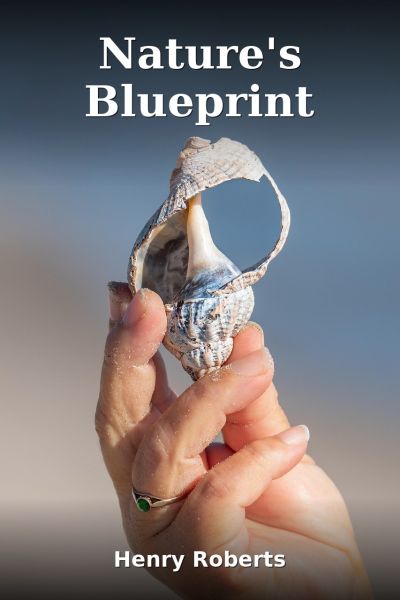
Patterns are nature's silent signatures, woven intricately throughout every leaf, mountain, and gust of wind. Henry Roberts' Nature's Blueprint takes this observation and builds a 25-chapter architecture around it, revealing how the same mathematical principles govern the branching of lungs, the spiraling of galaxies, and the collective intelligence of ant colonies. The result is a field guide to the hidden grammar of the physical world.
What the book is about
Nature's Blueprint is structured as a progressive journey from mathematical foundations to planetary-scale systems. The first six chapters establish core concepts — fractals, the Golden Ratio, the Fibonacci sequence, numerical patterns, symmetry, and spirals — using examples from biology and geometry. Chapters 7 through 15 explore how these principles manifest in living structures (tessellations, phyllotaxis, animal markings, insect societies, crystals) and geological forms (mountains, rivers, dunes, snowflakes). Chapters 16 through 20 scale up to fluid dynamics and global systems: waves, seasons, weather, ocean currents, and climate. The final five chapters synthesize these patterns into frameworks for understanding emergence, evolutionary design, biomimicry, and conservation. The intended reader is curious but not necessarily specialized; Roberts explains concepts like reaction-diffusion systems and Murray's Law without assuming prior expertise, while offering enough depth to satisfy readers with scientific backgrounds.
Fractals as nature's space-filling algorithm
Chapter 1 makes a compelling case that fractals are not mathematical curiosities but evolutionary solutions to packing and distribution problems. Roberts writes: "The reason nature 'chooses' fractals for so many of its designs isn't just for aesthetic appeal; it's often a matter of optimization and efficiency." He traces the bronchial tree of human lungs, the branching of circulatory systems, river drainage basins, and lightning strikes — all exhibiting statistical self-similarity across scales. The chapter connects Mandelbrot's mathematical formalism to the concrete problem of maximizing surface area within a confined volume, showing why a fractal lung extracts oxygen far more efficiently than a simple sac would.
The Golden Ratio and Fibonacci as growth protocols
Chapters 2 and 3 treat the Golden Ratio (Φ ≈ 1.618) and the Fibonacci sequence not as mystical constants but as emergent properties of efficient growth. Roberts explains how the logarithmic spiral — which maintains its shape while expanding — allows organisms like the nautilus to grow without changing form: "Each new chamber is a scaled-up, perfectly proportioned version of the last, ensuring continuous growth without altering the fundamental form of the shell." In plants, the golden angle (≈137.5°) between successive leaves minimizes self-shading, and the Fibonacci spirals in sunflowers and pinecones achieve optimal packing. The chapters distinguish between the ratio (governing proportional expansion) and the sequence (counting spiral arms), clarifying a common confusion.
Emergence: complex order without a central architect
Chapters 10 and 22 form a paired exploration of how simple local rules generate global complexity. In insect societies, Roberts describes how ant colonies build ventilation systems and foraging networks through pheromone-mediated feedback loops: "Simple rules, such as 'deposit soil where pheromone concentration is high' or 'follow the strongest pheromone trail,' can lead to the formation of highly organized and functional nest architectures." Chapter 22 generalizes this to physical and biological systems — convection cells in boiling water, superconductivity, magnetism, bird murmurations, termite mounds, and cardiac synchronization — arguing that "the whole truly becomes greater than the sum of its parts" without any central blueprint. The concept of self-organized criticality (power-law distributions in forest fires, earthquakes, avalanches) provides a quantitative signature of systems poised at the edge of chaos.
Evolutionary design as iterative optimization
Chapter 23 reframes every pattern in the book as the output of a blind, relentless design process. Roberts emphasizes that evolution "doesn't design from scratch; it modifies existing structures and patterns," producing what he calls "kluges" — imperfect but functional solutions like the vertebrate eye's blind spot. Convergent evolution appears as independent arrivals at the same mathematical optimum: the torpedo shape of sharks, dolphins, and ichthyosaurs represents a hydrodynamic pattern discovered three separate times. The chapter also links evolutionary timescales to the fractal branching of the phylogenetic tree itself, showing that the pattern of life's diversification mirrors the patterns within individual organisms.
From observation to application: biomimicry and conservation
The final two chapters turn descriptive science into prescriptive guidance. Chapter 24 catalogs concrete biomimetic innovations: lotus-effect self-cleaning surfaces, kingfisher-beak bullet trains, humpback-whale tubercle turbine blades, gecko-inspired dry adhesives, termite-mound passive ventilation, and neuromorphic chips modeled on neural networks. Chapter 25 argues that conservation must protect patterns, not just species: "Conservation, at its heart, is about preserving these vital patterns. It's not merely about protecting individual species, but about safeguarding the intricate webs of life, the delicate cycles of nutrients, the vast flows of energy." Roberts advocates for circular economies mimicking nutrient cycles, urban drainage inspired by river deltas, and agriculture patterned on forest succession — framing sustainability as alignment with nature's existing blueprints rather than domination of them.
Who should read this
Readers who enjoy interdisciplinary synthesis — where mathematics illuminates biology, which informs geology, which inspires engineering — will find this book consistently rewarding. It works equally well as a cover-to-cover narrative and as a reference for dipping into specific phenomena. Those seeking purely qualitative nature writing may find the mathematical explanations dense in places, while specialists might wish for more technical depth in individual chapters. But for the generalist who wants to understand why the world looks the way it does, and how that knowledge might guide better design, Nature's Blueprint delivers a coherent, richly illustrated framework.
Read “Nature's Blueprint” on MixCache.com →
Please log in or create an account to leave a comment.
No comments yet. Be the first to say something.