
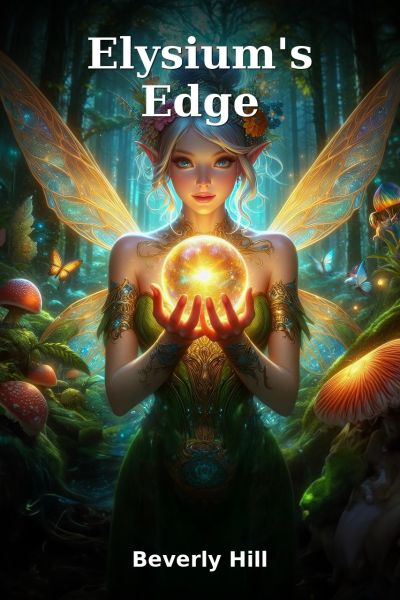
In a genre crowded with chosen ones and destiny-driven plots, Elysium's Edge distinguishes itself by making its hero's reluctance feel earned rather than perfunctory. Oriana Gray doesn't stumble into power — she has spent twenty years actively suppressing it, and the novel's opening chapters make the cost of that suppression visceral. The result is a fantasy adventure where the magical system serves the character arc, not the other way around.
What the Book Is About
Elysium's Edge is a 25-chapter fantasy novel set in a world where the Imperial Empire has outlawed magic, rewriting it as chaos and rebellion. The story follows Oriana Gray, an apothecary's apprentice in the city of Thalinn, whose dormant Elysian heritage ignites during an Imperial raid, forcing her flight into the forbidden Veilwood. There she joins a rebel cell — Kael, Thorne, Lyra, and Finn — and begins a journey that intertwines personal awakening with a realm-spanning conflict. The narrative alternates between the Outer Realm's gritty suppression and the mythical realm of Elysium, where magic remains pure. Structured as a progressive revelation — each chapter typically centers on a discovery, trial, or confrontation — the book targets readers who want high-stakes fantasy with a defined magic system, found-family dynamics, and a protagonist whose growth feels incremental rather than instantaneous.
A Magic System That Demands Balance, Not Just Power
The novel's most distinctive element is its dualistic magic: Aetheria (creation, healing, connection) and Umbralia (unraveling, dissolution, discernment). Rather than presenting them as opposing forces of good and evil, the text treats both as necessary components of harmony. Oriana's early outbursts — shattering vials with sleeping herbs in Chapter 1, collapsing guards with a "mind-clouding spell" she doesn't know the name for — are raw, uncontrolled surges. Her training with Kael in the Heartwood Sanctuary (Chapters 4–6) and later with the Stone Warden (Chapter 13) reframes these impulses: "Umbralia is not inherently evil, Oriana. It is the necessary counterpoint to Aetheria, just as shadow defines light" (Chapter 12). The climax of this theme arrives in Chapter 21, when Oriana uses "a surgical strike of unraveling, aimed directly at the Umbra's connection to his essence" to sever the Shadow Lord without destroying him. The system rewards precision over spectacle, and the novel consistently shows the toll of wielding either force without the other.
The Veilwood as Character, Not Just Setting
The forest that borders Thalinn is introduced as a place of legend and fear — "twisted beasts, predatory spirits, and forgotten dangers" (Chapter 2) — but quickly reveals itself as a sentient participant in the story. It reacts to Oriana's presence: luminous fungi shift color when she passes (Chapter 6), ancient trees guide her through hidden paths (Chapter 10), and its very ley lines become targets for Imperial corruption (Chapter 14). The Whispering Fens, the Sunken Spires, and the Whispering Mire each possess distinct magical ecologies, and the Empire's siphons cause measurable suffering the forest communicates through Oriana's growing empathy. When she cleanses the three siphon points in Chapter 23, the land's relief is described as "a deep, cleansing sigh" and "a joyous chorus of awakening." The Veilwood is not backdrop; it is a stakeholder with memory, agency, and a voice Oriana learns to hear.
From Invisibility to Agency: Oriana's Measured Transformation
The novel opens with Oriana's survival strategy: "The art of silence before she could speak" (Introduction). Her life in Thalinn is built on "careful neutrality, a fragile shield against the chaos outside" (Chapter 1). The first chapter's raid sequence — where panic triggers an instinctive magical explosion — shatters that neutrality, but the book refuses to make her instantly competent. Chapters 3–7 depict a frustrating, uneven learning curve: leaves she tries to lift either refuse to move or "shoot fifty feet into the air"; mending a twig produces "an unidentifiable lump." Kael's mentorship is grounded in analogy: "It's like trying to catch mist in a sieve" (Chapter 4). Her breakthroughs come through emotional integration, not technique alone — the golden light against Shadow Wisps (Chapter 6) emerges when she stops fighting fear and "focus[es] on the core of your power. Imagine it as a beacon." By Chapter 19's Test of Will, she confronts the Shadow Lord's whispers not with greater force but with "the warmth of her mother's locket" and "the collective strength of the Font of Souls." The arc earns its endpoint because every step is shown, not summarized.
Two Kinds of Tyranny: Empire and Shadow Lord as Mirror Threats
The novel constructs its conflict around parallel corruptions. The Empire represents control through suppression: "Magic meant chaos, rebellion, dissolution of order. And so it was hunted" (Introduction). Its Wardens wield "cold, analytical, devoid of the natural flow" magic (Chapter 3), using Seeker Rods that are "not just a detector. It's a siphon" (Chapter 3). The Shadow Lord, revealed through the Font of Whispers in Chapter 11, embodies corruption through excess: a betrayer who "attempted to merge the realms, to control both worlds," unleashing "chaotic magic" that fractured Elysium and allowed "the insidious darkness to seep in." The two threats converge in Chapter 14 when Imperial forces weaponize Vorlag's corrupted elemental magic, and in Chapter 18 when a high-ranking Warden channels the Chaos Seed's "twisted elemental power." Oriana's final choice in Chapter 24 — opening the flow of magic rather than protecting the barrier — is a direct rejection of both models: "The gradual path is too slow... The world needs true healing, a profound transformation." The symmetry gives the climax thematic weight beyond simple victory.
Found Family That Carries Narrative Weight
The rebel cell — Kael, Thorne, Lyra, Finn — could easily have been archetypes, but the novel invests in their individual histories and evolving dynamics. Thorne is a former Imperial soldier "disillusioned by the Empire's tyrannical rule" (Chapter 4). Lyra's village was burned for "harboring a suspected magic user" (Chapter 4). Finn, orphaned by an Imperial crackdown, channels trauma into scholarship: "The legends say the Elysian trials focus on the mastery of the elements... but also on wisdom" (Chapter 12). Their bond with Oriana develops through shared risk, not instant loyalty. When Oriana heals Imperial soldiers trapped by Nightshade Vines in Chapter 10, Thorne's skepticism — "Soothe killer plants? You've been spending too much time with Finn's books" — gives way to action: "Now! Before the curse reforms!" (Chapter 10). In Chapter 15, their reunion after Oriana's solo mission carries the weight of months of separation: Kael's embrace, Thorne's "rare, wide grin," Lyra's pride. The epilogue (Chapter 25) shows them dispersed into teaching roles across the healing Veilwood, their relationships permanently altered by what they survived together.
Who Should Read This
Readers who appreciate magic systems with internal logic and narrative consequences will find the Aetheria/Umbralia framework rewarding, especially as it shapes combat, healing, and moral choices. Those who prefer character-driven fantasy where the protagonist's growth is gradual and messy — marked by failures, ethical dilemmas, and emotional setbacks — will connect with Oriana's arc. The book assumes familiarity with genre conventions (hidden heritage, rebel cells, ancient prophecies) but subverts enough of them to feel fresh. Readers seeking pure escapism or romance-forward plots may find the pacing deliberate and the stakes existential rather than personal. The novel rewards attention: callbacks to early chapters (the sleeping herbs, the Seeker Rod, the silver locket) resolve in ways that feel earned. If you want a fantasy where balance is both a magical principle and a thematic argument, Elysium's Edge delivers it without sacrificing momentum.
Read “Elysium's Edge” on MixCache.com →
Please log in or create an account to leave a comment.
No comments yet. Be the first to say something.