
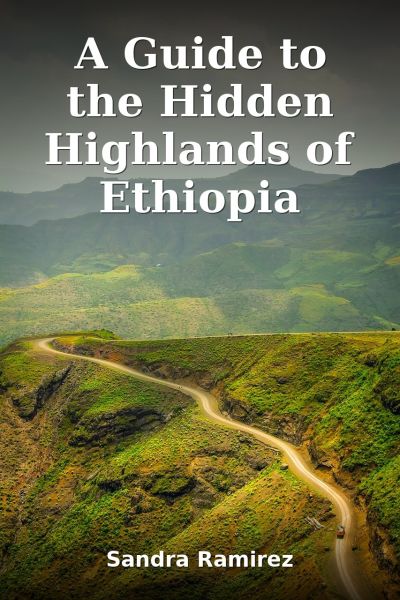
The Ethiopian Highlands — often called the "Roof of Africa" — are more than a dramatic backdrop; they are a living system where geology dictates agriculture, altitude shapes culture, and ancient traditions persist alongside modern pressures. Sandra Ramirez's guide moves fluidly across these connections, treating the highlands not as a tourist destination but as an integrated landscape of rock, people, faith, and food.
What the Book Is About
Organized into 25 chapters, the book progresses from the geological origins of the highlands (Chapter 1) through the distinct mountain ranges of the Simien and Bale Mountains (Chapters 2–3), the central plateau (Chapter 4), and the climate and biodiversity that define the region (Chapter 5). It then turns to the peoples — Amhara, Tigrayans, Oromo, Gurage, Dorze, and others (Chapters 6–10) — before tracing the arc of ancient civilizations from Aksum to Lalibela, Gondar, and the stelae fields of Tiya and Yeha (Chapters 11–15). The culinary core covers teff and injera, wot and tibs, coffee and tej, fasting foods, and how geography shapes every plate (Chapters 16–20). The final chapters address conservation in national parks, endemic wildlife, trekking and eco-tourism, modernization pressures, and contemporary guardians of heritage (Chapters 21–25). The intended reader is broad: armchair travelers, history enthusiasts, culinary explorers, and trekkers planning a visit will all find relevant detail, but the book rewards anyone interested in how environment and culture co-evolve.
Geology as Destiny: The Highlands' Deep Structure
The book opens with a geological narrative that reads like epic poetry: "Imagine the Earth's crust, not as a static, immovable shield, but as a restless, churning canvas." Chapter 1 traces the uplift of the Arabian-Nubian Shield 75 million years ago, the flood basalts that covered an area "roughly equivalent to the size of France," and the Great Rift Valley's bifurcation of the highlands into northwestern and southeastern plateaus. This deep time explains the present: the basalt bedrock yields fertile soils for teff; the escarpments create microclimates for coffee; the Afroalpine zones above 3,000 meters harbor endemic species like the giant lobelia and Ethiopian wolf. Ramirez makes clear that you cannot understand highland agriculture, settlement patterns, or biodiversity without this geological framework.
A Mosaic of Peoples, Not a Monolith
Chapters 6 through 10 dismantle any notion of a single "highland culture." The Amhara, with their round thatched homes and Orthodox Christianity centered on the church calendar, contrast with the Tigrayans' square stone houses and cliffside monasteries. The Oromo, the Horn's largest ethnic group, bring the Gadaa system — "an ancient, elaborate, and uniquely democratic socio-political institution" that rotates leadership every eight years — and the Irreecha thanksgiving festival. Further south, the Gurage build their lives around ensete ("false banana"), using its fibers "to tie off an umbilical cord after birth, and a corpse may be wrapped in its fronds after death." The Dorze weave elephant-shaped huts that can be lifted and moved as termites eat the base. Ramirez lets each community speak through its architecture, food, language, and ritual, showing how altitude and isolation fostered distinct adaptations rather than a uniform highland identity.
Stone Testaments: Aksum, Lalibela, and the Cliffside Monasteries
The historical chapters reveal a continuum of sacred architecture carved from the highlands' own rock. Aksum's stelae — "colossal stone towers, carved from single blocks of granite" — mimic multi-story palaces, the largest weighing "over 170 tons" (Chapter 11). Lalibela's eleven monolithic churches were excavated top-down: "the last element sculpted was at the bottom, a reversal of conventional construction" (Chapter 12). In Tigray, over 120 rock-hewn churches cling to cliffs; Abuna Yemata Guh requires a climb across a "natural stone bridge with a sheer drop of approximately 250 meters on either side" to reach 15th-century murals preserved by "the church's remote and low-humidity location" (Chapter 13). Gondar's 17th-century castles blend Ethiopian, Hindu, Arab, and Baroque styles within a 900-meter fortified wall (Chapter 14). These are not ruins but active sites of pilgrimage and worship, linking the Aksumite conversion to Christianity in the 4th century to today's Timkat celebrations.
Cuisine as Conversation with the Land
Chapters 16–20 present food as a direct dialogue with geography. Teff, domesticated 6,000–3,000 years ago, thrives at 1,700–2,800 meters and yields injera, the "spongy, sourdough flatbread" that serves as "both the serving platter and the utensil" (Chapter 16). The stews — wot — begin with onions "slow-cooked in a dry pan without any fat or oil until much of their moisture has evaporated," then enriched with niter kibbeh, a spiced clarified butter infused with "cardamom, cinnamon, cloves, coriander, turmeric, ginger, garlic, and fenugreek" (Chapter 17). Kitfo, minced raw beef from the Gurage, is seasoned with mitmita and niter kibbeh, the spices also serving as "an antimicrobial agent" (Chapter 17). The coffee ceremony (Chapter 18) and honey wine tej (Chapter 18) structure social time, while the Orthodox fasting calendar — 180 to 252 days a year — drove the invention of a vast vegan repertoire: shiro wot, ater kik, oilseed sauces from niger, flax, and safflower (Chapter 19). Chapter 20 ties it together: terracing in Konso, rain-fed planting cycles, and the use of crop residues for livestock feed all reflect "a cuisine born of necessity, refined by tradition."
Conservation on a Human Landscape
The final chapters refuse to separate nature from people. Simien Mountains National Park, once on UNESCO's "List of World Heritage in Danger," stabilized its Walia ibex, Ethiopian wolf, and Gelada populations through "cash-for-work programs, which involve locals in trail restoration and campsite clean-ups" (Chapter 21). Bale Mountains, designated a World Heritage Site in 2023, supports 10–12 million people downstream while hosting over half the world's Ethiopian wolves and the endemic Mountain Nyala (Chapter 21). The Guassa Community Conservation Area has managed Afroalpine grassland sustainably for "over 400 years through an indigenous institution known as 'Qero'" (Chapter 21). Church forests — "islands of biodiversity in largely deforested landscapes" — survive because monks view them as "sacred gifts from God" (Chapter 25). The Green Legacy Initiative aims to plant 50 billion trees by 2026, now backed by parliamentary law (Chapter 24). Ramirez presents conservation not as fencing off wilderness but as negotiating livelihoods on a densely populated roof.
Who Should Read This
Readers who want a single volume that connects tectonic plates to teff fermentation, from Aksumite coinage to modern wolf vaccination campaigns, will find this guide indispensable. Trekkers will appreciate the practical detail on Simien and Bale routes, seasons, and community-based tourism. History buffs get a clear archaeological narrative without academic jargon. Food lovers receive recipes embedded in cultural context. Those seeking only a lightweight travelogue or a coffee-table photo book should look elsewhere — this is a dense, interdisciplinary work that demands attention but rewards it with a systems-level understanding of one of Africa's most distinctive regions.
Read “A Guide to the Hidden Highlands of Ethiopia” on MixCache.com →
Please log in or create an account to leave a comment.
No comments yet. Be the first to say something.