
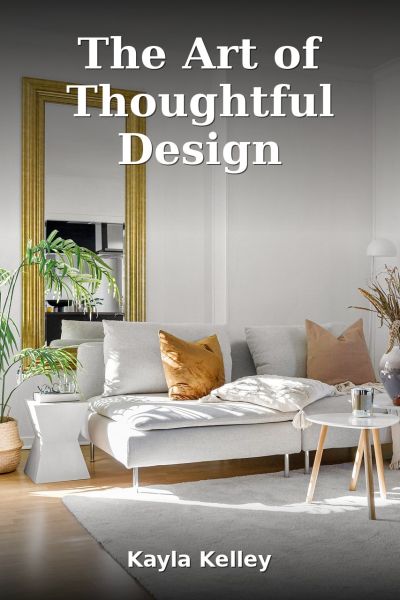
Most design books teach you how to make a room look good. Kayla Kelley's The Art of Thoughtful Design asks a different question: how can a room make you feel good? Drawing on environmental psychology, neuroscience, and decades of design principles, the book argues that our homes are not passive backdrops but active participants in our well-being—shaping stress levels, sleep quality, productivity, and even our sense of belonging.
What the Book Is About
Structured across 25 chapters, the book moves systematically from foundational principles (balance, contrast, rhythm, scale) through the psychological mechanics of color and light, into furniture selection and layout, and finally into the deeply personal work of curating art, accessories, plants, and sensory details. It covers seven distinct design styles—minimalist, modern, contemporary, eclectic, bohemian, classic, and timeless—with practical guidance for each. The intended reader is anyone looking to move beyond trend-chasing: homeowners, renters, design students, or professionals who want a framework for making intentional, health-supporting choices in any space, regardless of budget or square footage.
Design as a Health Intervention
The opening chapter reframes design as a public-health tool. Kelley introduces concepts like biophilic design ("an approach that seeks to integrate elements of nature into indoor spaces"), sensory design ("a holistic approach by engaging all our senses"), cognitive ergonomics ("designing spaces that are intuitive, efficient, and reduce mental workload"), and universal design ("creating environments accessible and usable by people of all abilities"). These aren't presented as abstract ideals; each is tied to research on stress reduction, circadian regulation, and cognitive function. The argument is clear: a well-designed kitchen isn't just pretty—it lowers the barrier to cooking nutritious meals; a bedroom with proper light exposure isn't just serene—it regulates sleep architecture.
Core Principles as Decision-Making Tools
Chapters 2 through 5 treat balance, contrast, rhythm, and scale not as aesthetic rules but as practical frameworks for evaluating any room. On balance, Kelley breaks down visual weight into six factors—size, color, texture, form, placement, and material—giving readers a vocabulary to diagnose why a room feels "off." The chapter on contrast and emphasis shows how to create focal points "through contrast" rather than clutter, while the rhythm chapter introduces progression ("a gradual change in size, color, or intensity") and alternation as ways to guide the eye without monotony. Scale and proportion get perhaps the most actionable treatment: a Golden Ratio sidebar from architect Dr. Elias Vance suggests that "a 2:3 ratio of height to width for individual compartments often feels more balanced than a perfect square," and the chapter includes a low-tech trick—masking tape on the floor—to test furniture footprints before buying.
Color and Light as Biological Signals
Four chapters (6–10) treat color and light as physiological levers. Chapter 6 maps hue families to nervous-system responses: red "can stimulate conversation and appetite," blue "can lower heart rate and blood pressure," green "promoting feelings of tranquility, balance, and health." Chapter 7 translates theory into the 60-30-10 rule and warns about undertones: "If you pair a warm gray with a cool white, they can clash rather than complement." Chapters 8 and 9 build a three-layer lighting system—ambient, task, accent—and insist on dimmers as "non-negotiable for creating flexible ambiances." A neuroscientist, Dr. Evelyn Reed, ties it to biology: "Our biology is hardwired for bright, blue-rich light during the day to promote alertness, and warm, dim light in the evening to prepare for sleep." Chapter 10 then grounds palette choices in architectural context—north-facing rooms need warmer paint; south-facing rooms can handle cooler tones—so color works with the building, not against it.
Personalization Through Curation, Not Accumulation
Chapters 16 and 19 make the case that a home becomes a sanctuary only when it reflects a specific life. Kelley distinguishes decorating (filling surfaces) from curating ("selecting items that bring joy, spark conversation, or simply make a space feel distinctly yours"). The vignette framework—"hero object," varying heights, texture contrast, rule of odds, negative space—gives a repeatable method for arranging meaningful objects without clutter. Cultural anthropologist Dr. Anya Sharma underscores the stakes: "The most powerful stories told through objects are authentic… Don't be afraid for your home to look lived-in and loved, because those are the most powerful stories of all." The chapter on plants (18) extends this logic: greenery isn't decoration but "a biological imperative" that "reduces our cortisol levels, improves our ability to focus, and even accelerates recovery from stress."
Sensory Integration as the Final Layer
Chapter 20 synthesizes everything into a multi-sensory audit. It moves beyond visuals to address sound ("textiles are excellent sound absorbers"), smell ("our sense of smell bypasses the logical brain and goes straight to the limbic system"), touch ("the feeling of the floor beneath our feet profoundly impacts comfort"), and thermal comfort. A bedroom case study shows how warm dimmable light, a white-noise machine, lavender diffusion, high-thread-count sheets, and a cashmere throw align to a single goal: "peace and rest." The chapter ends with a nine-step "Sensory Audit" checklist that turns the whole book into a field guide: walk each room, note what you see, hear, smell, and feel, then adjust one layer at a time.
Who Should Read This
This book rewards readers who want a cohesive, science-informed framework for making design decisions—not a lookbook of finished rooms. It's ideal for someone renovating or moving who needs to understand why certain choices feel right, for design students seeking a consolidated reference on principles and psychology, and for anyone who suspects their space is subtly undermining their focus, sleep, or mood. Readers looking for quick style hacks, strict shopping lists, or a single aesthetic manifesto will find the breadth overwhelming. But for those willing to treat their home as a system they can tune, The Art of Thoughtful Design offers a rare combination: rigorous enough to cite neuroscience, practical enough to suggest masking tape on the floor, and personal enough to insist that the best-designed room is the one that tells your story.
Read “The Art of Thoughtful Design” on MixCache.com →
Please log in or create an account to leave a comment.
No comments yet. Be the first to say something.