
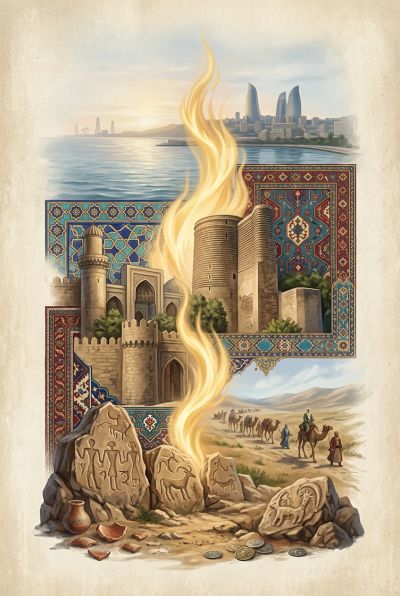
Nestled between the Caspian Sea and the Caucasus Mountains, Azerbaijan has long been a place where continents collide and cultures fuse. Dr. Alex Bugeja's sweeping narrative captures this dynamism across twenty-five chapters, showing how a land known since antiquity as "The Land of Fire" forged a distinct identity despite — or perhaps because of — its position as both a bridge and a battleground for empires.
What the book is about
The book moves chronologically from the Lower Paleolithic settlements of Azykh Cave through the ancient kingdoms of Caucasian Albania and Atropatene, the Arab conquest and Islamization, the Turkic migrations under the Seljuqs, the cultural flourishing under the Atabegs, the Mongol Ilkhanate, the Turkoman confederations of the Kara and Ak Koyunlu, the rise of the Safavid Empire, Russian conquest and the division of Azerbaijani lands along the Araxes River, the Baku oil boom, the brief Azerbaijan Democratic Republic (1918–1920), seven decades of Soviet rule, the Nagorno-Karabakh conflict, the post-Soviet transition, the Heydar Aliyev era, the 2020 war, and contemporary challenges. Written for general readers and students of Caucasian history, it assumes no prior knowledge but rewards it, balancing political narrative with social, economic, and cultural developments. Each chapter focuses on a distinct era, making the volume usable as both a continuous history and a reference work.
Geography as destiny: the crossroads that became a crucible
The book's central argument emerges early: Azerbaijan's location "has destined it to be a bridge between civilizations for millennia" while simultaneously making it "a coveted prize for a succession of empires." This tension structures the entire narrative. The Introduction notes that the very name Azerbaijan — "The Land of Fire" — reflects both the natural gas flames that inspired Zoroastrian worship and "the spirit of a nation that has been forged in the crucible of conflict." Chapter 1 shows this dynamic in the dual formation of Caucasian Albania north of the Araxes and Atropatene to the south, two distinct political traditions that would be repeatedly unified and divided by outside powers. The pattern repeats with the Achaemenids, Sasanians, Arabs, Seljuqs, Mongols, Safavids, Ottomans, Russians, and Soviets, each leaving administrative, religious, or demographic traces. Bugeja makes clear that this is not passive victimhood; the region's peoples actively negotiated, resisted, and adapted, creating a layered identity that the book traces through language, religion, and political culture.
The slow, deep process of Turkification
One of the book's most valuable contributions is its patient explanation of how Azerbaijan became linguistically and culturally Turkic without erasing its Iranian and Caucasian substrata. Chapter 5 details the Seljuq arrival not as a sudden replacement but as waves of Oghuz migration that "fundamentally changing the ethnic composition of the region" over centuries. The iqta system settled Turkic military elites on the land, while pastoral nomads filled the lowlands. Crucially, Bugeja emphasizes fusion: "The process was one of fusion rather than simple replacement. The incoming Turkic nomads brought their own rich traditions... They intermarried with the existing population of Iranians, Caucasian Albanians, and Arabs, creating a new ethno-cultural synthesis." By the Atabeg period (Chapter 6), Azerbaijani Turkish was the language of court and army while Persian remained the language of high culture — a bilingualism that produced poets like Nizami Ganjavi and Khaqani Shirvani. The Safavid chapter (9) shows this synthesis at the imperial level: the dynasty's Qizilbash base was Turkoman, its state religion Twelver Shi'a Islam (distinguishing it from Sunni neighbors), and its administrative language Persian. This layered identity, the book argues, is what allowed Azerbaijani nationalism to emerge in the 19th and 20th centuries as a distinct project, neither purely Persianate nor purely Ottoman.
Oil, modernity, and the birth of a national bourgeoisie
Chapter 13 stands out as a self-contained study of how resource extraction can reshape a society in a single generation. The 1872 abolition of the state monopoly triggered a "black gold rush" that turned Baku from a provincial port into the world's leading oil producer by 1900. Bugeja contrasts the foreign capital — Nobel Brothers, Rothschilds — with the emergence of a local industrial class, profiling figures like Haji Zeynalabdin Taghiyev, a former stonemason whose gusher made him a philanthropist who founded "the first secular, all-girls boarding school in the entire Muslim world." The chapter does not romanticize: alongside the "Paris of the Caspian" with its Secessionist palaces lay "Black City," where "the ground was permanently saturated with oil" and workers — many from Iran — endured twelve-hour shifts in toxic conditions. This duality fueled both a vibrant intellectual ferment (the first Azerbaijani-language press, theaters, schools) and explosive labor politics, culminating in the 1904 general strike and the 1905 Armenian-Azerbaijani pogroms. The oil boom, Bugeja suggests, created the material and social preconditions for the 1918 independence movement while embedding structural inequalities that would persist through the Soviet and post-Soviet eras.
The democratic experiment that was strangled in its cradle
The Azerbaijan Democratic Republic (Chapter 14) receives careful attention as "the first secular parliamentary republic in the Muslim world." Lasting only twenty-three months, the ADR nonetheless established universal suffrage — including women's voting rights before the United States or Britain — a multi-ethnic parliament with reserved minority seats, a national army, a university, and a currency. Bugeja traces its doomed trajectory: born amid the chaos of World War I and the Russian Civil War, dependent on Ottoman military support that became a liability after the Armistice, then forced to navigate British occupation and Bolshevik pressure. The March Days massacre of 1918 and the September retaliation created a cycle of communal violence that poisoned relations with Armenians. When the Red Army arrived in April 1920, the ADR parliament voted to surrender under conditions the Bolsheviks immediately violated. The episode, Bugeja implies, left a template: a democratic aspiration repeatedly crushed by geopolitical forces, a memory that would resurface in the Popular Front movement of 1988–1990 and again in the post-1991 transition.
From Soviet industrialization to the "Contract of the Century"
The Soviet chapters (16–18) are notable for integrating the republic's experience into the wider USSR story without losing sight of Azerbaijani particularities. Baku's oil "fueled the Allied victory in World War II" — four out of five Soviet tanks and planes ran on Azerbaijani fuel — while the republic lost over 300,000 lives. The post-war period brought the rise of Heydar Aliyev from KGB chief to First Secretary (1969–1982), whose anti-corruption campaigns and lobbying for investment brought real development but also entrenched a patronage system. The transition to independence (Chapters 21–23) is framed around the "Contract of the Century" (1994), the production-sharing agreement that brought Western capital into the Caspian and, in Bugeja's assessment, functioned as "Azerbaijan's primary security guarantee, a powerful shield against potential pressure from its larger neighbors, Russia and Iran." The pipeline politics that followed — Baku-Tbilisi-Ceyhan versus Russian and Iranian routes — are presented as a deliberate geopolitical choice to orient the country westward. The 2020 war (Chapter 24) and the 2023 dissolution of the Nagorno-Karabakh Armenian administration (Chapter 25) are treated as the military and diplomatic culmination of this strategy, achieved through drone warfare, Turkish alliance, and energy leverage.
Who should read this
Readers seeking a single-volume political history of Azerbaijan from prehistory to the present will find this book thorough and well-structured. It is particularly strong on the pre-Soviet periods — the ancient states, the Islamic and Turkic transitions, the Safavid and khanate eras — which are often compressed in broader Caucasian histories. The Soviet and post-Soviet sections are detailed but assume familiarity with general Soviet history; readers new to that context may want a companion volume. The book's even-handed treatment of contested events — the 1918 massacres, the Soviet border decisions on Karabakh, the 1990s war, the 2020 offensive — makes it a reliable reference, though those looking for deep social history, gender analysis, or cultural studies will need to supplement it. For policymakers, journalists, or travelers wanting to understand the historical depth behind today's headlines, it is an excellent starting point.
Read “A History of Azerbaijan” on MixCache.com →
Please log in or create an account to leave a comment.
No comments yet. Be the first to say something.