
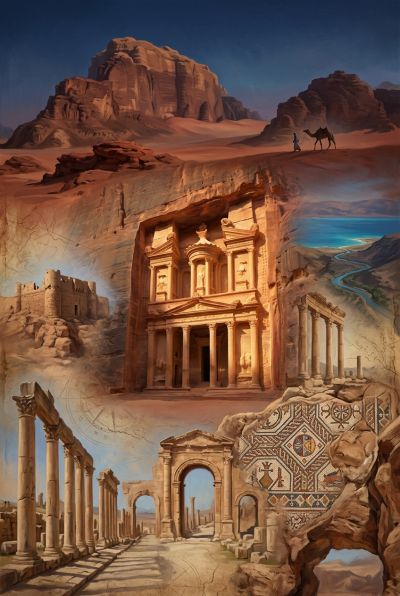
Few nations embody the weight of history as visibly as Jordan. Its landscape holds the rose-red facades of Petra, the colonnaded streets of Roman Jerash, Crusader castles perched on windy ridges, and the crowded refugee camps that have shaped its modern demography. Noor Al-Hassan's A History of Jordan does not merely catalog these layers; it argues that the kingdom's defining trait is its capacity to absorb shocks — invasion, displacement, resource collapse — and reconfigure itself without breaking.
What the Book Is About
The book spans 25 chapters, moving chronologically from the Paleolithic stone-tool makers of the Azraq Basin to the 21st-century challenges of King Abdullah II's reign. Al-Hassan structures the narrative around successive political formations: Iron Age kingdoms (Ammon, Moab, Edom), the Nabataean trade empire, Roman Provincia Arabia, Byzantine Christianity, the Rashidun and Umayyad caliphates, Crusader lordships, Ayyubid and Mamluk rule, four centuries of Ottoman administration, the British Mandate, and the Hashemite kingdom from Abdullah I through Hussein to Abdullah II. Each chapter blends archaeological evidence, primary sources (the Mesha Stele, the Madaba Map, the Petra papyri), and diplomatic records. The intended reader is someone who wants a single-volume political and social history that does not flinch from the complexities of Jordan's Palestinian majority, its tribal foundations, or its uneasy peace with Israel. The prose is dense but accessible, assuming no prior expertise while rewarding readers who know the region.
Geography as a Repeating Script
Al-Hassan returns repeatedly to the idea that Jordan's physical setting — the Rift Valley, the King's Highway, the desert steppe — imposes constraints and opportunities that persist across millennia. The Nabataeans "mastered the desert" by carving "intricate systems of channels, dams, and cisterns directly into the rock," turning Petra into a hydraulic marvel. The Romans built the Via Traiana Nova along the same north-south spine. The Ottoman Darb al-Hajj and the Hejaz Railway followed it again. Even the 1948 armistice Green Line and the 1994 peace treaty's border demarcation echo this ancient corridor. The book shows how each regime, whether Nabataean, Roman, or Hashemite, had to solve the same logistical puzzle: moving water, people, and goods across an arid plateau. This geographic determinism is not presented as fatalism; rather, it frames Jordan's history as a series of improvisations on a fixed theme.
The Palestinian-Jordanian Identity as a Structural Condition
One of the book's most sustained arguments concerns the demographic transformation triggered by the 1948 and 1967 wars. Al-Hassan writes that "Transjordan, a nation of some 450,000 people, mostly of Bedouin and rural stock, suddenly found itself with a new population that was larger, more urbanized, more educated, and deeply traumatized and politicized by its recent dispossession." The 1954 Nationality Law granted citizenship to West Bank residents and 1948 refugees — "a policy of inclusion unique in the Arab world" — creating what the author calls a "unique dual identity." Chapter 17 traces how this duality shaped everything from the 1970 Black September conflict ("a state within a state") to King Hussein's 1988 disengagement from the West Bank, which "formally relinquishing responsibility for the West Bank" and turned Jordanian citizens there into stateless persons. The tension between "East Bankers" and Palestinians remains, in Al-Hassan's telling, the "deep, often unspoken, current running beneath the surface of Jordanian politics."
Hashemite Survival as Pragmatic Statecraft
The monarchy's longevity is a central thread. Al-Hassan portrays the Hashemites not as passive beneficiaries of British patronage but as active negotiators who leveraged their religious legitimacy (descent from the Prophet, custodianship of Jerusalem's holy sites) and their army (the Arab Legion, later the Jordanian Armed Forces) to extract concessions. Abdullah I's 1921 meeting with Churchill — "a meeting of two shrewd political operators" — set the pattern: the Emir accepted a British subsidy and advisors in exchange for abandoning his Syrian ambitions. Hussein's 1956 Arabization of the army (dismissing Glubb Pasha) and his 1970 crushing of the PLO were both "bold and decisive assertion[s] of sovereignty" that also deepened Western reliance on Jordan. The 1994 peace treaty, negotiated after Jordan's isolation during the Gulf War, is framed as "a peace of calculated interests rather than soaring emotions," securing water rights, debt relief, and U.S. aid while earning domestic opprobrium. Abdullah II's "Jordan First" campaign and economic liberalization continue this tradition: "chart its own course based on its own needs."
Water, Oil, and the Economics of Survival
Resource scarcity is not a backdrop but a driver of policy. The book details how the Nabataeans' water engineering enabled Petra's wealth, how the Mamluks' sugar industry in the Jordan Valley collapsed after the Black Death, and how the 1970s Gulf oil boom turned Jordan into a labor exporter — "remittances far outstripped domestic exports and rivaled foreign aid as the main source of hard currency." The 1988-89 debt crisis (foreign debt "spiraled to over $8 billion"), the 1991 Gulf War expulsion of 300,000 Jordanian workers, and the 2003 Iraq war's "Iraq boom" (Amman as "rear base") all illustrate an economy hostage to external shocks. Today, Al-Hassan notes, the Aqaba-Amman desalination project and solar farms are "mega-projects [that] are hugely expensive for a state already burdened by massive public debt." The water crisis is called "an existential threat" — per capita availability is "among the lowest levels on the planet."
Refuge as a Permanent Condition
From the Circassians and Chechens settled by the Ottomans in the 1870s to the 1.3 million Syrians estimated in 2014, Jordan has repeatedly absorbed displaced populations. The book treats this not as a series of discrete crises but as a structural feature. The 1948 Nakba brought 400,000-500,000 Palestinians; 1967 added 300,000 more; 1991 brought Kuwait returnees; 2003 brought Iraqi professionals; 2011 onward brought Syrians. Each wave altered the labor market, housing, and sectarian balance. The Zaatari camp became "the fourth-largest 'city' in Jordan." Al-Hassan argues that the international community's shift from emergency aid to "protracted situation of care and maintenance" has left Jordan shouldering costs "that would have broken many wealthier and more stable nations." The Jordan Compact's attempt to convert refugee presence into economic opportunity (work permits, EU market access) is noted as a rare innovation, but the underlying strain persists.
Who Should Read This
This book is for readers who want a rigorous, single-volume political history of Jordan that integrates archaeology, diplomatic history, and social analysis without oversimplifying the Palestinian-Jordanian relationship or the monarchy's authoritarian resilience. It will reward students of Middle Eastern history, development economics, or refugee studies. Readers looking for a cultural history of everyday life, a biography of any single monarch, or a polemical take on the Israeli-Palestinian conflict will find those only tangentially addressed. The density of names, treaties, and tribal confederations demands attention, but the payoff is a framework for understanding why a resource-poor, landlocked state surrounded by wars has not only survived but often set the terms of regional diplomacy.
Read “A History of Jordan” on MixCache.com →
Please log in or create an account to leave a comment.
No comments yet. Be the first to say something.