
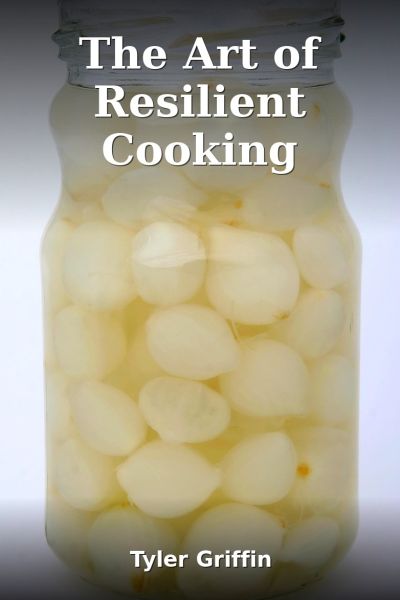
Empty shelves, rising prices, and shifting dietary needs have turned everyday cooking into an improvisational act. The Art of Resilient Cooking meets that moment not with panic but with a philosophy: limitations are "sparks for new ideas, delicious improvisations, and meaningful connection." Tyler Griffin builds a 25-chapter framework that treats resilience as a daily practice rather than an emergency checklist.
What the book is about
The book moves chronologically from historical foundations to lifelong habits. Early chapters trace resilient cooking from early human foraging through wartime rationing and global peasant cuisines, establishing that "adaptability wasn't a choice; it was the key to sustenance." Middle sections lay out modern principles—nose-to-tail and root-to-stem utilization, intelligent substitution, seasonal eating, preservation, and pantry management—before diving into specific techniques: global cooking methods, energy-saving appliances, one-pot meals, and cooking without recipes. Later chapters apply these ideas to reimagined family favorites, budget dishes, crowd-pleasers, and emergency planning. The intended reader is anyone who wants to "move beyond rigid recipes" and develop "a flexible mindset that embraces ingredient substitution, seasonal eating, and intelligent resource management," whether they're a novice building foundational skills or a seasoned cook honing adaptability.
History as a resilient cookbook
Griffin opens by grounding modern anxiety in deep time. Chapter 1 argues that "the story of cooking is inextricably linked with resilience," citing Indigenous food systems that "utilize every part of an animal or plant, honor the cycles of nature, and pass down knowledge through generations" and Mediterranean eating patterns that "thrived on local abundance and simple, yet deeply flavorful, preparations." Wartime rationing recipes become case studies in substitution: "using breadcrumbs to bulk up meatloaves or substituting root vegetables for more expensive produce." This historical lens reframes current supply-chain hiccups as the latest chapter in a long human story, offering both perspective and proven tactics.
Substitution as a creative discipline
Rather than treating swaps as compromises, Chapter 6 positions ingredient substitution as "a culinary superpower" rooted in understanding ingredient function. The text breaks down roles—structure, moisture, leavening, flavor, binding—then maps alternatives: flax eggs for binding, cashew cream for richness, lime juice or vinegar for lemon's acidity. A key passage captures the mindset: "This isn't about rigid adherence to a recipe but rather about understanding the fundamental balance of flavors and textures, empowering you to adapt with flair." The chapter includes practical ratio guides (one-third dried herbs for fresh, 1/8 teaspoon garlic powder per clove) that turn guesswork into a repeatable skill.
Preservation as season-extending alchemy
Chapter 8 treats preservation not as a chore but as "capturing peak flavor, extending the seasons, and ensuring a steady supply of nutritious ingredients." It surveys fermentation ("a living process where beneficial microorganisms transform food"), freezing (with blanching tips), water-bath and pressure canning, dehydration, curing, and quick pickling. The author emphasizes interconnectedness: "A bumper crop of tomatoes in summer can be partially canned into sauce, some frozen for future soups, and a portion dehydrated into sun-dried tomatoes." Safety is addressed through tested recipes and extension-service resources, making the techniques accessible rather than intimidating.
Community infrastructure as kitchen backup
Chapter 4 expands resilience beyond the household. It profiles community gardens as "powerful social hubs," food co-ops that "cut out intermediaries" for affordability and stability, food banks that "creatively utilize surplus food," and seed-saving libraries that "ensure a diverse array of heirloom and open-pollinated seeds remain available." The argument is structural: "Building robust local food systems is a macro-level expression of resilient cooking's social dimension." Direct-to-consumer models like CSAs and farmers' markets shorten supply chains, while regional food hubs "streamline distribution and logistics for multiple small farms." These networks turn individual pantries into nodes of a larger, more shock-resistant system.
Intuition over instruction
Chapter 14 makes the case that "true culinary resilience blossoms when the recipe becomes an optional suggestion." It outlines a progression: observe the "why" behind recipe steps, internalize flavor balances (sweet, sour, salty, bitter, umami), master core methods (sauté, roast, braise, simmer, bake), and build a mental library of ingredient pairings. The author encourages treating the kitchen as a "culinary laboratory where 'mistakes' are simply learning opportunities" and suggests starting small—improvising a side dish or vinaigrette—before scaling up. The payoff is a cook who can "tailor every dish precisely to your taste" and respond to any ingredient mix with confidence.
Who should read this
Home cooks who feel paralyzed when a recipe ingredient is missing, budget-conscious households wanting to stretch staples without boredom, gardeners and CSA members facing seasonal gluts, and anyone interested in reducing kitchen waste will find immediate, usable material. Readers looking for a traditional recipe collection—glossy photos, precise measurements, step-by-step photos—should look elsewhere; this is a methodology book, not a coffee-table cookbook. For the cook ready to trade rigid instructions for a resilient mindset, Griffin delivers a thorough, encouraging, and deeply practical roadmap.
Read “The Art of Resilient Cooking” on MixCache.com →
Please log in or create an account to leave a comment.
No comments yet. Be the first to say something.