
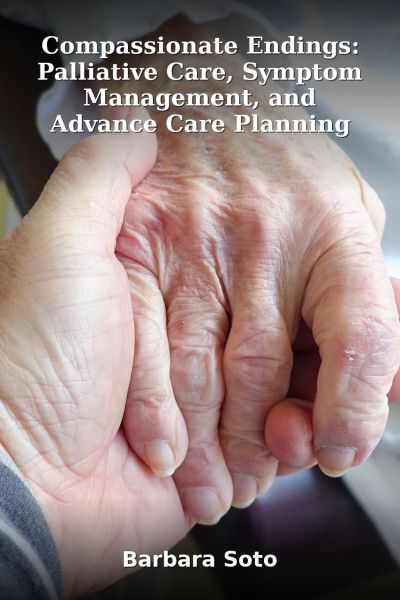
Serious illness reshapes every dimension of a person's life, yet the medical system often treats it as a narrow biological problem. Barbara Soto's Compassionate Endings argues that palliative care is not a last resort but a philosophy of whole-person support that belongs at the bedside from day one. The book makes this case with clinical precision and moral clarity, showing how symptom control, communication, and advance planning intertwine to protect dignity.
What the Book Covers
Organized across 25 chapters, Compassionate Endings moves from foundational principles to specialized applications. Early chapters define palliative care's scope—"appropriate at any age and at any stage of a serious illness, and it can be provided alongside curative treatment"—and introduce holistic assessment across physical, emotional, social, and spiritual domains. Middle chapters provide granular guidance on symptom management: pain, nausea, dyspnea, fatigue, constipation, delirium, and psychological distress each receive dedicated chapters with pharmacologic and non-pharmacologic strategies, assessment tools (ESAS-r, PQRST, CAM), and case examples. Communication gets two full chapters covering the SPIKES protocol, shared decision-making, and goals-of-care conversations. Advance care planning spans three chapters on values exploration, legal instruments (living wills, DPOAHC, POLST), and documentation. Later sections address the interdisciplinary team, pediatric and geriatric considerations, cultural humility, ethical frameworks, family conflict mediation, care integration across settings, systemic barriers, and future innovations. The intended audience is broad: clinicians seeking a reference text, families navigating decisions, and anyone committed to improving serious-illness care.
The Philosophy Shift: Integrated, Not Terminal
Soto's opening argument reframes palliative care's identity. The etymology of "palliative" from the Latin pallium—"to cloak" or "to cover"—signals an approach focused on alleviating suffering rather than exclusively pursuing cure. Chapter One dismantles the "old paradigm where palliative care was only considered when all other treatments had failed," illustrating with a chemotherapy patient whose debilitating nausea and fatigue are managed concurrently with curative treatment. This integrated model appears throughout: a patient with advanced heart failure receives opioid titration for dyspnea while continuing disease-modifying therapy; a woman with ovarian cancer accesses outpatient palliative care alongside oncology visits for months before transitioning to home hospice. The book insists that early integration improves both quality of life and, in some populations, survival—a claim supported by references to oncology literature. This repositioning matters because it changes when and how clinicians introduce palliative care, moving it from a handoff at the end to a parallel track from diagnosis.
Symptom Management as Meticulous Practice
Chapters Three through Eleven demonstrate that effective relief requires more than good intentions—it demands systematic assessment and tailored prescribing. Chapter Three establishes that "the process of symptom assessment is far more than just ticking boxes on a form; it's an ongoing dialogue, a continuous act of listening, observing, and interpreting," introducing tools like the Edmonton Symptom Assessment System (ESAS-r) and the PQRST mnemonic adapted beyond pain. Each symptom chapter then applies this rigor. Chapter Four on pain management walks through the WHO ladder with nuance: adjuvant selection for neuropathic versus nociceptive pain, opioid rotation strategies, and proactive bowel regimens initiated "simultaneously with the first dose of an opioid." Chapter Six on dyspnea reveals that opioids reduce air hunger "even in the absence of pain" and that fan therapy—"directing a stream of cool air towards the patient's face"—stimulates trigeminal nerve receptors to reduce breathlessness perception. Chapter Ten on delirium distinguishes hyperactive, hypoactive, and mixed subtypes, emphasizing that hypoactive delirium is "often missed or misdiagnosed as depression, fatigue, or simply 'being sleepy'" and carries a worse prognosis. These chapters collectively model a clinical mindset: assess thoroughly, match mechanism to medication, anticipate side effects, and reassess relentlessly.
Communication Frameworks for the Hardest Conversations
Soto treats communication as a clinical skill on par with prescribing. Chapter Twelve declares that "communication is the very breath of palliative care" and provides the SPIKES protocol (Setting, Perception, Invitation, Knowledge, Empathy, Strategy/Summary) with scripts for delivering serious news. The chapter emphasizes "warning shots" before difficult information—"I'm afraid I have some concerning news"—and probabilistic language over false precision: "likely months rather than years." Chapter Fourteen extends this to goals-of-care conversations, structuring them around "What are your most important goals right now?" and "What does a 'good day' look like for you these days?" A case study of Mr. Rossi, an 88-year-old on dialysis, shows how the physician links each option to the patient's stated goal of being home eating his wife's pasta, resulting in a plan that "aligned his medical care with his deeply personal wishes." Chapter Thirteen grounds advance care planning in values exploration before documentation: "What abilities are so important to your quality of life that you would not want to live without them?" The book insists these conversations are iterative, not one-time events, and that the designated healthcare proxy is "arguably the most important advance directive" because it provides flexibility for unforeseen scenarios.
The Interdisciplinary Team as Care Engine
Chapter Sixteen and Seventeen illustrate why no single clinician can deliver palliative care alone. The interdisciplinary team—physician, nurse, social worker, chaplain, pharmacist, dietitian, physical and occupational therapists—functions through "regular team meetings" where "seemingly disparate pieces of information are integrated, revealing connections (e.g., anxiety from financial stress exacerbating fatigue) and leading to a comprehensive, coordinated plan of care." The Mrs. Kim case study demonstrates this synthesis: the pharmacist catches a drug interaction the physician missed; the social worker addresses the daughter's financial strain that was worsening the patient's anxiety; the physical therapist designs chair exercises that combat fatigue while respecting frailty. Chapter Seventeen deepens the roles of social workers and spiritual care providers, showing how the social worker secures guardianship and survivor benefits for a single mother's children while the chaplain facilitates Anointing of the Sick and helps the patient "find peace amidst pain." Their collaboration is explicit: "The social worker's intervention freed Elena from worldly worries, creating mental space for spiritual exploration. The spiritual care provider's solace deepened Elena's inner peace, which in turn strengthened her emotional resilience." This model challenges siloed practice and offers a blueprint for team-based care.
Cultural Humility and Ethical Navigation
Chapters Twenty and Twenty-One argue that cultural sensitivity and ethical reasoning are not add-ons but core competencies. Chapter Twenty distinguishes cultural competence—a finite knowledge base—from cultural humility: "a lifelong process of self-reflection, self-critique, and learning" that "involves recognizing one's own biases, being open to learning from patients about their unique cultural context." The Mrs. Garcia case exemplifies this: the physician initially hesitates when the family requests nondisclosure of prognosis to the patient, but after exploring their cultural framework—"In our culture, we protect our elders… It is our duty to keep her spirit strong"—agrees to share updates with the son, who filters information. The result: "Mrs. Garcia lived her final weeks calmly, surrounded by her family, passing peacefully at home. Her family felt that her wishes, and theirs, had been profoundly respected." Chapter Twenty-One applies the four principles—autonomy, beneficence, non-maleficence, justice—to withholding/withdrawing life support, medical futility, palliative sedation, and surrogate decision-making. It clarifies that "there is no ethical or legal distinction between withholding (not starting) and withdrawing (stopping) life-sustaining treatments" and that palliative sedation's "primary intent… is always to relieve suffering, not to hasten death." These chapters equip clinicians to navigate value conflicts without abandoning either patient autonomy or cultural respect.
Who Should Read This
Compassionate Endings serves best as a working reference for palliative care clinicians, hospice teams, and primary care providers who manage serious illness. Its clinical detail—dosing tables, assessment scales, medication mechanisms—assumes medical literacy. Families and caregivers will find the communication chapters and advance care planning sections accessible and immediately useful, though the pharmacology chapters may be dense. Health system administrators and policy advocates should read Chapters Twenty-Three and Twenty-Four for the care integration models and barrier analysis. Readers seeking a narrative memoir or philosophical meditation on dying will not find it here; this is a practice-oriented textbook. For its intended audience, it delivers exactly what the subtitle promises: a practical guide to improving quality of life through symptom control and communication.
Please log in or create an account to leave a comment.
No comments yet. Be the first to say something.