
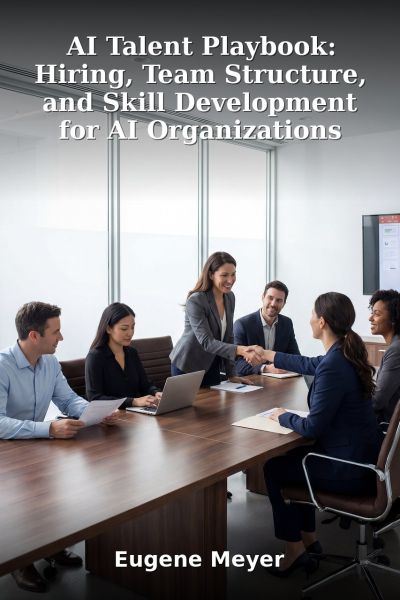
Most AI hiring guides stop at the offer letter. Eugene Meyer's AI Talent Playbook treats recruitment as just the first step in a longer chain that includes onboarding, team topology, platform tooling, and the governance habits that keep models trustworthy after they ship. The result is a reference manual that reads like an operating system for an AI organization rather than a collection of HR tips.
What the book is about
The playbook spans 25 chapters organized roughly along the talent lifecycle: landscape and role definition (Chapters 1–3), sourcing and assessment (Chapters 4–12), offer and onboarding (Chapters 13–14), team design and cross-functional collaboration (Chapters 15–18), and long-term growth through upskilling, mobility, and retention (Chapters 19–25). Meyer writes for CTOs, VPs of Engineering, AI Product Leaders, and HR partners who need to translate business strategy into role archetypes, competency maps, interview rubrics, and career ladders. The tone is pragmatic; every framework comes with a checklist or a worked example, and the text repeatedly warns against "theater" practices—generic job descriptions, unstructured interviews, isolated ethics committees—that look rigorous but produce no signal.
Three archetypes, not one "data scientist"
Chapter 2 argues that the label "data scientist" obscures three fundamentally different value-creation engines: the AI Researcher who pushes frontier capability, the ML/AI Engineer who productionizes it, and the AI Product Leader who matches it to user problems. Meyer insists that conflating them leads to "brilliant research languishing in a lab" or "models solving problems nobody has." The book then builds separate competency maps and dual-track career ladders for each archetype (Chapter 3), so that a Staff ML Engineer is rewarded for architectural influence while a Principal Researcher is rewarded for novel publications—without forcing either into management.
Assessment as evidence collection, not vibe checking
Chapters 7–11 replace the typical loose interview loop with a signal-rubric-structured interview system. Meyer defines signals as "specific, observable behaviors or demonstrations of skill" tied directly to the competency maps. Rubrics have five levels with concrete descriptors—for example, "Exceeds Expectations" for Model Evaluation means "consistently selects optimal evaluation metrics, articulates their limitations, and expertly translates model performance into business impact." Practical exercises (Chapter 11) include take-homes capped at 6–8 hours, live coding focused on preprocessing or inference endpoints, and model reviews where candidates critique a production architecture. The goal throughout is "evidence-based discussions" that reduce affinity and confirmation bias.
Pods over silos, platforms over heroics
Chapter 15 makes the case for cross-functional "pods" of 5–9 people—product leader, researchers, engineers, UX designer, data analyst—owning a measurable mission such as "increase user engagement by 15% through personalized content recommendations." Autonomy is bounded by clear SLAs with shared services: data engineering, MLOps platform, security, and legal (Chapter 16). Chapter 17 then details the MLOps platform as the "nervous system" that automates experiment tracking, data versioning, feature stores, pipeline orchestration, model registry, canary deployment, and drift monitoring. The platform team treats researchers and engineers as internal customers, providing self-service compute and standardized deployment so that "productivity plunges" when teams wrestle with bespoke scripts.
Governance baked into the workflow, not bolted on
Chapter 18 rejects the "isolated ethics committee reviewing at the end" model. Instead, it describes embedding AI Ethics Officers, AI Risk Analysts, and AI Safety Engineers directly into sprint planning, code reviews, and model evaluations. An ethics checklist becomes a standing agenda item; code reviews extend to data provenance and model response sanity checks. The chapter also introduces the AI Compliance Officer role to navigate regulations like the EU AI Act, and it stresses that training must flow both ways: "compliance professionals need to build basic machine learning knowledge, while developers must grasp regulatory requirements."
Retention through narrative, not just numbers
Chapter 24 frames retention as "cultivating compelling career narratives." Meyer notes that "people don't just work for companies; they work for their careers and their personal stories of professional growth." Managers are coached to run stay interviews, map individual aspirations to internal mobility paths (Chapter 20), and protect "innovation time" so maintenance work doesn't crowd out greenfield exploration. Compensation calibration (Chapter 13) is proactive—"waiting for an external offer is a reactive strategy that often comes too late"—and tied to the same competency maps used for hiring and promotion, preserving internal equity.
Who should read this
Leaders building or scaling an AI function—whether hiring the first applied scientist or restructuring a 200-person org—will find ready-to-adapt frameworks for roles, interviews, ladders, pods, and platform contracts. Readers looking for deep technical tutorials on model architecture or a philosophical treatise on AI ethics will not find them here; the book assumes technical fluency and focuses on the human systems that let that fluency compound. For its intended audience, it is a dense, decision-speeding reference that earns its place on the desk, not the shelf.
Please log in or create an account to leave a comment.
No comments yet. Be the first to say something.