
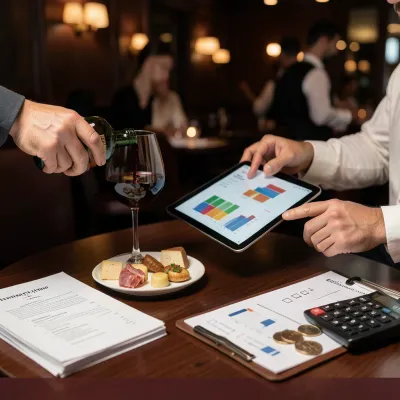
Most wine programs fail not because the bottles are poorly chosen, but because they're treated as a romantic sideline rather than an engineered revenue stream. Emma Wagner's The Restaurateur's Guide to Food and Wine Program Success reframes the entire endeavor as a system of measurable decisions — from how you categorize each SKU to when a server suggests a half-pour — and backs it with case studies, templates, and a 90-day rollout plan.
What the book is about
The guide spans 25 chapters organized as a working manual for owners, beverage directors, and general managers who want to turn a wine list into a profit center. It opens with vision-setting — defining non-negotiables, target KPIs, and the "lanes" different guest occasions travel — then moves through guest segmentation, menu engineering, by-the-glass strategy, pricing psychology, inventory and PAR management, vendor negotiation, POS configuration, sales-mix dashboards, staff training and tasting protocols, pairing menu design, flights and discovery tools, cross-cuisine pairing, non-alcoholic programs, service sequencing, marketing and list design, a 90-day launch playbook, turnaround case studies, kitchen-beverage collaboration, events and private dining, compliance, technology stack, sustainable sourcing, and a final toolkit of templates and checklists. The tone is instructional and systems-oriented; the reader is expected to treat the book as a reference they jump into at the point of greatest pain, whether that's a bleeding pour cost or a flat pairing attachment rate.
Profit-driven pairing and the four-quadrant matrix
Wagner adapts classic menu engineering to beverage by classifying every wine — by-the-glass pours, bottle listings, pairing components — as Stars (high popularity, high margin), Plow Horses (high popularity, low margin), Puzzles (low popularity, high margin), or Dogs (low on both). The goal is not merely to identify them but to "strategically place high-margin wines alongside popular dishes to maximize contribution margins and increase average check totals." Chapter 3 walks through calculating contribution margin per pour, adjusting Plow Horse pricing "even slightly" to lift margin without killing volume, and using Star dishes to pull Puzzle wines into the mix. The framework turns subjective taste into a scorecard you can review weekly.
Guest segmentation that servers can actually use
Rather than abstract demographics, Chapter 2 maps occasions (business lunch, date night, solo diner) against behavioral segments — curious explorer, confident loyalist, cautious skeptic, crowd-pleaser — and gives staff a decision tree: "A curious guest in a high-time lane might receive a flight suggestion with three short stories; that same guest in a low-time lane might get a single glass recommendation with one vivid detail." The book supplies a simple matrix plotting time versus spend, plus scripts for lane-switching mid-service when a business lunch turns celebratory. It's segmentation designed for a Friday night floor, not a marketing deck.
By-the-glass as an engineered profit engine
Chapter 4 treats the BTG list as a portfolio with "anchors" (familiar Plow Horses), rotating Puzzles, and a preservation strategy that lets higher-end bottles survive oxidation. Wagner specifies pour-size math — "If a standard 750ml bottle yields five 5oz pours, and your cost on that bottle is $15, then each pour costs you $3" — and argues for a core-and-feature rotation: keep Stars and Plow Horses permanent, swap Puzzles weekly on a sommelier's-choice board. She also details how to negotiate vendor deals for BTG-friendly formats (1L, bag-in-box) and how to use Coravin to turn cellar selections into by-the-glass revenue without spoilage risk.
Training built on micro-tastings and storytelling, not certification
Chapters 10 and 11 replace sommelier-track curricula with daily five-minute pre-shift tastings focused on one or two BTG wines, blind drills to sharpen palate confidence, and "talking points" cards that give servers "a safety net, ensuring even less confident servers have something memorable to say." The book emphasizes guest-friendly language — "like blackcurrants and a bit smoky" over "cassis and pencil lead" — and role-plays for objection handling ("If you enjoy Cabernet, you might also appreciate this [X wine] because it shares some similar characteristics"). Incentives tie to behaviors that match the program's vision: education rewards for discovery-focused concepts, attachment-rate bonuses for revenue-driven ones.
From launch to turnaround: a 90-day playbook and real case studies
Chapter 18 breaks a new program into four phases: internal alignment and POS lock-down (days 1-14), soft-launch dinners with structured debriefs (days 15-30), official launch with daily KPI tracking (days 31-60), and optimization plus seasonal planning (days 61-90). Chapter 19 then shows the framework in reverse: three restaurants — The Gilded Spoon (bloated list, intimidated staff), Bistro Étoile (generic identity), The Urban Eatery (high volume, leaky pour costs) — each diagnose root causes via inventory audit and sales-mix data, then apply targeted fixes: liquidation events, reimagined BTG with narrative-driven selections, flight programs, POS recipe precision, preservation systems, and vendor renegotiation. The common thread: "data-driven decision-making was non-negotiable" and "intensive and ongoing staff training proved to be the single most impactful lever."
Who should read this
This is a hands-on manual for restaurateurs, beverage directors, and GMs who already operate a food-and-wine program and need to tighten the mechanical link between hospitality and margin. It will not teach you wine regions or tasting technique; it assumes you have or can hire that expertise. If you're opening a first concept, the 90-day playbook and templates (Chapter 25) give you a runbook. If you're fixing a tired list, the turnaround case studies show the diagnostic steps. Casual wine enthusiasts or sommelier students looking for theory should look elsewhere — this book lives in the office, not the library.
Read “The Restaurateur’s Guide to Food and Wine Program Success” on MixCache.com →
Please log in or create an account to leave a comment.
No comments yet. Be the first to say something.