
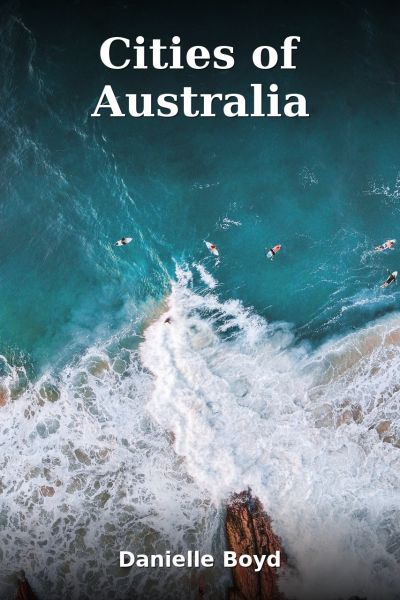
Australia is one of the most urbanized nations on Earth, yet its cities rarely get the sustained, comparative treatment they deserve. Danielle Boyd's Cities of Australia fills that gap with a book that is part history, part travel companion, and part urban policy primer — all grounded in the particular geography and history that shaped each place.
What the book is about
The book moves chronologically and thematically. It opens with the big picture — why 85% of Australians live in cities and why those cities hug the coastline (Chapter 1: The Rise of Australian Urbanization). It then rewinds 65,000 years to document Aboriginal settlement systems, trade routes, and engineered landscapes like the Budj Bim aquaculture complex (Chapter 2). Chapter 3 traces European arrival from the First Fleet through the gold rushes that turned Melbourne into "Marvellous Melbourne." The next fourteen chapters profile individual cities — the eight capitals plus Newcastle, Wollongong, Geelong, Gold Coast, Townsville, and Cairns — each with history, economy, transport, food, and practical visitor detail. The final seven chapters zoom out again: urban planning frameworks, transport networks, economic structures, liveability metrics, cultural life, geography and climate, tourism, and a forward-looking chapter on population growth, housing affordability, climate adaptation, and Indigenous inclusion in planning.
First cities, not first fleets
One of the book's most valuable corrective is Chapter 2: Aboriginal Australia: The First Cities and Settlements. Boyd argues that "the underlying principles of community, resource management, trade networks, and cultural hubs were very much present" long before 1788. She describes seasonal gathering sites that swelled to thousands, the 6,600-year-old Budj Bim eel-farming system with stone houses, and songlines that functioned as "living archives" mapping resources and law across the continent. The chapter reframes "urban" not as a European import but as a continuum: "Understanding these ancient patterns of settlement is not merely an academic exercise; it is crucial for a complete and accurate understanding of Australia's urban history."
The coastal lock-in
Why do Australia's cities form a necklace around the continent? Chapter 1 and Chapter 23 make the case that it wasn't inevitable — it was logistical. "They came by sea, and the accessible coastal areas offered not only convenient trade and travel routes but also more reliable supply of water, a precious commodity on this dry continent." The Great Dividing Range reinforced the pattern, creating natural harbors at Sydney, Melbourne, Brisbane, and Newcastle while blocking easy inland expansion. Even Canberra, the lone major inland city, exists only because the Constitution mandated a capital "not less than one hundred miles from Sydney." The result: 68% of the population lives in eight coastal capitals, generating nearly 80% of GDP.
Liveability as policy, not luck
Chapter 21 digs into why Australian cities dominate global liveability indices. Melbourne scored perfect 100s for healthcare and education in the 2025 EIU index; Sydney and Adelaide matched those scores. But the chapter doesn't just celebrate — it dissects the gaps. "Approximately half of the residents in Australia's five largest cities do not live within walking distance of public transport that is frequent enough to allow them to forego car ownership." Brisbane sits at just 33.7% access. Housing affordability is "one of the most significant challenges," with Sydney repeatedly ranked among the world's least affordable markets. The data makes liveability readable as a set of policy choices — investment in green space, transit, mixed-use zoning — rather than an accident of climate or culture.
Economic pivot: from wool and gold to knowledge
Chapter 20 traces a clear arc: primary extraction (wool, gold, coal) built the cities, but "knowledge services" now drive them. International education, professional services, ICT, finance, and pharmaceuticals dominate CBDs. Sydney and Melbourne alone concentrate 53% of national economic activity. Yet the book shows the unevenness: Perth remains tethered to mining headquarters, Darwin to defence and gas, Cairns almost entirely to tourism. The chapter also notes the spatial mismatch — high-value jobs cluster in CBDs while workers are pushed to outer suburbs with poor transit, a tension that shapes every planning discussion in later chapters.
Planning for a hotter, denser future
The final chapter, The Future of Australian Cities, doesn't flinch. It names the "pervasive housing affordability crisis," climate vulnerability ("bushfires, floods, heatwaves, and coastal erosion"), and the "persistent challenge" of equitable service access. It advocates "30-minute cities," circular economy principles, and "genuine partnership with traditional owners" to embed Indigenous knowledge in design. The tone is pragmatic: "The future of Australian cities is not a fixed destination but a dynamic journey, characterized by ongoing innovation, careful stewardship, and a continuous commitment to creating truly liveable, sustainable, and equitable urban environments for all."
Who should read this
Urbanists, travelers, students, and anyone who wants a single volume that connects Budj Bim's stone channels to Sydney Metro's driverless trains will find this book rewarding. It's less suited for readers seeking deep architectural criticism or granular neighborhood guides — the city chapters are broad overviews, not street-level maps. But as a framework for understanding why Australian cities look, function, and feel the way they do, it's thorough, balanced, and genuinely useful.
Read “Cities of Australia” on MixCache.com →
Please log in or create an account to leave a comment.
No comments yet. Be the first to say something.