
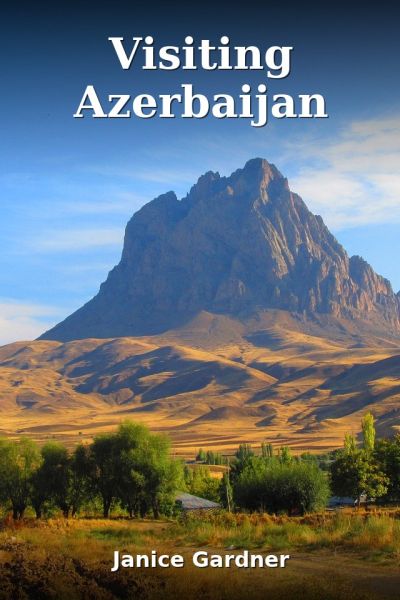
Azerbaijan markets itself as the Land of Fire, but the phrase only hints at what awaits: a country where Zoroastrian flames still lick a hillside outside Baku, where a village perched at 2,350 metres preserves a language unrelated to any other, and where tea arrives in pear-shaped glasses as a ritual of welcome. Janice Gardner's guide does more than list sights; it equips you to move between these worlds without losing your footing.
What the book is about
Structured as 25 chapters, the guide opens with a historical and geographical overview before dividing into two clear halves. The first twelve chapters handle logistics — visas, transport, accommodation, currency, language, safety, health, and packing — each written with the specificity of someone who has navigated the system. The second half tours the country region by region: Baku, the Absheron Peninsula, Ganja, Sheki, Qabala, Quba and Khinalig, Lankaran and the south, the Nakhchivan exclave, and a final chapter on lesser-known corners like Lahij and Ivanovka. Closing chapters cover culture, cuisine, music, and a consolidated practical-information section. The intended reader is an independent traveller who wants both big-picture context and granular detail — whether they plan a four-day Baku city break or a three-week loop through the Caucasus foothills.
The visa system is surprisingly digital, but the 15-day registration rule catches people out
Gardner devotes a full chapter to entry requirements, centring on the ASAN e-visa portal (evisa.gov.az). Citizens of nearly 100 countries can apply online, pay roughly $20–25, and receive a PDF within three business days — or three hours for an urgent fee. She stresses a detail many miss: the e-visa is valid for 90 days from issue but permits only a 30-day stay, and it is strictly single-entry. Equally critical is the State Migration Service registration, mandatory for any stay exceeding 15 calendar days. Hotels usually handle it automatically; private rentals and homestays require the guest or host to register online or at an ASAN service centre. Overstaying or skipping registration can mean fines and future entry bans.
Getting around means choosing between modern trains, Soviet-era marshrutkas, and 4WD only a local driver should handle
The transport chapter lays out a tiered reality. Baku's metro and bus network run on a rechargeable BakuCard; Bolt ride-sharing eliminates taxi haggling. Between cities, new double-decker Stadler trains connect Baku to Ganja and Qabala in comfort, while the overnight Baku–Tbilisi sleeper handles border formalities on board. For regional hops, marshrutkas — minibuses that leave when full — are cheap and ubiquitous but cramped. The road to Khinalig, however, is a different league: "Standard cars simply cannot handle the terrain. The ubiquitous choice is usually a sturdy Russian Lada Niva or a similar 4WD vehicle capable of navigating rough, unpaved sections, steep gradients, and potential obstacles." Gardner advises arranging this through a Quba guesthouse or taxi stand, not attempting it in a rental saloon.
Accommodation ranges from Flame Towers luxury to sleeping in a Silk Road caravanserai
Baku offers the full spectrum: international five-stars inside the Flame Towers, boutique hotels in restored Old City mansions, mid-range chains, hostels, and a thriving Airbnb market. Outside the capital, the guide highlights two experiences you won't find on generic booking platforms. In Sheki, sections of the Upper and Lower Caravanserais — 18th-century merchant inns — operate as hotels: "While amenities in the rooms might be relatively basic compared to conventional hotels — expect simplicity rather than luxury — the sheer experience of sleeping within walls that have sheltered travellers for centuries is unparalleled." In Khinalig and Ivanovka, homestays replace hotels entirely, offering shared facilities and home-cooked meals but requiring cash, patience, and often a guide to bridge the language gap.
The cuisine chapter reads like a menu you'll actually use, not a glossary you'll skip
Rather than listing dishes alphabetically, Gardner groups them by cooking method and occasion. Plov gets its own section — saffron rice, separate accompaniments, the prized qazmaq crust — while dolma appears in grape-leaf, cabbage-leaf, and stuffed-vegetable variations. Regional specialities are tied to their towns: piti in Sheki (eaten in two stages from a clay pot), lavangi in Lankaran (chicken or fish stuffed with walnuts and sour plum paste), and Sheki halva, "a rich, intensely sweet confection made primarily from layers of finely ground rice flour batter formed into intricate lattice patterns, generously filled with chopped nuts… flavoured with spices like cardamom, and drenched in fragrant syrup." The tea ritual — black, strong, served in armudu glasses with jam — is framed as social infrastructure, not just a beverage.
Music and dance are presented as living practices, not museum pieces
The penultimate chapter treats mugham — UNESCO-listed modal improvisation on tar, kamancha, and daf — as the country's classical core, but gives equal space to ashug bards, folk instruments like the balaban, and the mugham-jazz fusion pioneered in Baku clubs. Dance descriptions distinguish male and female styles: women's "fluidity, grace, and delicate hand movements" versus men's "rapid footwork, sharp turns, high leaps" often with sabres. Gardner points readers to specific venues — the Philharmonic Hall, the Opera and Ballet Theatre, chaykhanas with live tar players — and notes that weddings and festivals like the Qabala International Music Festival offer the most authentic exposure.
Who should read this
Travellers planning an independent trip to Azerbaijan — whether a long weekend in Baku or a multi-region itinerary — will find the guide indispensable for its logistical precision and regional depth. It is less suited to tourists on fully escorted package tours who need only superficial background, or to readers seeking a narrative travelogue; Gardner's voice is authoritative and utilitarian, not personal. For anyone who wants to understand why the road to Khinalig demands a Lada Niva, how to register a 16-day stay in an Airbnb, or what distinguishes Quba-school carpets from Karabakh patterns, this book delivers the answers without fluff.
Read “Visiting Azerbaijan” on MixCache.com →
Please log in or create an account to leave a comment.
No comments yet. Be the first to say something.