
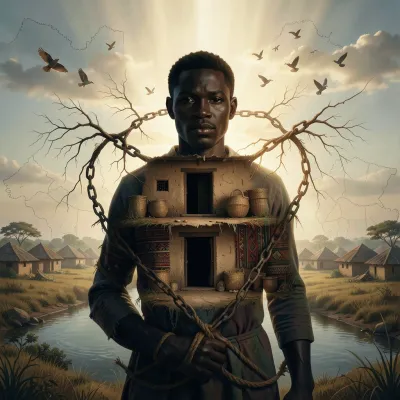
Most histories of slavery treat Africa as a supply zone for the Atlantic trade, a backdrop where nothing important happened until European ships arrived. Roger Collins's Bound Within refuses that framing entirely. The book demonstrates that African societies developed complex, regionally distinct institutions of unfreedom — household servitude, militia slavery, agrarian dependence, debt bondage, clientage — with their own logics of incorporation, mobility, and negotiation long before and alongside external pressures.
What the book is about
Bound Within is a 25-chapter comparative study organized geographically and thematically. After three introductory chapters on concepts, sources, and methodology, the book moves through regional case studies: West African household servitude (Ch. 4), Niger-Volta pawnship (Ch. 5), Sahelian militia slavery (Ch. 6), Western Sudan serfdom (Ch. 7), royal slavery in Asante, Oyo, and Dahomey (Ch. 8), Trans-Saharan routes (Ch. 9), the Swahili coast (Ch. 10), Ethiopia and the Horn (Ch. 11), Central African polities (Ch. 12), Great Lakes clientage (Ch. 13), and pastoral frontiers (Ch. 14). Cross-cutting chapters examine war and raiding (Ch. 15), gendered lives (Ch. 16), children and age grades (Ch. 17), urban and commercial slavery (Ch. 18), faith and reform (Ch. 19), internal abolition movements (Ch. 20), colonial interventions (Ch. 21), resistance (Ch. 22), emancipation's afterlives (Ch. 23), memory politics (Ch. 24), and a global comparative conclusion (Ch. 25). The book integrates oral histories, court records, Islamic legal texts, missionary accounts, and archaeological evidence. It assumes familiarity with African history but explains regional contexts thoroughly, making it accessible to serious general readers and valuable for specialists.
Unfreedom as relationship, not condition
Collins's central insight is that African systems treated dependency as a volume knob rather than a toggle switch. As he writes in Chapter 2: "Dependency thus functioned like a volume knob rather than a toggle switch, turned up or down by drought, war, harvest, or the mood of a patron." People moved between categories — captives became kinspeople, debt pawns became traders, soldiers' slaves became commanders — through negotiation, strategic service, or conversion. This fluidity appears across regions: in West African compounds where a captive woman nursing the chief's son "might later speak with surprising authority" (Ch. 4); in Sahelian militia slavery where a captive could "distinguish himself in a hunt and find himself dining with the prince" (Ch. 1); in Great Lakes clientage where a young man could "accumulate enough animals to attract followers of his own" (Ch. 13). The book argues this incorporation logic was not a "failed rehearsal for Atlantic slavery" but "performances with their own logic, pacing, and stakes" (Ch. 1).
Gender and generation as analytical necessities
Women's unfreedom "often wore the softer masks of fosterage, marriage, or pawnship, yet the constraints were real" (Ch. 2). Chapter 16 shows how reproductive labor bound women in ways both intimate and exploitative: "A woman's unfreedom might arrive as pawnship, concubinage, or the aftermath of a raid, and it could be softened by motherhood or hardened by infertility, depending on what the household needed most." In Swahili towns, domestic servitude placed women at the center of "invisible economies" where cooking was "the regulation of household mood, the lubrication of deals, and the display of a family's wealth" (Ch. 10). Children were equally central — "the hinges on which many systems turned" (Ch. 2). Chapter 17 details how age grades and initiation schools "stretched or compressed the timeline of belonging," turning "raw captivity into structured belonging" while childhood's plasticity made unfreedom "negotiable in ways adulthood rarely allowed." A captured child "could become a sibling, a servant, or a future rival depending on choices made by people he or she barely knew."
Emancipation as prolonged negotiation, not clean break
The book traces how abolition unfolded "from within" through local edicts, religious reforms, and community debates long before colonial pressures. Chapter 20 examines Ethiopia's Tewodros II, who "railed against the slave trade while simultaneously conscripting the manpower he needed," and Somali territories where elders "worried about retaliation or who saw advantage in appearing just." In Buganda, kings lightened burdens "not out of pure benevolence but to maintain the loyalty of those they needed to govern" (Ch. 20). Colonial abolition then created a "gap between ledger and life" (Ch. 21): "A clerk in Zanzibar or Lagos might register a dependent as free on paper, while the same person continued to fetch water and mediate disputes in a courtyard where deeds carried less weight than whispers." Chapter 23 shows emancipation's afterlives: freedom often meant "the right to argue over a calf's paternity or the terms of a brideprice rather than the sudden liberty to walk away with nothing." The law became "a living argument" people used "as they would any other resource, citing it when it helped and ignoring it when it did not."
Methodological pluralism as corrective
Chapter 3 makes the case for reading across source types: "Oral narratives preserve memory and moral judgment alongside chronology; legal documents formalize disputes while occluding routine practices; imperial archives register colonial ambitions more clearly than local voices." The book demonstrates this triangulation concretely. In a Sahelian case, court cases saw "simple theft" where oral histories explained claimants as "captives who had earned horses in battle and expected reward," and archaeology revealed "stabling arrangements that matched that version" (Ch. 3). Linguistic attention matters too: "Many West African languages describe relationships with verbs that imply belonging, owing, or serving, rather than nouns that label a person once and for all" (Ch. 4). Translating these verbs into 'slave' or 'servant' "risk turning a living negotiation into a fixed category." This methodological self-awareness runs throughout — the book treats its own categories as "rough tools rather than exact mirrors" (Ch. 1).
Africa in global perspective without flattening
The conclusion argues for placing Africa at the center of global slavery studies "without reducing African experiences to Atlantic paradigms." Collins notes that African systems were "calibrated to risk as much as to profit" — a pawn was "not a depreciating asset but a potential ally" (Ch. 25). Markets were porous: in Kano, Kumasi, or Zanzibar, "a dependent's skill at weighing gold or negotiating credit could earn him a reputation that outshone his legal status." Religion introduced "new arguments about personhood, new avenues for manumission, and new literacies that could be used to challenge authority" (Ch. 25). The book cautions against easy optimism: "The end of legal slavery did not mean the end of exploitation, and the rise of formal equality did not erase the habits of hierarchy." Freedom emerged as "less about a single moment of liberation and more about the ability to negotiate, to move, to argue, and to build alliances that can withstand the pressures of scarcity and power."
Who should read this
Bound Within rewards readers willing to engage with density and complexity. Historians of slavery, Africanists, and scholars of comparative emancipation will find a rigorous, source-rich framework that reorients the field. General readers with background in African history will appreciate the clear regional organization and the refusal of simplification. Those seeking a narrative-driven overview or a simple moral accounting of slavery should look elsewhere — this book demands attention to contingency, regional variation, and the coexistence of coercion and negotiation. Its greatest contribution may be methodological: showing how to read "the gaps as seriously as the words" (Ch. 3) when reconstructing lives that archives were never designed to capture.
Please log in or create an account to leave a comment.
No comments yet. Be the first to say something.