
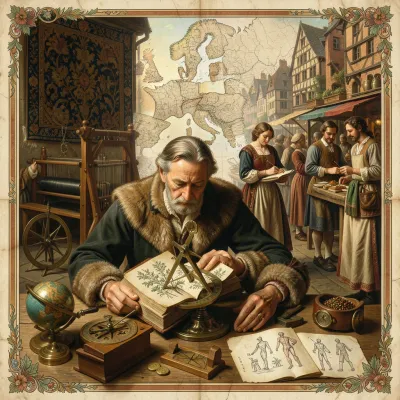
The Renaissance did not radiate outward from Florence like light from a single lamp. It was, as Isabella Carter argues in this sweeping reappraisal, a "constellation of centers" — a Europe-wide negotiation among artists, artisans, scholars, merchants, and rulers that unfolded across two centuries and connected Kraków to Lisbon, Nuremberg to Seville. The Long Renaissance replaces the familiar story of Italian genius with something messier, richer, and far more revealing: a continent in motion, bound together by trade routes, printing presses, migrating craftsmen, and the shared labor of making and knowing.
What the book is about
Carter structures the book as a series of regional and thematic case studies across twenty-five chapters, moving from broad frames (urban patronage, the print revolution, the migration of artists) to focused examinations of specific zones: the Low Countries, the Iberian Atlantic, the Baltic Hanse, Bohemia and Hungary, Poland-Lithuania, Scandinavia. Later chapters trace thematic threads — science in the studio, astronomy, anatomy, fortification engineering, mining, the image debates of the Reformation, women's work, vernacular literature, cartography, cabinets of curiosity, and the institutional scaffolding of universities, guilds, and courts. The final chapters follow the Renaissance's "afterlives" into the Scientific Revolution and the Enlightenment. The intended reader is anyone who has encountered the standard Italy-centered narrative and suspects it leaves out whole continents of activity; no specialist background is required, but the book rewards patience with its density of detail.
A Renaissance built on timber, pigment, and silver
One of the book's most consistent insights is that cultural production rode on material logistics. Chapter 2 shows how Lübeck's timber trade, the Baltic grain market, and the silver mines of the Erzgebirge generated the surplus wealth that funded altarpieces, printing presses, and university chairs. Chapter 8 details how the very woodblocks for early prints came from the same slow-growth Baltic oak that built Hanseatic cogs. Chapter 15 traces how the Joachimsthal silver mines not only minted the coins that gave us the word "dollar" but also drove innovations in water-powered pumping and metallurgy that fed directly into instrument making. As Carter puts it in the Introduction, "Behind every great painting was a ledger book, and behind every great library was a customs record." The Renaissance, in this telling, is inseparable from the economies that sustained it.
The workshop as laboratory: where art met optics and engineering
Chapters 12 and 13 make a persuasive case that the painter's studio and the instrument maker's bench were effectively the same space. Nuremberg's goldsmith-engravers produced astrolabes and sundials alongside prints; Gemma Frisius in Louvain collaborated with goldsmith Gaspard van der Heyden to turn astronomical theory into working brass instruments; Martin Behaim's 1492 "Erdapfel" globe required translating flat maps onto a sphere — a problem of geometry and craft combined. Carter writes that "the painter's studio, the instrument maker's bench, and the scholar's desk were all points on a single continuum of knowledge-making." The book follows this continuum into cartography (Mercator's projection), anatomy (Vesalius's Fabrica relied on artists from Titian's workshop), and fortification engineering (the trace italienne as applied geometry).
Print did not flatten Europe — it amplified its voices
Chapter 3 offers one of the clearest accounts of the print revolution I've encountered. Carter resists the temptation to present printing as a simple democratizer. She shows how Aldus Manutius in Venice curated Greek classics for a learned elite, while Antwerp's Plantin-Moretus operation ran a factory-scale polyglot Bible project, and Lyon's scrappy shops flooded markets with almanacs, broadsheets, and vernacular polemics. The press created a "Republic of Letters" that linked scholars from Kraków to Copenhagen, but it also preserved linguistic diversity: a Kraków printer might issue a Latin grammar alongside a Polish catechism; a Lyon bookseller stocked Occitan alongside Latin and Italian. As Carter notes, "The press did not flatten Europe into uniformity; it gave Europe's many voices a mechanism through which they could be heard far beyond their place of origin."
Women as patrons, printers, and practitioners — not exceptions, but participants
Chapter 17 systematically recovers women's roles across the cultural economy. Charlotte Guillard ran a Paris printing house for decades after her husband's death, corresponding with leading humanists. Lavinia Fontana and Sofonisba Anguissola secured altarpiece commissions and court positions in Bologna and Madrid. In Nuremberg and Augsburg, widows legally continued their husbands' workshops, training apprentices and fulfilling contracts. The book also highlights the invisible labor: women grinding pigments, managing workshop accounts, producing the embroidered vestments and illuminated manuscripts that filled churches and cabinets. Carter argues that "to write them out of the story is to misunderstand the Renaissance fundamentally — not as a chorus of individual geniuses but as a vast, collaborative, and deeply human endeavor."
Confessional conflict reshaped visual culture as much as theology
Chapter 16 traces how the Reformation's image debates produced distinct material cultures. Luther's moderation left Lutheran churches with altarpieces and crucifixes; Zwingli and Calvin drove the stripping of Zürich and Geneva to whitewashed austerity; the Beeldenstorm of 1566 shattered Antwerp's churches in days. The Counter-Reformation answered with sensory overload — Jesuit churches designed as "total environments" of gilded altarpieces and illusionistic ceilings. Carter shows how these choices redirected artistic markets: in the Dutch Republic, painters turned to landscapes, still lifes, and genre scenes; in England, Nicholas Hilliard's portrait miniatures offered a private, portable alternative to public veneration. The visual environment, she argues, became "a material trace of a fundamental disagreement about how human beings should encounter the divine."
Who should read this
Readers who want a single-volume map of the Renaissance beyond the Italian peninsula will find this indispensable. It is especially valuable for those interested in the history of science and technology, the economics of culture, or the history of the book — fields that often treat the Renaissance as background but here appear as central drivers. The density of regional detail (twenty-five chapters, each with its own cast of cities, patrons, and artisans) means the book rewards dipping and returning more than a single straight read. Specialists in any one region may quibble with emphases, but the synthesis is the achievement. If you prefer narrative biography or a focused argument, this may feel encyclopedic. But for anyone who has wondered what was happening in Kraków, Lübeck, or Seville while Michelangelo painted the Sistine Chapel, Carter has assembled the most thorough and readable answer currently available.
Read “The Long Renaissance: Art, Science, and Society Across Europe” on MixCache.com →
Please log in or create an account to leave a comment.
No comments yet. Be the first to say something.