
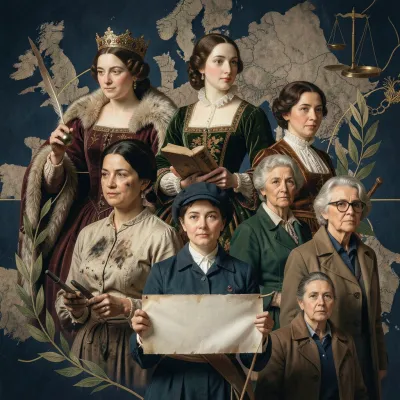
The following is an excerpt from “Women of Influence: Gender and Power in European History” by Carolyn Cox, available on MixCache.com.
Introduction
This book asks a deceptively simple question: how did women shape European history? To answer it, we move beyond cameo appearances of “exceptional” figures and instead trace the many ways women—elite and poor, urban and rural, devout and skeptical—exercised agency within and against the structures that constrained them. Agency here is not a synonym for unfettered freedom; it is the capacity to act, influence, negotiate, and imagine otherwise amid shifting regimes of law, labor, culture, and belief. By centering gender as a key category of analysis, we illuminate patterns that conventional, male-centered narratives obscure: the political intelligence of queenship and regency, the intellectual labor of nuns and humanists, the economic strategies of guildswomen and peasant producers, the mobilization of activists from salons to factory floors.
The approach is both chronological and thematic. We begin in the medieval world, where spiritual authority, household management, and dynastic politics opened paths to influence even as canon law and custom defined women’s subordination. We follow transformations through the Renaissance courts and the Republic of Letters, into the upheavals of the Reformations and the policing of gender in witchcraft prosecutions. We explore the Enlightenment’s promises and exclusions, the revolutionary redefinition of citizenship, and the industrial reordering of work and family life. Finally, we trace transnational feminisms, suffrage campaigns, and twentieth-century struggles for rights, bodily autonomy, and political voice, paying special attention to conflict, dictatorship, and the resilient creativity of everyday resistance.
Our evidence is deliberately eclectic. Letters, household accounts, guild statutes, court depositions, medical treatises, convent chronicles, petitions, newspapers, posters, and photographs all speak—sometimes obliquely—about women’s actions and the meanings attached to them. Material culture and spaces matter too: markets and monasteries, workshops and salons, kitchens and barracks, printshops and parliaments. Reading “against the grain,” we attend to silences and distortions in archives built by states, churches, and families that often sought to discipline or domesticate women’s activities. Throughout, we pair close studies of individuals with collective histories of movements, institutions, and communities to show how singular lives were embedded in broader structures.
Constraints are a constant presence in these pages. Law and custom circumscribed property rights and political participation; marriage and household governance organized dependency; ecclesiastical and civic authorities policed sexuality and labor; imperial and colonial projects racialized and stratified gendered experiences. Yet within these limits, women developed strategies that altered outcomes: forging marriage alliances and regencies, cultivating patronage networks, petitioning and litigating, building cooperative economies, disguising or redefining labor, organizing clandestine assemblies, and mobilizing the moral language of piety, motherhood, or respectability to press radical claims. Agency thus appears as repertoire rather than essence—a set of practices honed in particular times and places.
Because Europe was never a singular cultural entity, comparison is essential. The lives of a Castilian regent and a Danish merchant, an Italian printer and a Polish peasant, a French salonnière and a Russian factory organizer unfolded within distinct legal codes, confessional landscapes, and economic ecologies. Regional variation did not preclude circulation: books, people, commodities, and ideas moved across borders, knitting together solidarities and sparking conflicts. Empire further complicated the story, as women participated in and resisted imperial projects, reworking gendered identities at home and abroad. Attending to difference—of class, confession, ethnicity, and region—prevents the flattening of women’s history into a single narrative and reveals the plural grammars of power they navigated.
Finally, this is a feminist history in method as well as subject. It treats women not as supplements to an already-written script but as protagonists whose actions refashioned politics, economies, and cultures. It reads “private” life as political terrain; insists on labor, care, and embodiment as engines of historical change; and tests inherited periodizations against the rhythms of women’s work, mobilization, and memory. By the end of the book, the familiar contours of European history look different: revolutions begin earlier and end later; the map of influence extends from council chambers to kitchens; and progress is no longer a simple march of rights but a braided path of gains, losses, and reinventions.
The chapters that follow provide a scaffold for this reorientation. Each pairs analytical framing with vivid case studies, asking not only what women did but how they understood their actions and how contemporaries made sense of them. Together they chart a long history of constraint and creativity, revealing that European modernity was built as much by the labor of market stalls and textile rooms, by the discipline of convents and classrooms, and by the courage of petitioners and picketers as by the decrees of kings and parliaments. To tell that story is to restore complexity to the past—and to recognize in women’s strategies a durable legacy for imagining power differently.
Read “Women of Influence: Gender and Power in European History” on MixCache.com →
Please log in or create an account to leave a comment.
No comments yet. Be the first to say something.