
The following is an excerpt from “Valletta” by Dr Alex Bugeja, PhD, available on MixCache.com.
Introduction
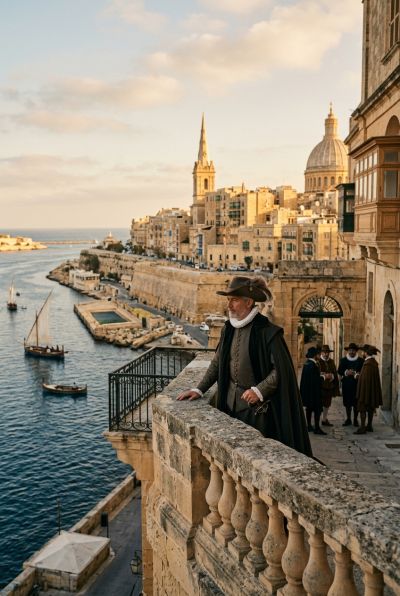
Approaching the island of Malta by sea, a traveler is met by a fortress that rises from the water like a monolithic golden shield. It does not look like a conventional city, nor does it appear entirely natural, yet it seems to have grown organically out of the very bedrock of the Mediterranean. This is Valletta. Enclosed entirely by massive, angled bastions, it is a city that wears its military pedigree with unabashed prominence. Yet, crossing through its imposing gates reveals an entirely different world. The heavy, militaristic shell gives way to a meticulously planned grid of streets lined with ornate baroque palaces, towering churches, and refined townhouses adorned with painted wooden balconies. It is a place of striking paradoxes: a martial stronghold designed for brutal warfare that simultaneously serves as a spectacular monument to aristocratic refinement and high culture.
The famous description of Valletta as "a city of palaces built by gentlemen for gentlemen" is generally attributed to the British statesman and novelist Benjamin Disraeli, who visited Malta in the summer of 1830. Disraeli was deeply taken by the architectural splendor he found on the tiny island, comparing Valletta's grandeur favorably to Venice and Cadiz. His assessment perfectly captures the fundamental anomaly of the city. Valletta was not the result of gradual, organic growth over centuries, nor was it built by merchants, local kings, or a burgeoning middle class. It was willed into existence by an elite, multinational military order of aristocrats and monks. These men possessed the wealth of European nobility, the militant discipline of crusaders, and the refined tastes of Renaissance princes. When they decided to build a new capital from scratch on a barren promontory, they did not just build a garrison; they built a stage for their own power and prestige.
To understand Valletta, one must first understand the stage upon which it was set. The Mediterranean Sea in the sixteenth century was the center of the known world for European and Levantine powers, serving as a superhighway for trade, a boundary between empires, and a relentless theater of war. Right in the middle of this volatile maritime chessboard lies the Maltese archipelago. On a map, Malta appears as little more than a speck of dust floating south of Sicily and north of the North African coast. Its total landmass is minuscule, and it lacks mountains, rivers, and natural resources. However, it possessed one geographical feature that made it an object of intense desire for every major power in the region: its natural harbors.
The eastern coast of Malta is deeply indented by a complex network of creeks and deep-water anchorages. The most spectacular of these is the Grand Harbour, a massive geological fault that allows deep-draft vessels to sail almost directly up to the shoreline while being perfectly sheltered from the treacherous Mediterranean gales. Adjacent to the Grand Harbour, separated only by a steep, tongue-shaped peninsula of rock, lies another vast inlet known as Marsamxett Harbour. The peninsula dividing these two exceptional maritime sanctuaries was known as Mount Sceberras. For centuries, this ridge of rock was largely ignored. It was a rugged, dusty, wind-battered spine of scrubland where locals occasionally hunted wild birds. It was utterly devoid of fresh water, making it seemingly uninhabitable. The medieval capital of Malta, Mdina, had been sensibly built far inland on a high plateau, safe from the sudden raids of corsairs who regularly prowled the coastline.
Yet, as naval technology advanced and control of the sea became the key to regional dominance, the strategic value of the harbors eclipsed the safety of the inland plateau. The side that controlled the anchorages of Malta essentially held the keys to the central Mediterranean, able to intercept shipping lanes between the Christian north and the Islamic east and south. It was a geopolitical choke point of monumental importance. When a multinational fraternity of warrior-monks known as the Order of St. John of Jerusalem arrived on the island in 1530, the fate of the barren Mount Sceberras was sealed. It was destined to become the foundation of one of the most remarkable urban planning projects in European history.
The Order of St. John, also known as the Knights Hospitaller, was an ancient and unique institution. Founded in Jerusalem in the eleventh century to provide medical care for pilgrims to the Holy Land, the Order quickly evolved into a fearsome military organization tasked with defending the Crusader states. When the crusaders were ultimately driven from the Levant, the Knights relocated first to Cyprus, and then to the island of Rhodes, where they maintained a formidable naval presence and operated as a sovereign state for over two centuries. They were eventually expelled from Rhodes in 1522 after a massive siege by the Ottoman Empire. Homeless and drifting across Europe, the Order desperately needed a new base of operations to continue their dual mission of caring for the sick and waging holy war at sea.
In 1530, the Holy Roman Emperor, Charles V, recognized the strategic necessity of keeping the central Mediterranean out of Ottoman hands. He offered the Maltese archipelago to the Knights of St. John. The rent for this sovereign territory was famously set at one live Maltese falcon, to be presented annually to the Emperor's viceroy in Sicily on All Saints' Day. It was a purely symbolic fee, acknowledging the Emperor's ultimate suzerainty while allowing the Knights to operate with practical independence. The Knights were initially dismayed by their new home. Coming from the lush, fertile landscape of Rhodes, they found Malta to be an arid, sun-baked rock with a tiny, impoverished population. However, the Grand Harbour offered them the perfect base for their war galleys, and they reluctantly settled in the small fishing village of Birgu on the harbor's southern shore.
These knights were the "gentlemen" to whom Disraeli would later refer. They were not ordinary soldiers. To become a Knight of Justice within the Order, a candidate had to prove unbroken noble descent spanning several generations, depending on their nationality. They were the younger sons of the greatest aristocratic houses of France, Italy, Spain, Portugal, Germany, and England. Denied inheritance of their family estates by the laws of primogeniture, these young nobles joined the Order to seek glory, military command, and spiritual salvation. They took traditional monastic vows of poverty, chastity, and obedience, but they interpreted these vows with a distinctly aristocratic flair. Their "poverty" often meant turning their vast personal fortunes over to the Order, which in turn provided them with a lavish lifestyle, fine armor, silver dining sets, and retinues of servants.
To manage this diverse, multinational brotherhood, the Order was divided into linguistic and geographical groupings known as Langues, or "Tongues." Each Langue was responsible for specific administrative and military duties within the Order, and their distinct identities would eventually define the architecture and social life of Valletta.
Langue Geographical Base Traditional Role within the Order Provence Southern France Grand Commander (Finance and Accounts) Auvergne Central France Marshal (Supreme Military Commander) France Northern & Western France Grand Hospitaller (Medical and Hospital operations) Italy Italian Peninsula Admiral (Commander of the Fleet) Aragon Iberian Peninsula (Aragon, Catalonia, Navarre) Grand Conservator (Logistics, Clothing, Supplies) England British Isles Turcopolier (Commander of the Cavalry and Coastal Defenses) Germany Holy Roman Empire and surrounding regions Grand Bailiff (Inspector of Fortifications) Castile, Leon, and Portugal Iberian Peninsula (Castile, Leon, Portugal) Grand Chancellor (Foreign Affairs and Administration)This division of labor and nationality brought the wealth, artistic tastes, and intense rivalries of all of Europe into the concentrated space of a single institution. The French knights vied with the Spanish, the Italians brought the latest Renaissance architectural theories, and all of them expected a standard of living commensurate with their noble birth. When it became clear that the small town of Birgu was insufficient to house this sprawling, wealthy aristocracy, and more importantly, inadequate to defend the harbors against the growing threat of the Ottoman navy, the eyes of the Order's leadership turned toward Mount Sceberras.
The peninsula of Sceberras was the key to holding Malta. It separated the two massive harbors, and any enemy who managed to place artillery on its heights could rain fire down upon the Knights' fleet and settlements below. The Knights realized early on that they needed to fortify this ridge. They built a small star-fort at the very tip of the peninsula, naming it Fort St. Elmo, but they knew it was not enough. They needed a fortified city covering the entire promontory. For decades, they debated, surveyed, and drew up plans, but the sheer cost and engineering difficulty of leveling the rocky terrain and building massive walls from scratch delayed the project.
It was the realities of sixteenth-century warfare that finally forced the issue. The era of tall, thin medieval castle walls was over, rendered obsolete by the invention of the iron cannonball and advanced siege artillery. To survive the gunpowder age, a fortress needed deep ditches, sloped bastions, and thick earth-filled walls that could absorb sustained bombardment. Building such a fortress required modern engineering and staggering amounts of money. It also required a catalyst, a terrifying shock that would convince the crowns of Europe to open their treasuries and fund the project. In 1565, that catalyst would arrive on the shores of Malta in the form of the largest armada the Ottoman Empire had ever assembled.
When the decision was finally made to build the city, it was conceived not just as a military necessity, but as an architectural utopia. The sixteenth century was the height of the Renaissance, an era fascinated by the concept of the "Ideal City." For centuries, European cities had grown chaotically. They were typically characterized by dark, winding, narrow medieval streets that followed the natural topography of the land. They were difficult to navigate, terrible for sanitation, and virtually impossible to defend systematically. Renaissance architects, studying the classical texts of ancient Rome, dreamed of starting with a blank slate. They envisioned cities laid out on rational, mathematical grids, with straight, wide streets designed to allow the free flow of air, light, and troops.
Mount Sceberras provided exactly this blank canvas. There were no pre-existing structures to demolish, no entrenched local property owners to negotiate with, and no existing street plans to incorporate. The architects imported by the Knights were handed an entire peninsula and told to design a masterpiece of rational urban planning. They designed a grid system that remains largely unchanged to this day. The long, straight streets were engineered to capture the sea breezes from the Mediterranean, acting as a natural air-conditioning system during the sweltering summer months. The rigid geometry of the streets also allowed for rapid movement of soldiers from the center of the city to any point on the defensive perimeter.
The primary material for this grand endeavor was found directly beneath their feet. Malta is composed almost entirely of sedimentary limestone, specifically a type known as globigerina limestone. This geological feature is the defining aesthetic characteristic of Valletta. Freshly quarried, globigerina is relatively soft, making it remarkably easy to cut into perfectly square ashlars or carve into the intricate baroque escutcheons, gargoyles, and floral motifs that decorate the city's palaces. Once exposed to the salty Mediterranean air and the intense sun, the stone undergoes a chemical reaction, oxidizing and hardening into a durable, weather-resistant shell. It takes on a brilliant, warm honey-gold color that seems to glow from within at sunrise and sunset. Because the entire city—the fortifications, the streets, the churches, and the houses—was built from this exact same local stone, Valletta possesses a striking visual unity. It looks less like an assemblage of individual buildings and more like a single, massive sculpture carved directly out of the peninsula.
The official name bestowed upon the new capital was Humilissima Civitas Valletta—The Most Humble City of Valletta. It was a name steeped in the monastic traditions of the Order of St. John, reflecting their vow of poverty and their nominal dedication to serving the poor and the sick. Yet, there was nothing humble about the city that rose on Mount Sceberras. From the sheer scale of its landward bastions, which stand dozens of meters high and are cut deep into the solid rock, to the dazzling interior of its churches, dripping in gold leaf and adorned with masterpieces of European art, the city was a testament to extreme wealth and supreme confidence. The ruling classes of Europe quickly recognized this paradox, and the city unofficially became known as Superbissima—The Most Proud.
This tension between the humble and the proud, the martial and the refined, is woven into the very fabric of Valletta. The exterior walls of the city were engineered purely for death and survival. They present a blind, impenetrable face to the outside world, dominated by sharp angles designed to deflect artillery fire and wide ditches meant to trap attacking infantry. But inside those walls, the Knights created a cosmopolitan European capital. They built grand auberges to serve as the headquarters and palatial residences for each of the Langues. They constructed a state-of-the-art hospital that rivaled any medical facility in the world, reflecting their original mandate as Hospitallers. They commissioned grandmaster palaces, vast arsenals, and a staggering number of churches, packing the small peninsula with an unprecedented density of architectural wealth.
The history of Valletta is, in many ways, a microcosm of the history of the Mediterranean over the last five centuries. The city was born from the great clash of empires between the Christian West and the Islamic East. It spent its early years as a heavily armed corsair base, with the Knights of St. John operating essentially as state-sponsored pirates, enriching the city with plunder taken from Ottoman shipping. It evolved into a baroque center of art and culture, attracting luminaries like Caravaggio, who sought refuge within its impregnable walls.
As the geopolitical landscape shifted and the threat from the East subsided, the city's military rationale began to fade, leading to a period of decadence and decline for the once-fearsome Order. The impregnable walls of Valletta, which had deterred empires, eventually fell without a fight to Napoleon Bonaparte, ending the centuries-long rule of the Knights. Shortly thereafter, the city transitioned into the hands of the British Empire, serving as the linchpin of British naval supremacy in the Mediterranean. Under British rule, Valletta modernized, survived plagues, and adapted to the industrial age. Its deep-water harbors transitioned from hosting oar-powered galleys to coal-fired dreadnoughts, and its streets filled with sailors, merchants, and the diverse population of the British Empire.
In the twentieth century, Valletta's strategic location once again placed it in the crosshairs of global conflict. During the Second World War, the city suffered some of the most concentrated aerial bombardments in history. The golden limestone was shattered, palaces were reduced to rubble, and the population was driven underground into ancient tunnels carved by the Knights. Yet, the city endured, rising from the ashes to become the political and cultural capital of an independent Republic of Malta.
Walking through Valletta today is an immersive journey through these distinct eras. The original sixteenth-century grid plan dictates the rhythm of the city. The monumental baroque architecture of the Knights of St. John dominates the skyline. Red British pillar boxes and Victorian shop fronts line the main thoroughfares, while the scars of World War II shrapnel are still visible on the stonework of the bastions. It is a city of immense verticality, characterized by steeply stepped streets that plunge dramatically toward the sea, offering sudden, breathtaking glimpses of the blue water framed by towering golden walls.
Despite its grandeur, Valletta is incredibly compact. It spans roughly one kilometer in length and six hundred meters in width. One can walk from the monumental City Gate at the landward end to Fort St. Elmo at the tip of the peninsula in about twenty minutes. Within this small footprint lies an astonishing concentration of history. It is an urban environment entirely defined by its boundaries. Because it was built on a peninsula and surrounded by massive fortifications, it could not sprawl outward as its population grew. Instead, it grew denser, building upward and subdividing its grand palaces, creating a vibrant, tightly knit community.
This book traces the remarkable trajectory of this unique capital. It explores how a barren rock was transformed into an architectural masterpiece, examining the brilliant engineers, ambitious Grandmasters, and skilled local craftsmen who made it possible. It delves into the daily lives of the aristocrats who ruled the city and the common people who lived in their shadows. It follows Valletta's transformation from a monastic fortress into a cosmopolitan hub of trade, art, and empire, and its ultimate survival through the devastating conflicts of the modern era. The story of Valletta is the story of a city built against all odds, a masterpiece of stone and strategy that remains one of the most fascinating urban spaces in the world. The foundation of this extraordinary endeavor, however, required a crisis of epic proportions, a crucible of fire and blood that would prove to the world exactly why a fortress-city on Mount Sceberras was an absolute necessity.
Read “Valletta” on MixCache.com →
Please log in or create an account to leave a comment.
No comments yet. Be the first to say something.