
The following is an excerpt from “The World's Greatest Castles” by Dr Alex Bugeja PhD, available on MixCache.com.
INTRODUCTION
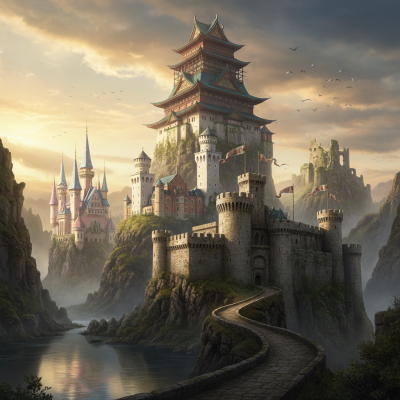
The word ‘castle’ evokes a powerful and romantic image: soaring towers, formidable battlements, and cavernous halls echoing with the clang of armor and the whispers of history. These structures are the titans of architectural history, symbols of power, and the settings for our most enduring fairy tales and legends. They are at once beautiful and brutal, homes built not just for comfort but for conflict. From the rugged cliffs of Scotland to the sun-drenched hills of Spain and the dense forests of Romania, castles are a dramatic and enduring feature of the landscape, each with its own unique story to tell. They represent a time when a lord's strength was measured in stone and his authority was absolute within the shadow of his fortress walls.
Before delving into the grand tour of the world’s most magnificent examples, it is essential to understand what a castle truly is. The term, derived from the Latin castellum, meaning "fortified place," refers specifically to the private fortified residence of a lord or noble. This definition distinguishes a castle from a simple fortress, which is a purely military installation, and a palace, which is an unfortified, luxurious residence designed for comfort and ceremony rather than defense. While a fortress is built for a garrison and a palace for a monarch, the castle is a hybrid, combining the roles of a defensive stronghold, an administrative center, and a stately home. It was a projection of power, a tool of domination, and a family residence all encased within a formidable shell of stone and timber.
The story of the castle begins not in the Middle Ages, as is commonly thought, but has its roots in the ancient walled cities and hilltop forts of early civilizations. However, the castle as we recognize it today emerged in Europe during the 9th and 10th centuries, following the collapse of the Carolingian Empire. The ensuing fragmentation of power created a landscape of competing lords and princes, each needing to secure their territory and project their authority. The earliest of these structures were often of the motte-and-bailey type, a Norman innovation that proved to be remarkably effective. This design consisted of a wooden or stone keep built atop a raised earthen mound, the ‘motte,’ which was adjacent to a ‘bailey,’ a walled courtyard containing barracks, stables, and workshops. These could be constructed relatively quickly and cheaply, making them ideal for conquering forces, as demonstrated by William the Conqueror's prolific castle-building campaign to subdue England after the Norman Conquest of 1066.
Initially, many of these castles were constructed from earth and timber, materials that were readily available but had significant drawbacks. They were susceptible to fire and would eventually rot, necessitating a move toward more permanent and imposing materials. The transition to stone marked a new era in castle construction, transforming them from temporary strongholds into enduring symbols of dynastic power. Stone keeps, or donjons, became the heart of these new fortresses—massive, multi-storied towers that served as the lord's residence and the last line of defense. The Tower of London is a prime example of this evolution, its imposing White Tower standing as a testament to Norman engineering and ambition. The strategic placement of these stone fortresses was paramount; they were often situated on high ground, near rivers, or along important travel routes to control the surrounding territory and its populace.
As the medieval period progressed, castle design became increasingly sophisticated, influenced in part by the military innovations encountered during the Crusades. Crusaders returning from the Holy Land brought back knowledge of advanced fortification techniques, including the concept of concentric defense. This led to the development of castles with multiple layers of walls, one within the other, creating a series of defensive rings that an attacker would have to breach. Towers, once simple square structures, became rounded or polygonal to better deflect projectiles and eliminate blind spots. Architectural features focused on defense were refined and multiplied: high curtain walls were topped with crenellations for archers, imposing gatehouses were fortified with portcullises and murder holes, and deep moats, either wet or dry, were dug to hinder an assault. Every element of the castle's design served a defensive purpose, turning it into a complex and deadly puzzle for any besieging army.
Life within these formidable walls was a world unto itself. The castle was far more than just a military base; it was the vibrant heart of the feudal system. It served as the center for local government, where the lord would hold court, administer justice, and collect taxes. The castle was also an economic hub, attracting merchants and craftsmen and providing a market for local produce. For the inhabitants, it was a self-contained community. The lord and his family occupied the private chambers, often in the keep, while knights, soldiers, servants, and artisans lived and worked within the bailey. Grand halls were the center of social life, hosting feasts, banquets, and celebrations that displayed the lord's wealth and status. Despite the romantic image, however, daily life could be harsh. Castles were often cold, damp, and dark, with stone walls offering little insulation and windows being small slits designed for defense rather than illumination.
The purpose of a castle was multifaceted. Militarily, it was both a defensive bastion and an offensive tool. It provided a secure base from which a lord could control the surrounding lands and launch raids into enemy territory. For the local populace, the castle could be a place of refuge in times of war. Politically, the castle was an unambiguous statement of power and prestige. Its size, complexity, and architectural grandeur were a direct reflection of its owner's rank and influence. Building a stone castle was an enormously expensive and time-consuming undertaking, a clear demonstration of a lord’s resources and permanence. These structures dominated the landscape, a constant and imposing reminder to all of who held authority.
The golden age of the castle, however, was not destined to last. By the late Middle Ages, the very nature of warfare began to change, rendering the traditional stone fortress increasingly obsolete. The primary catalyst for this change was the advent of gunpowder and the development of powerful cannons. Stone walls that had withstood catapults and trebuchets for centuries could be shattered by artillery fire. Military architecture had to adapt, leading to the development of lower, thicker fortifications with angled bastions designed to deflect cannonballs—the star forts that would come to dominate military engineering.
Simultaneously, political landscapes were shifting. Monarchs began to centralize power, diminishing the authority of individual feudal lords. The need for private armies and personal fortresses waned as national armies grew. The focus of the nobility shifted from warfare to courtly life and politics. As a result, the emphasis in architecture moved from defense to comfort and aesthetics. The fortified castle gradually gave way to the grand country house and the opulent, unfortified palace. Castles, once the epicenters of power, began to fall into disuse, some were abandoned to ruin, while others were repurposed or transformed into more comfortable residences.
Yet, the allure of the castle never truly faded. During the 18th and 19th centuries, a wave of romanticism swept through Europe, sparking a renewed interest in the medieval past. This led to the Gothic Revival movement in architecture, which saw the construction of new "castles" and the restoration of old ones. These structures, however, were not built for war. They were follies, stately homes, and royal residences designed to evoke a romanticized and picturesque vision of the Middle Ages, prioritizing dramatic silhouettes and grand interiors over defensive functionality. These revival castles were built for show, not for siege.
This book embarks on a journey to explore some of the most remarkable castles the world has to offer. The chapters that follow will transport you from the fairy-tale spires of Germany's Neuschwanstein to the impenetrable fortress of Japan's Himeji Castle, and from the legendary home of Dracula in Romania to the ancient royal residences of England. Each castle is a unique product of its time and place, a reflection of the culture that built it and the history it has witnessed. We will uncover their stories, explore their architectural marvels, and meet the powerful figures who called them home. From formidable strongholds that witnessed bloody battles to extravagant palaces that hosted lavish courts, we will discover the incredible diversity and enduring legacy of these magnificent structures. The stones of these great castles have countless tales to tell, and it is time to begin listening.
Read “The World's Greatest Castles” on MixCache.com →
Please log in or create an account to leave a comment.
No comments yet. Be the first to say something.