
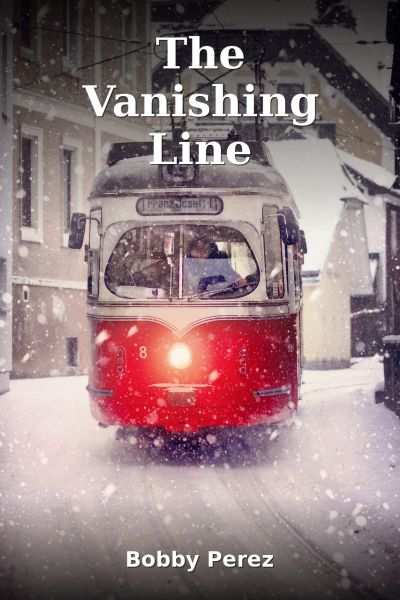
The following is an excerpt from “The Vanishing Line” by Bobby Perez, available on MixCache.com.
Introduction
The photograph shouldn't have existed — and yet it stared up at me like a dare. Glossy paper, the cheap kind that curls at the edges, catching the kitchen light in a thin, oily sheen. Two women on a platform at dusk. One is me, shoulders hunched in a battered field jacket, hair pinned back with a clip I lost years ago. The other is a smudge at my side, a suggestion of a face that my mind resolves and the world refuses. I know her. I know the shape of her laugh in the tilt of her chin. The name rises sure and warm to my tongue, and then the room goes cold.
Lena, I think, and the radiator coughs like it's choking on the word. Outside, the city exhales in wet gusts that carry the smell of metal and old leaves. Rain threads down the window in lines that remind me of the map I keep taped to the wall — the red route that splits the city where factories turn to condos, where alleys end at chain link. The line that people ride and sometimes don't come back from, if you believe in that kind of folklore. If you don't, the numbers still don't add up.
I hold the photo by its edges, fighting the urge to press my thumb over the blur and smooth her back into focus. My coffee has gone stale and bitter. The clock says 2:13 a.m., which is when the trains cut their speed and their brakes start to sing — a long, thin scream that pulls through the bones of the old buildings like the city talking in its sleep. I should sleep. I don't. I haven't slept right since the blackout four years ago, the night that folded over on itself and left a seam in my head I can feel but can't open.
A year after that, Lena vanished. That's the accepted word people use when they're being kind. Vanished sounds like fog. It doesn't sound like phones that ring twice then die, or a bank account that stops moving, or an apartment door that never opens again. It doesn't sound like the way a name can be here and then not, like a trick of light. But that's what happened. One day there were messages and receipts and dumb photos of cheap takeout. The next there was nothing. And now there is this photo, and the feeling in my chest like a bruise when I say her name even in my head.
I tried to fix it the way I fix everything: I called. Old friends, the neighbor with the dog, the woman at the corner store who always asked about the sister with the dark hair. "You mean you?" she said, puzzled, as if I were speaking a language she used to know. I searched. Social media turned up blank spaces and error codes. No Lena. No tagged photos, no ID, no forwarding address, no nothing. The city clerk on night shift listened to me with the careful expression people use when they don't want to make you cry. "There's no record of a sibling," she said. Her screen threw blue light across her hands. She offered me a number to call in the morning.
In the photo, a tram idles on the far track. The destination board is a blur of yellow. The rails shine like wet teeth. If I lean close enough, if I tilt the paper just so, I see the edge of a blue cap in the reflection of the station glass, a slash of color like an underline. My mouth dries out. I touch the clip in my hair, feel the ghost of the old one, feel the snag. Every sense has its hooks in me: the tin taste of fear, the hum of the fridge, the distant brakes, the rain. Memory doesn't arrive; it ambushes. It doesn't ask permission; it rewrites.
I tell myself the city is not a person, but it acts like one. It has moods. It keeps secrets. It decides who gets remembered and who doesn't. It's in the rivulets of rain that carry soot off the girders and into the river; it's in the boarded-up windows and the new coffee bars with Edison bulbs and carefully cracked plaster. I have spent years photographing its skin. I thought that meant I could read its face. Lately, it won't look me in the eye.
This is how it begins: with a picture that shouldn't be, a name lodged under my tongue like a seed hull, and the sense of a line drawn somewhere I can't see yet. I can follow it by sound — metal on metal, a whisper under static — and by the absences it leaves behind: data that won't load, doors that won't remember me, faces that don't light when I say "my sister." The map on my wall is a dare, the same as the photo. Ride the line. Count the stops. Listen to what the city tries not to say.
I carry the photo to the sink and don't drop it. I tuck it into my jacket instead. The jacket is old enough to remember me before the blackout, before the gaps. It smells like rain and film chemicals that aren't there anymore. I slide my keys into my pocket, feel the way they press against my thigh. I say her name out loud, once, in the empty kitchen, just to hear it bounce back. I wait for the echo. The radiator clanks. The train screams. The city swallows. And somewhere along that red route, the line goes out, and then back in again, like a heartbeat I can't quite catch.
Read “The Vanishing Line” on MixCache.com →
Please log in or create an account to leave a comment.
No comments yet. Be the first to say something.