
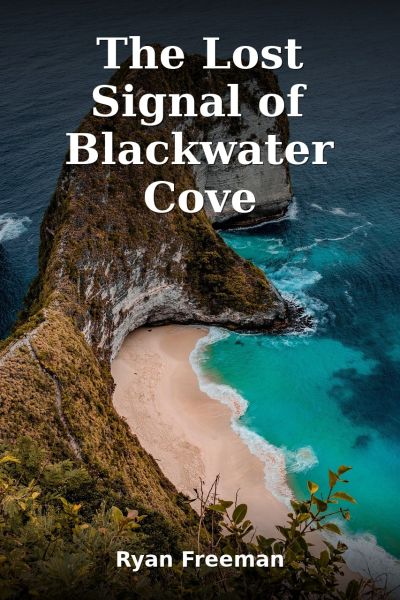
The following is an excerpt from “The Lost Signal of Blackwater Cove” by Ryan Freeman, available on MixCache.com.
Introduction
Fog owns the mornings in Blackwater Cove. It comes in low and sullen, swallowing the pilings and the tired skiffs, beading the air with salt until the world feels damp to the touch. From the highway turnout above the harbor, Mara Quinn watched the lighthouse lamp drag a pale circle across the gray and thought of the last distress call she’d taken—years and miles away, and still close enough to bruise. She had promised herself that the sea could keep its voices. Yet here she was with a duffel, an old radio case, and a town she had not set foot in since she fled it.
Blackwater was smaller than the memory she’d carried, its clapboard streets slouched with age and salt. The cannery was a museum now, the bait shop a coffee bar with weathered charts tacked up as decoration. New banners flapped on the pier advertising redevelopment—clean lines, glossy renderings of condos where boat sheds used to lean. Beneath the veneer, the old sounds persisted: the clank of halyards, the throat-clearing honk of a distant buoy, the deep, patient roll of swell against rock.
Mara had learned to read sound before she learned to drive. Her grandfather, who had minded the radio in storms when the Coast Guard cutter was short-handed, had taught her the hum of healthy equipment and the way true trouble carried in a voice. In uniform, she’d become the one who translated panic into action, held a frequency steady while chaos boiled across the water. Until the night she couldn’t. The rescue that soured her career had a date and a case number and a family attached. When she turned in her badge, the silence felt like mercy.
The silence didn’t last. It began as a rumor tucked into her mother’s worried voicemail—the lighthouse acting strange in the fog, fishermen swearing they heard a station that hadn’t existed since before the war. Then a text from Liza, breezy and late, with a photo of the lighthouse shot at an angle that made the catwalk look like a blade. Look what I found, sis. No words after that, just a half-second clip of static and a fragment that edged under Mara’s skin: a clipped burst shaped like code.
In person, the town felt smaller still. Sheriff Tom Harlan met her on the pier with a handshake that hovered between caution and welcome. The old-timers at the bait tanks watched without watching. Across the water, the lighthouse threw its slow, reassuring eye. Liza was not at the house. Her bed was made. Her car sat near the end of Wharf Street with the door unlocked and a hoodie in the back seat like she’d shrugged out of it between thoughts. On the passenger side, a smear of rust dusted the sill—old iron from the catwalk at the light, if Mara had to guess.
That night, in the rented room above the harbor, she cracked open the case she swore she’d lock away forever. The radio smelled faintly of ozone and old oil. She ran a hand across the dials, the way a diver pats his tanks. It was foolish, she told herself, sentimental even. The set warmed in her hands anyway. She tuned to the marine bands, slid past the chatter of harbor pilots, past weather bulletins and traffic advisories, and found—nothing but the patient breath of the ocean. Then, at 02:17, a scatter of sound bled in from somewhere it shouldn’t: a tight, encrypted burst, a pause, a whisper of coordinates buried in the hiss. It wasn’t possible. Not with that protocol. Not from this coast.
Outside, the fog thickened until the lighthouse was a halo and the pier a smear of light. Mara listened with headphones digging into the ache at the base of her skull and with the part of her that had never stopped listening at all. The burst repeated, then cut, as if someone out there was keying a microphone with a trembling hand. In the gap, she could hear her own breath and, faint beneath it, the bow wave of something large turning in the cove.
By dawn, word had hardened from worry into fact. Liza Quinn, late-twenties, known in every diner and dock in town, had not come home. Her friends had not seen her since the fog pushed in. The sheriff’s office noted the abandoned car and took a statement, the way small-town departments do—with patience and the suggestion that folks often walk off their troubles for a night. Mara stood on the pier and felt the old habit settle onto her shoulders like a dry jacket: checklist, timeline, frequencies to monitor, questions to ask.
She looked at the lighthouse, a pale needle in the milky light, and then down to the radio case by her boots. The cove breathed; the buoy moaned; gulls railed about something only they could see. Whatever this signal was—whatever it meant to pull at an old code and the oldest parts of town—Liza had heard it first. Mara reached for the handle, the decision so simple it surprised her. She was not leaving. Not until the light steadied, the signal fell quiet, and the sea gave her sister back—or told her, at last, what had taken her.
Read “The Lost Signal of Blackwater Cove” on MixCache.com →
Please log in or create an account to leave a comment.
No comments yet. Be the first to say something.