
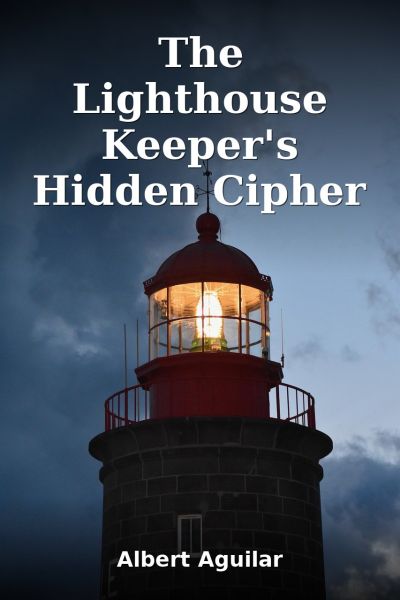
The following is an excerpt from “The Lighthouse Keeper's Hidden Cipher” by Albert Aguilar, available on MixCache.com.
Introduction
“UFMFW ZMW NLNV—GSV TIVVM RH ILEVI.”
—Keeper’s Log, October 13, 1987
Salt rode the wind like a dare the morning Mara Ellis came home. The road into Harrow’s Inlet narrowed between reeds and tidal flats, then rose to a bluff where weathered shingles leaned into the sky and gulls fought over nothing in particular. Her father’s name was still posted in black letters on the church board, a stark pronouncement the town didn’t have to say aloud. People nodded from porches and storefronts, faces composed in that coastal way that confused reserve with kindness. She returned their nods, counting heartbeats until she could be alone with the noise inside her head.
The funeral had been efficient, the condolences practiced. Thomas Reed’s handshake lasted a second too long, his smile as polished as the plaque he’d funded for the pier. Sheriff Daniel Hargrove stood in the back, hat in hand, eyes steady with a concern she didn’t know how to accept anymore. Mara caught her reflection afterward in the mortuary’s dim glass—older around the eyes, the woman who left for truth and came back burdened by it. The whispers didn’t follow her out into the parking lot, but she could feel them pressed into the fog, waiting.
By late afternoon the fog thickened and the lighthouse rose from it like a kept promise. Decommissioned now, its great eye blind, the tower still owned the point with a mechanical patience she remembered in her bones. The iron door rasped against its swollen frame, and the smell of old oil and salt and metal greeted her. She climbed the spiral with a hand on the rail, each step a hollow note, each landing stippled with salt pollen. The lantern room’s glass, streaked and sea-scratched, made the horizon a broken mirror; beyond it, water heaved and settled, old lungs never tiring.
Her father had worked maintenance here on and off, back when the light mattered, back when the town still phoned the keeper before it phoned anyone else. He’d taught her the names of things: trunnion, catadioptric, gallery deck; words like shells she’d keep in her mouth to taste the old days. They’d stopped speaking after she wrote what she wrote—after a source failed her, after a headline outpaced its proof and took her with it. Coming back wasn’t penance, she told herself. It was obligation. It was the last task for a man who could lift a beam one-handed and go silent for days without explaining why.
She found the logbook in a dented locker below the service bench, bound in leather that had swallowed decades of damp. The cover creaked like late ice when she opened it, and the pages breathed salt as if they’d been waiting. There were neat, slanted entries in a keeper’s hand—wind speed, sea state, vessel names—then elsewhere, a different voice crowding the margins in pencil: dates paired with initials, a lattice of tiny symbols, a compass rose drawn and redrawn until the paper thinned. On the back of a dog-eared page, in red, a single line of ciphered letters marched across the white like ants. It meant nothing and everything at once. She dragged her fingertip beneath it and felt the old itch that used to wake her at three a.m. with the shape of a story fully formed.
A gull screamed overhead, and the tower answered with a low, tired groan. Down on the water, a lone skiff traced a slow arc toward the inlet, then stopped as if reconsidering its own intent. Mara slipped the logbook into her bag. The town had been polite to her. Polite like the ocean when it recedes, showing its teeth in the slick stones it leaves behind. She told herself she would take a photograph or two, return the book to the locker, ask Gideon Park what he remembered of the old nights and their weather. Instead she tightened the strap, let the weight of the leather settle against her hip, and listened to the wind pace around the lantern room.
On the stairs down, her phone buzzed—voicemail from a number she didn’t recognize, just the hush of the caller’s breath and a hang-up—and for a second she was back in the newsroom, back in the thread of a pursuit that had both saved and wrecked her. She paused at the door and looked out toward the town. Lights were coming on, small constellations stitched along the harbor road. Somewhere below, a door slammed. Somewhere far out, a horn sounded twice, warning or welcome depending on how you heard it. Mara squared her shoulders, stepped into the fog, and locked the lighthouse behind her. The ciphered line—those red letters marching—kept time with her pulse as she crossed the gravel, and the sea carried the sound away.
Read “The Lighthouse Keeper's Hidden Cipher” on MixCache.com →
Please log in or create an account to leave a comment.
No comments yet. Be the first to say something.