
The following is an excerpt from “The Highlands” by Gregory Evans, available on MixCache.com.
Introduction
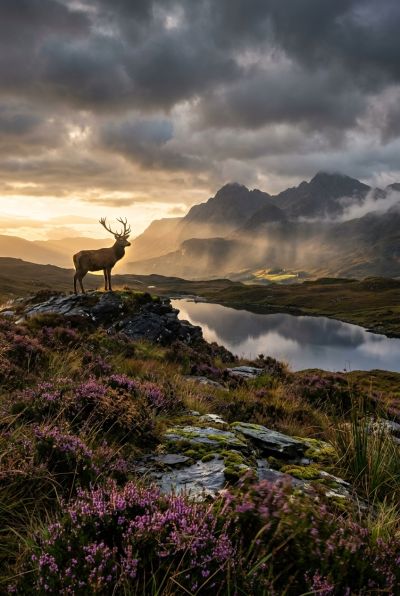
Ask someone to picture the Scottish Highlands and a familiar set of images is likely to spring to mind: mist-wreathed mountains, lonely glens, and deep, dark lochs. They might imagine kilted warriors, the skirl of bagpipes, or the romantic silhouette of a ruined castle against a dramatic sky. This is the Highlands of popular imagination, a potent brand of wilderness and romance that has captivated writers, artists, and tourists for generations. It is a land of myth and legend, a backdrop for epic tales of clan loyalty and heroic, lost causes.
This version of the Highlands, however, is a relatively recent invention, largely shaped by the Romantic movement of the 18th and 19th centuries. Before then, to outsiders, particularly those in the Scottish Lowlands and England, the Highlands were often seen in a very different light. It was viewed as a backward, lawless, and impoverished region, inhabited by a people speaking an alien Gaelic tongue and adhering to a tribal social structure—the clan system—that seemed a world away from the "civilised" south. The history of the Highlands is, in many ways, the story of the collision between these two perceptions: the romanticised ideal and the often harsh and brutal reality.
This book aims to navigate the complex history that lies behind the tartan and heather. It is a history written not just in books and manuscripts but etched into the very landscape itself. The story of the Highlands is inseparable from its geography. The region is defined by the Highland Boundary Fault, a great geological fracture in the Earth's crust that runs diagonally across Scotland from Arran in the west to Stonehaven in the east. North and west of this line, the land rises dramatically into the rugged, mountainous terrain that gives the region its name. This is a landscape of ancient, hard rocks, carved by glaciers into the glens and lochs we see today.
This dramatic topography has always been a defining feature of life in the north. It created a barrier, not just physical but cultural, separating the Gaelic-speaking, clan-based societies of the Highlands from the Scots- and English-speaking, feudal structures of the Lowlands. For centuries, this divide shaped the politics, economy, and culture of Scotland. The mountains and glens fostered a fierce independence and a society organised around kinship and loyalty to a clan chief, a system often at odds with the authority of the Scottish crown.
Our journey begins long before the clans, with the prehistoric settlers who left their mark in stone circles and burial cairns, and continues through the age of the Picts and their encounters with the Roman Empire at the edge of the known world. We will explore the arrival of the Gaels from Ireland, the establishment of the kingdom of Dál Riata, and the subsequent Viking raids that reshaped the political map of the north. The narrative traces the growing influence of the Scottish crown, the turbulent Wars of Independence, and the flourishing of the great Highland clans and the Lordship of the Isles, which for a time created a semi-independent maritime empire.
We will delve into the fabric of daily life, the seasonal rhythms that governed existence, and the beliefs that shaped the Highlanders' worldview, from the early Celtic church to the seismic shifts of the Reformation. The story will then turn to one of the most mythologised and misunderstood periods in Scottish history: the Jacobite Risings. These conflicts were not simply a romantic struggle for a lost royal house but a complex civil war with devastating consequences, culminating in the final, bloody defeat at Culloden.
The aftermath of Culloden ushered in an era of profound and often violent change. We will examine the systematic attempt to dismantle the clan system, the proscription of Highland dress and culture, and the infamous Highland Clearances, when landlords replaced tenants with more profitable sheep, forcing thousands from their ancestral lands. Yet, this was also an age of transformation, marked by ambitious engineering projects—roads, bridges, and canals—that sought to tame the landscape and integrate the Highlands into modern Britain.
In the 19th and 20th centuries, the story of the Highlands takes further, often contradictory, turns. While the region became a romanticised playground for Queen Victoria and a source of inspiration for writers like Sir Walter Scott, its people faced ongoing economic hardship. This led to the Crofters' War, a fight for land rights that brought about significant reforms. We will follow the impact of the World Wars, which drew heavily on the Highlands' martial tradition while accelerating social change, and explore the post-war era of hydro-electric schemes and the North Sea oil boom, which brought new opportunities and challenges.
This history, therefore, is one of constant change and adaptation. It is a story of a people and a landscape that have been romanticised, brutalised, emptied, and reinvented. It is a narrative that challenges the myths and seeks to understand the complex, resilient, and often tragic history of one of the world's most iconic regions. From the first Stone Age hunter-gatherers to the devolved Scotland of the 21st century, this is the history of the Highlands.
Read “The Highlands” on MixCache.com →
Please log in or create an account to leave a comment.
No comments yet. Be the first to say something.