
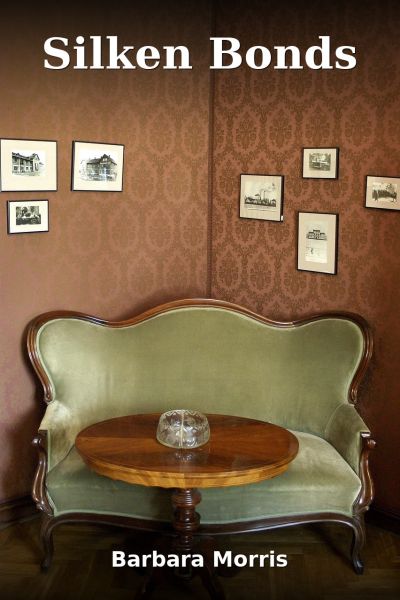
The following is an excerpt from “Silken Bonds” by Barbara Morris, available on MixCache.com.
Introduction
This is a book about consent in an age of curtains and codes. In certain houses lit by gaslight and guarded by civility, grown men and women found a language for power that did not wound. Within parlours perfumed with bergamot and warmed by the steady breath of coal fires, they wrote their own contracts, even as the wider world insisted upon silence. They spoke softly, not because the words were fragile, but because they were rare—and because in the rarity there was carefulness.
I am the keeper of one such parlour, a hostess by vocation and an archivist by temperament. In my rooms on Grafton Square, arrangements were not accidents of passion but agreements of precision. Invitations did not demand attendance; they offered a choice. Those who crossed my threshold did so as willing adults, with their faculties, boundaries, and desires intact. We began with tea, always, for ordinary rituals steady the hand before bolder ones. Then we spoke, we listened, and we wrote our terms. Nothing commenced without clarity; nothing concluded without care.
Victorian London is remembered for its varnished surface: starched collars, veiled hats, the clatter of hansoms, and a catechism of propriety. Yet beneath the bustle lay an undercurrent of negotiation—wives bargaining for hours, clerks for pennies, lovers for a private word in a shadowed garden. The practices nurtured in my salon did not defy the age so much as make explicit what the age would not name: that power, when offered and accepted, can be a form of intimacy, and restraint, when consented to, can be a strange and steadying mirror. To be held is sometimes to be seen.
This account does not chase sensation. There are other pages, cheap and breathless, for that. These pages attend to what occurs before and after the knot is tied: the converse where boundaries are drawn in ink; the pauses where trust is tested and affirmed; the hands that bring water, blankets, and quiet words when the ritual ends. Aftercare is not an epilogue but a promise kept, the soft landing that makes the flight possible. If there is drama here, it belongs to the heart, which is to say it is composed of patience, misstep, repair, and the relief of being understood.
You will meet people who wore their masks to the opera and their true faces to my hearth: a widow who sought a structure stronger than grief; a young barrister who required permission to rest; a physician who could not cease diagnosing until he learned to surrender his stethoscope and his worry. Some came to lead for an hour, some to be led; many learned that both roles are forms of offering. Their stories are cut from silk and thread, not spectacle—subtle, tensile, capable of bearing weight without breaking.
If I write now, it is because secrecy preserved us but also simplified us into rumor. The truth is less convenient: nothing we practiced thrived without negotiation, nothing proceeded without a safeword, and no ritual outlived its consent. The world beyond my door believed power was a ladder to be climbed; we discovered it could be a circle, entered and exited by mutual accord. Judge as you wish. I ask only that you attend to the details—the contracts folded into reticules, the bell that rings when a limit is reached, the tea brewed after—because it is in such particulars that dignity resides.
Should you find, as I did, that tenderness can wear many costumes, do not be alarmed. The heart recognizes its steward whether clothed in velvet or simple wool. Our age prized appearances; our practice prized agreements. Between them, a bridge of silk was spun, and across it passed men and women who chose, together, to be bound and thereby, paradoxically, to be free.
Read “Silken Bonds” on MixCache.com →
Please log in or create an account to leave a comment.
No comments yet. Be the first to say something.