
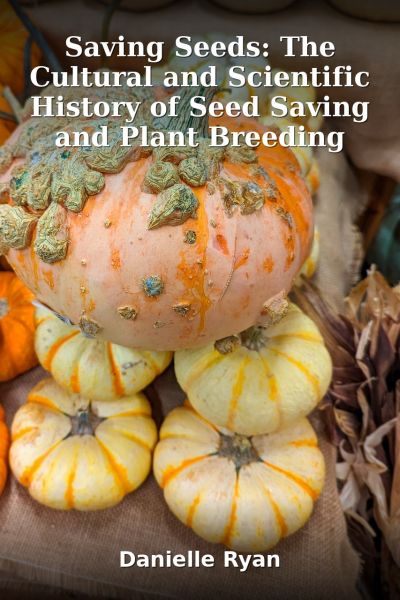
The following is an excerpt from “Saving Seeds: The Cultural and Scientific History of Seed Saving and Plant Breeding” by Danielle Ryan, available on MixCache.com.
Introduction
Seeds are more than the beginnings of plants; they are vessels of memory, technology, and hope. Each seed carries a story—of landscapes and climates, of farmers and foragers, of rituals and trade routes, of scientific inquiry and institutional ambition. Across millennia, people have selected, saved, shared, and sometimes fought over seeds, sculpting the astonishing biodiversity that feeds us today. This book is a dual history of that human–seed relationship: the grassroots practices of farmer-led seed saving and the formal world of plant breeding institutions that emerged from laboratories, experiment stations, and seed companies.
By setting these two strands side by side, we can better see their interdependence and tension. Farmer-led seed saving anchors crops in place—attuned to seasons, soils, pests, and taste. It is local knowledge encoded through repeated selection, exchange, and care. Institutional breeding, in contrast, seeks generalized solutions: stable varieties, standardized testing, yield gains, and broad adaptation. Both traditions have achieved remarkable successes; both have made mistakes. The central question is not which path is superior, but how they might inform and strengthen one another at a time when agriculture must adapt rapidly to environmental change and shifting social demands.
The narrative begins with domestication—how early cultivators nudged wild species toward traits that fit human needs, and how landraces emerged as living archives of local adaptation. We follow seeds through markets and festivals, monasteries and manor gardens, and the commons of customary law. We then turn to the rise of modern genetics and public institutions: the rediscovery of Mendel’s work, the spread of experiment stations, the ascent of hybrid crops, and the establishment of seed banks devoted to safeguarding diversity. Along the way, we meet scientists and stewards whose lives were bound to the fate of seeds, from field collectors to molecular breeders.
As breeding grew more sophisticated, so did the economic and legal frameworks surrounding seeds. Intellectual property regimes—patents, plant variety protection, and licensing—redefined who could save, sell, or improve a variety. These rules have spurred investment and innovation, but they have also sparked heated debates about access, equity, and the proper bounds of ownership over living materials. Movements for farmers’ rights and open-source seeds arose in response, proposing alternatives that keep germplasm both protected and shareable. The book traces these debates not as abstract policy disputes, but as lived realities shaping what farmers can plant and what eaters can taste.
Practical stewardship is a throughline. Saving seeds is a craft as much as a cause: timing harvests, preventing unwanted cross-pollination, drying and cleaning, maintaining population size to avoid inbreeding, and selecting for traits that matter—flavor, storability, resistance, beauty. Community seed libraries, regional networks, and participatory breeding projects have become crucibles where practice, science, and culture mingle. These efforts demonstrate that conservation is not simply about freezing diversity in vaults, but about keeping it in circulation and in evolution.
At the same time, the scientific toolkit has expanded dramatically. Marker-assisted selection, genomic prediction, and gene editing promise to accelerate the development of crops suited to drought, heat, salinity, and emerging diseases. The challenge is to wield these tools without narrowing genetic bases or displacing the very communities that have stewarded diversity. Rather than pitting tradition against technology, this book explores models that link them: farmer–researcher collaborations, decentralized trials, and open data commons that return value to the field.
Because seeds sit at the crossroads of ecology and economy, culture and chemistry, any single perspective will be incomplete. A seed lot is a population; a population is a history; a history is a set of choices. We will consider how taste and nutrition shape selection, how phytosanitary rules govern exchange across borders, and how urban agriculture and school gardens are cultivating new seed savers. We will also confront loss—of varieties, languages, and habitats—and ask what resilience means when climates destabilize and supply chains strain.
Saving Seeds invites readers to see seeds not as static inputs, but as evolving relationships. The chapters that follow move from origins to institutions, from markets to movements, from gene to kitchen table. If there is a thesis, it is this: the future of food depends on renewing the commons of genetic diversity while sustaining the scientific and organizational capacities that help it flourish. Our task is not merely to conserve what we inherited, but to steward a living legacy—one harvest at a time, one selection at a time, one shared packet at a time.
Please log in or create an account to leave a comment.
No comments yet. Be the first to say something.