
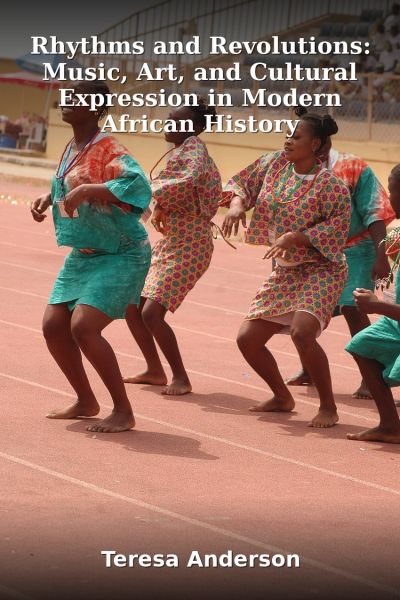
The following is an excerpt from “Rhythms and Revolutions: Music, Art, and Cultural Expression in Modern African History” by Teresa Anderson, available on MixCache.com.
Introduction
This book traces how music, visual arts, and performance have both reflected and reshaped political life in modern African history. From royal courts and caravan towns in the nineteenth century to today’s festivals, galleries, and streaming platforms, culture has been a site where power is negotiated, identities are composed, and global connections are forged. By listening to soundscapes and reading images side by side, we uncover how artists and audiences have made meaning under shifting regimes of authority—from empire to independence, from one‑party states to liberalization, and from broadcast monopolies to digital networks.
Beginning around 1800, we meet musicians, sculptors, photographers, dancers, and designers working within complex social worlds: palaces and mosques, mission schools and markets, railway depots and mining compounds, recording studios and cinema halls. Their practices reveal continuities across upheaval as well as bursts of innovation prompted by new instruments, technologies, and audiences. Visual modernities emerge with photography and print, while novel ensembles and repertoires take shape through migration and urbanization. As caravans yield to steamships and railroads—and later to radio, cassette, satellite, and fiber‑optic cable—the circulation of styles accelerates, tying local scenes to continental and transoceanic publics.
Culture is not merely expressive; it is infrastructural. Licenses, levies, and cultural ministries have shaped what could be sung, filmed, displayed, or danced, just as censorship, policing, and propaganda sought to discipline the senses. Yet artists repeatedly turned constraint into possibility. Satire smuggled critique onto the page; dance floors doubled as classrooms of citizenship; street photography documented new urban subjectivities; and the studio—whether a courtyard with borrowed lights or a laptop on a kitchen table—became a laboratory for reimagining the present. By foregrounding cultural policy alongside biography, this book shows how rules, resources, and institutions have structured creativity, even as creative work has pressured those structures to change.
Attending to gender, generation, and place is essential. Women vocalists, bandleaders, curators, and painters challenged patriarchal norms and transformed repertoires and publics; youth scenes—from dance crazes to graffiti and fashion—recast the politics of respectability; religious movements reoriented aesthetics and audiences; and refugees and exiles remapped the cultural geography of the continent. The chapters follow these crossings carefully, resisting any singular story of “African culture” while tracing patterns—call‑and‑response across regions, recurring struggles over morality and modernity, and the inventive uses of sound and image to imagine freedom.
Africa’s cultural histories are also global histories. The Black Atlantic braided palm‑wine guitar with jazz and salsa; the Sahara and the Indian Ocean connected Gnawa, raï, and taarab to Mediterranean and South Asian worlds; and world‑music stages, biennales, and film festivals created new circuits of prestige and power. Today, the digital turn collapses distance differently: home studios feed streaming platforms; social media choreographs dances into transnational memes; and algorithms, venture capital, and intellectual‑property regimes recast old debates about ownership, authenticity, and access. Throughout, the book explores how globalization is not a one‑way flow but a series of negotiations in which African artists and audiences have been decisive authors.
Methodologically, this is a cultural history grounded in archives and oral histories, close listening and close looking, policy analysis and political economy. Each chapter combines a wide lens—tracking infrastructures, markets, and states—with the intimacy of biography: the singer finding a new timbre after migration, the photographer staging a portrait that reimagines the city, the choreographer translating street steps to a proscenium stage, the curator arguing for restitution or rehangs. These stories are entry points into larger transformations, making the book accessible to general readers while offering scholars fresh syntheses and sources.
Finally, this is a book about responsibility. It treats songs, images, and performances as intellectual work, credits communities as co‑authors of style, and engages the ethics of collecting, archiving, and return. It recognizes the uneven geographies of publication and preservation, and it reads silences—what was banned, unrecorded, or lost—as historical data. By following rhythms and revolutions together, we encounter a modern African history in which culture is not an ornament to politics but one of its most enduring engines.
Please log in or create an account to leave a comment.
No comments yet. Be the first to say something.