
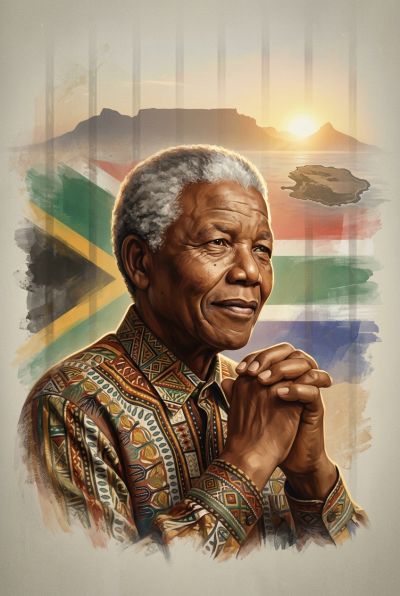
The following is an excerpt from “Nelson Mandela” by Dr Alex Bugeja, PhD, available on MixCache.com.
Introduction
On February 11, 1990, a tall, greying man walked through the gates of Victor Verster Prison near Cape Town, hand in hand with his wife, Winnie. He raised a triumphant fist to the cheering crowds, a gesture seen on television screens around the globe. For many, it was the first time they had seen his face in twenty-seven years. The man was Nelson Mandela, and his walk to freedom was more than just the release of a political prisoner; it was a moment that signaled the beginning of the end for one of the most brutally unjust systems of the twentieth century. The world watched, captivated, as a figure who had become a living legend, a global symbol of resistance, finally emerged from the shadows.
The journey that led to this moment, and the even more remarkable one that followed, is the subject of this book. Nelson Mandela's life is a story of epic proportions, a narrative that stretches from the rolling hills of the Transkei, where he was born into the Thembu royal family, to the corridors of power in Pretoria as South Africa's first democratically elected president. It is a story of transformation: of a country boy who became a sophisticated urban lawyer, a peaceful petitioner who became a guerrilla fighter, a man sentenced to life in prison who became a global icon and a Nobel Peace Prize laureate.
To understand Mandela is to understand the context of his struggle. He was a product of his time and place, a man whose destiny was inextricably linked with the fate of his nation. His life story is the story of South Africa in the twentieth century, a chronicle of racial division, oppression, and the long, arduous fight for freedom. Many South Africans knew him affectionately as Madiba, his Xhosa clan name, a term of respect and endearment that spoke of his connection to the people he led. This biography, A South African Life, seeks to place his extraordinary journey within that national tapestry, exploring the man behind the myth and the forces that shaped him.
At the heart of this story lies the system of apartheid. The word, which means "apartness" in the Afrikaans language, was given to the official policy of the white-minority National Party government, which came to power in 1948. But racial segregation was not new to South Africa; it had been a feature of Dutch and British colonialism for centuries. What the National Party did was to elevate it into a rigid, all-encompassing legal and social structure. It was an ideology of institutionalized racial segregation and white supremacy designed to control every aspect of life.
Apartheid dictated where people could live, work, and go to school based on a rigid racial classification. The Population Registration Act of 1950 categorized every South African as either White, Coloured (of mixed race), Indian/Asian, or Black (Bantu). Subsequent laws, like the Group Areas Act, enforced physical separation, leading to the mass forced removal of millions of Black Africans from their homes into segregated neighborhoods or impoverished rural "homelands" known as Bantustans. These homelands constituted just 13 percent of the country's land, reserved for the vast majority of the population.
The system was enforced with brutal efficiency. "Petty apartheid" governed daily life with signs designating separate park benches, beaches, buses, and hospital entrances. Education for black children was intentionally designed to be inferior, preparing them for a life of manual labor and subservience. To travel and work in so-called white areas, Black Africans were required to carry passes at all times, and failure to produce one could result in immediate arrest. This web of laws was designed to entrench the political and economic dominance of the white minority. It was this system that Nelson Mandela dedicated his life to dismantling.
His story begins far from the sterile halls of government where such laws were made. He was born Rolihlahla Mandela on July 18, 1918, in the small village of Mvezo. His birth name, in Xhosa, colloquially means "pulling the branch of a tree," or more simply, "troublemaker." It was a prescient name for a boy who would grow up to challenge the very foundations of the state. His father was a chief and a key counselor to the Thembu royal house, and after his death, the young Mandela became the ward of the acting regent of the Thembu people.
This upbringing in the royal household was profoundly influential. He observed the regent holding council, listening patiently to the grievances of his people before making a decision. He learned about leadership through consensus and the importance of collective responsibility. It was a traditional African upbringing, steeped in the customs of his people, which instilled in him a powerful sense of identity and duty. He grew up hearing stories of his ancestors' resistance against colonial rule, planting the seeds of his own future struggle.
But his was also a modern education. As the first in his family to attend school, he was given the English name "Nelson" by a teacher, a common practice for African students at the time. He excelled academically and eventually enrolled at the University of Fort Hare, the premier institution of higher learning for Black Africans in Southern Africa. It was here, and later in the bustling, gold-rush city of Johannesburg, that his political consciousness was forged. He left the pastoral world of the Transkei and entered the crucible of urban South Africa.
In Johannesburg, he witnessed the daily humiliations and structural injustices of segregation firsthand. He worked as a mine night-watchman and a law clerk while completing his degree by correspondence. It was in this vibrant, tense metropolis that he met fellow activists like Walter Sisulu and Oliver Tambo, men who would become his lifelong comrades. In 1943, he joined the African National Congress (ANC), the organization that would become the primary vehicle for the liberation struggle.
The ANC, founded in 1912 as the South African Native National Congress, had for decades pursued a path of peaceful protest, sending petitions and delegations to the government in the hope of redressing grievances. But for Mandela and a new, more assertive generation of leaders, this approach seemed increasingly futile, especially after the National Party's victory in 1948. Together, they formed the ANC Youth League in 1944, pushing the parent organization toward a more militant stance.
They advocated for a program of mass action, including boycotts, strikes, and civil disobedience. The 1952 Defiance Campaign, a coordinated effort of nonviolent protest against unjust laws, saw thousands of volunteers court arrest, dramatically increasing the ANC's membership and establishing Mandela as a prominent national leader. During this period, he and Oliver Tambo opened South Africa's first black-owned law firm, providing affordable legal counsel to those ensnared by apartheid legislation.
However, the state's response to peaceful protest was invariably violent. The years that followed were marked by increasing repression, including arrests, bans on public appearances, and a grueling, years-long Treason Trial in which Mandela and over 150 other activists were charged with plotting to overthrow the government. The turning point came on March 21, 1960, when police opened fire on unarmed protestors in the township of Sharpeville, killing 69 people. In the aftermath, the government banned the ANC and other liberation movements.
Faced with the closure of all peaceful avenues for change, Mandela and his colleagues came to a difficult and momentous conclusion: they had to meet the violence of the state with force. In 1961, in association with the South African Communist Party, he co-founded Umkhonto we Sizwe (MK), or "Spear of the Nation," the armed wing of the ANC. Initially, MK focused on acts of sabotage against state infrastructure, a campaign designed to pressure the government without causing loss of life.
This decision transformed Mandela from a protest leader into a wanted man. He went underground, living a life on the run, moving from safe house to safe house, sometimes disguised as a chauffeur or a chef. His ability to evade capture earned him the nickname "The Black Pimpernel." It was a period of immense personal sacrifice, separating him from his family and the life he had known. But his freedom was short-lived. In August 1962, he was arrested.
Initially sentenced for leaving the country illegally and inciting a strike, he was later brought back to court with his comrades in what became known as the Rivonia Trial. Facing the death penalty for sabotage and conspiracy, Mandela delivered a now-legendary four-hour speech from the dock. He ended with a defiant declaration of his principles: "I have fought against white domination, and I have fought against black domination. I have cherished the ideal of a democratic and free society in which all persons live together in harmony and with equal opportunities. It is an ideal which I hope to live for and to achieve. But if needs be, it is an ideal for which I am prepared to die."
He and his fellow accused were spared the gallows but were sentenced to life imprisonment. Mandela was sent to the notorious Robben Island Prison, a windswept former leper colony in the Atlantic Ocean off the coast of Cape Town. He would spend eighteen of his twenty-seven years in prison there. Conditions were brutal; prisoners were forced to perform hard labor in a lime quarry, slept in small cells with no plumbing, and were subjected to meager rations and constant degradation by the warders.
Yet, the prison could not break his spirit. Robben Island became a university behind bars, where political prisoners educated each other, debated political strategy, and kept the flame of the struggle alive. Mandela’s resilience and unwavering dignity earned him the respect of both fellow prisoners and, eventually, some of his jailers. He became a leader within the prison, a moral authority who represented the principled resistance to apartheid.
While the South African government tried to erase him from public memory, his stature grew internationally. The "Free Nelson Mandela" campaign became a global phenomenon, a rallying cry for one of the largest social justice movements the world has ever seen. Musicians composed anthems for him, streets and squares were named in his honor, and thousands of activists, students, and citizens in countries around the world demanded his release through protests and boycotts against the apartheid regime. He became the world's most famous political prisoner, a universal symbol of the fight for freedom and justice.
Inside South Africa, the struggle intensified. The 1976 Soweto Uprising, led by schoolchildren protesting inferior education, re-energized the internal resistance movement. International pressure, including economic sanctions and cultural and sporting boycotts, began to isolate the apartheid state. By the late 1980s, the regime, facing a spiraling economy and growing unrest, recognized that the system was no longer tenable.
In the final years of his imprisonment, Mandela was moved from Robben Island and began engaging in secret talks with government ministers. These were tentative, high-stakes discussions about the future of the country. It was a delicate and dangerous period. President F.W. de Klerk, a former hardliner who recognized the need for change, took the momentous step of unbanning the ANC and other political organizations. Finally, he announced Mandela's unconditional release.
The man who emerged from prison in 1990 was not consumed by bitterness. Instead, he spoke of reconciliation and the need for a peaceful transition to democracy. What followed was four years of tense and complex negotiations, a period fraught with political violence as extremist groups on both sides sought to derail the process. Mandela, leading the ANC, and de Klerk, representing the National Party, had to navigate a perilous path away from the abyss of civil war.
Their efforts culminated in South Africa's first-ever multiracial democratic election on April 27, 1994. Long lines of people, many of whom had never been allowed to vote before, snaked through cities and townships in a remarkable display of peaceful determination. The ANC won a resounding victory, and on May 10, Nelson Mandela was inaugurated as President of the Republic of South Africa. His inauguration was a moment of profound triumph, a testament to the idea that even the most entrenched systems of oppression could be overcome.
This book aims to tell that incredible story in all its complexity. It is the story of a South African life that, in its course, transformed a nation and inspired the world. It will trace the long walk from a boyhood in the Transkei to the presidency, examining the personal sacrifices, the political evolution, and the strategic genius of a man who became a global statesman. It is a story of conflict and compromise, of suffering and forgiveness, and ultimately, of the enduring power of the human spirit in the quest for freedom and dignity.
Read “Nelson Mandela” on MixCache.com →
Please log in or create an account to leave a comment.
No comments yet. Be the first to say something.