
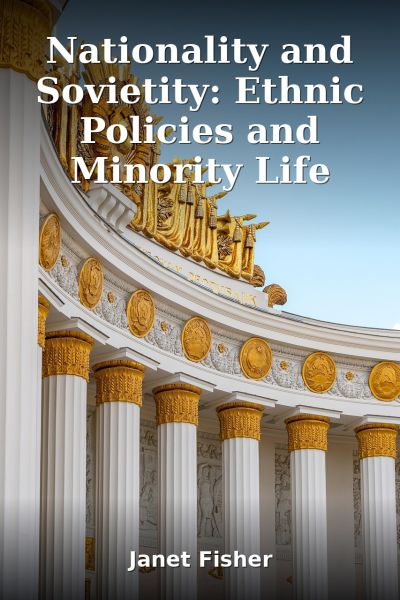
The following is an excerpt from “Nationality and Sovietity: Ethnic Policies and Minority Life” by Janet Fisher, available on MixCache.com.
Introduction
The Soviet Union was one of the twentieth century’s most ambitious political experiments—a vast, multiethnic superstate that sought not only to revolutionize economics and politics, but to reorganize the intricate tapestry of nationality and ethnic identity inherited from the Russian Empire. From the Red Square of Moscow to the steppes of Central Asia and the forests of the Baltics, the Communist regime imposed sweeping policies to mold its populace into “Soviet citizens,” while grappling with—and often aggravating—the diverse loyalties, languages, and historical wounds of its people. The intersection of Soviet ideology with the lived experiences of Ukrainians, Central Asians, Baltics, and Jews provides a profound window into both the possibilities and perils of state-led attempts at cultural transformation.
At the heart of Soviet policy was a deep ambivalence about difference. Early Bolshevik leaders, shaped by Marxist internationalism but pragmatic about the stubborn reality of nationalism, embarked on a policy known as korenizatsiya—an effort to integrate non-Russian populations by promoting local languages, cultures, and leadership. For a moment, Soviet Ukrainians, Kazakhs, Uzbeks, Estonians, Jews, and a host of other nations experienced what seemed to be a flowering of national life, albeit under the strict supervision of the Communist Party. Yet this experiment in multiethnic harmonization quickly gave way to suspicion, repression, and a march toward Russification, as the regime came to view local identities as threats to its authority.
The later Stalinist era, defined by centralization and paranoia, witnessed some of the most brutal episodes of ethnic engineering in modern history: mass purges of local elites, forced deportations of millions from their ancestral homes, and efforts to erase or marginalize native languages and customs. Even as the rhetoric of “national equality” was inscribed in the official doctrine, Soviet power created a hierarchy of privilege and marginality, in which the Russian language and culture dominated, and those suspected of “bourgeois nationalism” or insufficient loyalty were targeted for repression.
Yet the story is not only one of oppression. In each region, the subjects of Soviet nationality policy responded in complex and creative ways: some collaborated, others resisted, and many navigated the shifting boundaries of permissible identity. In Ukraine, famine and terror could not fully quash a deeply rooted sense of nationhood. In Central Asia, collectivization and secularization clashed with clan loyalties and Islamic traditions, resulting in hybrid identities that defied Kremlin blueprints. The Baltic peoples endured repression and demographic transformation, yet maintained powerful currents of dissent that would reemerge in the late Soviet period. Soviet Jews experienced both unprecedented opportunities and profound betrayals, shaping a unique Soviet-Jewish identity marked by creativity, suspicion, and longing for a distant homeland.
This book takes a comparative approach, tracing the arc of Soviet nationality policy through the close study of these diverse case studies. By doing so, it illuminates both the common patterns of assimilation and resistance across the USSR, and the distinctive trajectories shaped by local historical contexts. The chapters examine not only the high politics of Kremlin decisions, but also the everyday lives of minorities—how policy was translated (or resisted) in classrooms, workplaces, villages, and artistic communities.
Above all, the legacy of Soviet nationality policies remains alive in the successor states of the former USSR. The dilemmas of integration and identity left by the Soviet era continue to shape politics, memory, and social relations from Kyiv to Tashkent, from Riga to Jerusalem. In revisiting these histories, the following chapters seek to provide insight not just into a vanished superpower, but into the enduring challenges of pluralism, autonomy, and belonging in a multiethnic world.
Read “Nationality and Sovietity: Ethnic Policies and Minority Life” on MixCache.com →
Please log in or create an account to leave a comment.
No comments yet. Be the first to say something.