
The following is an excerpt from “Lockheed Martin” by Paul Mele, available on MixCache.com.
Introduction
Chances are, your day has already been touched by Lockheed Martin. Perhaps the weather forecast you checked relied on data from one of its satellites, or the GPS that guided your commute depended on the constellation it helps maintain. Maybe the flight you took benefited from air traffic management systems it developed, or the very peace and security underpinning your daily routine are, in part, maintained by technologies forged in its factories and laboratories. Lockheed Martin is a giant, a titan of aerospace, defense, information security, and technology, its presence woven deeply into the fabric of modern life, often in ways unseen and unremarked upon.
This book, 'Lockheed Martin: Portrait of an American Company', sets out to illuminate this complex and influential entity. It’s a story that spans more than a century, encompassing daring aviation pioneers, colossal wartime production efforts, clandestine Cold War innovations, audacious space exploration, and the relentless march of digital technology. It’s the tale of how disparate companies, founded by visionaries like Allan Loughead and Glenn L. Martin, navigated the turbulent currents of the 20th and 21st centuries – surviving financial crises, hostile takeovers, and seismic shifts in global politics – to ultimately merge and form the world's largest defense contractor.
Understanding Lockheed Martin is, in many ways, understanding a significant strand of American industrial and technological history. Its trajectory mirrors the nation's own journey: from the nascent days of flight to the complexities of the digital age, from isolationism to global power, from industrial expansion to the challenges of globalized competition and asymmetric threats. The company has been both a beneficiary and a driver of these changes, a key instrument of national policy and a powerful economic engine in its own right. Its products have shaped battlefields, explored planets, and connected the world.
But this is not just a story of machines and technologies. It's also a human story, involving hundreds of thousands of engineers, scientists, technicians, and support staff who have dedicated their careers to pushing the boundaries of the possible. It’s about legendary figures and secretive design teams, like the famed Skunk Works®, whose very name has become synonymous with rapid, groundbreaking innovation under intense pressure and secrecy. It's also about the intricate, often controversial, relationship between a major corporation and the governments it primarily serves, particularly the United States Department of Defense.
The aerospace and defense sector is a unique ecosystem. It operates at the intersection of technological ambition, immense financial investment, and critical national security interests. Companies within it must navigate long development cycles, stringent government regulations, intense international competition, and the ever-present scrutiny that comes with dealing in matters of defense and public funds. Lockheed Martin exists at the very center of this demanding world, a prime contractor whose performance is inextricably linked to global stability and technological superiority.
This book aims to provide a comprehensive, balanced, and engaging account of this corporate behemoth. We will journey back to the early 20th century, witnessing the parallel births of the Lockheed Aircraft Company and the Glenn L. Martin Company. We'll explore their distinct cultures, their pioneering achievements in aviation, and their crucial contributions during times of global conflict, particularly the Second World War, where their factories became vital components of the "Arsenal of Democracy."
The narrative will then trace the post-war era, a time of rapid technological advancement fueled by the Cold War. We will delve into the creation of iconic aircraft that defined generations, the early ventures into rocketry and space that laid the groundwork for future exploration, and the development of clandestine reconnaissance platforms that operated at the fringes of airspace and secrecy. The story of the Skunk Works®, an organization within Lockheed dedicated to advanced development programs, will be explored as a unique engine of innovation that produced some of the most revolutionary aircraft ever conceived.
We won't shy away from the challenges and controversies. The financial difficulties and scandals that rocked Lockheed in the 1970s, threatening its very existence, are a crucial part of the story. Similarly, the corporate maneuvering and high-stakes battles, like Martin Marietta's successful defense against a hostile takeover bid by Bendix Corporation in the early 1980s, reveal the often-brutal realities of the corporate world, particularly within the consolidating defense industry.
The separate but equally compelling story of Martin Marietta – its origins in aggregates and construction materials, its diversification into chemicals, and its eventual transformation into an aerospace and defense powerhouse specializing in missiles, space systems, and electronics – provides essential context. Understanding Martin Marietta's own rich history, its technological prowess, and its corporate culture is key to understanding the entity that emerged from the eventual merger.
A central event in this narrative is the 1995 "merger of equals" between Lockheed Corporation and Martin Marietta Corporation. This wasn't just a business transaction; it was the creation of a new industry superpower, a strategic move made in response to the shrinking defense budgets following the end of the Cold War. We will examine the rationale behind this merger, the challenges of integrating two distinct corporate cultures, and the subsequent acquisitions that further solidified Lockheed Martin's dominant position.
From the merger onwards, the focus shifts to the modern Lockheed Martin and its multifaceted operations. The book will explore the company's major business areas: Aeronautics, home to legendary fighter jets and transport aircraft; Missiles and Fire Control, responsible for precision strike systems and air defense technology; Rotary and Mission Systems, encompassing helicopters, naval systems, radar, and cyber solutions; and Space, continuing a legacy of exploration and satellite technology.
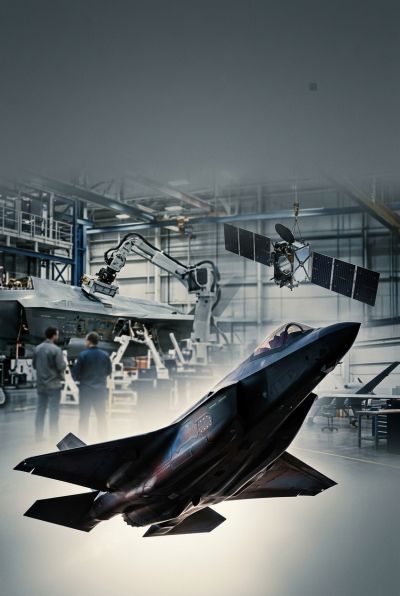
Specific, era-defining programs will be highlighted, such as the development and global deployment of the F-35 Lightning II, arguably the most complex and ambitious fighter aircraft program in history. The sheer scale and complexity of managing such vast undertakings, involving international partnerships, cutting-edge technology, and immense logistical challenges, offer a window into the operational realities of a 21st-century aerospace giant.
We will also look at how Lockheed Martin has adapted to the information age, transforming itself into a significant player in IT, data analytics, and cybersecurity. The increasing importance of software, networks, and artificial intelligence in modern defense and aerospace systems is a critical theme, as is the company's push into areas like digital transformation and secure communications architectures like 5G.MIL®.
Furthermore, the book will consider Lockheed Martin's role in addressing contemporary global challenges that extend beyond traditional defense, including initiatives related to climate monitoring, sustainable energy, and disaster response. The company's vision for the future – encompassing hypersonic flight, next-generation space exploration, integrated deterrence, and the continued evolution of the Skunk Works® – will also be examined, offering a glimpse into the technological frontiers it seeks to conquer in the coming decades.
Throughout this exploration, the aim is to maintain a straightforward and factual approach. The world of defense contracting is inherently complex and often subject to political debate. While acknowledging these debates, this book seeks to present the history, operations, and impact of Lockheed Martin based on available facts, avoiding speculation or sermonizing. It is a portrait, not a polemic. We will let the company's actions, its successes, its failures, and its undeniable influence speak for themselves.
The story of Lockheed Martin is one of ambition, innovation, controversy, and immense consequence. It's about building machines that defy gravity and explore the cosmos, but it's also about corporate strategy, political influence, and the intricate dance between private enterprise and public interest. It is, fundamentally, a uniquely American story, reflecting the nation's technological prowess, its global reach, and its enduring focus on national security. Prepare to delve into the world of Lockheed Martin – a company that not only builds the future but also shapes the present in countless ways.
Read “Lockheed Martin” on MixCache.com →
Please log in or create an account to leave a comment.
No comments yet. Be the first to say something.