
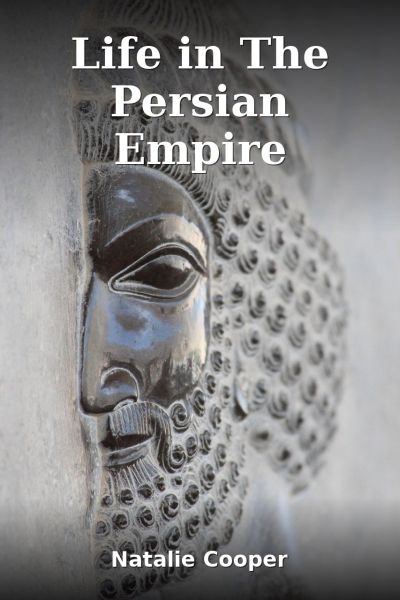
The following is an excerpt from “Life in The Persian Empire” by Natalie Cooper, available on MixCache.com.
Introduction
The Persian Empire stands as one of history’s greatest and most enduring civilizations. At its zenith, the empire stretched across an astonishing expanse, from the fertile banks of the Indus Valley to the mountainous regions of Anatolia, comprising a rich mosaic of peoples, languages, and traditions. Most narratives of the Persian Empire center on its kings, its victories and defeats, or its clashes with rivals like Greece. This book, however, seeks to explore a different but no less fascinating chapter of ancient history: the lived experiences of the men, women, and children who inhabited the Persian Empire.
What was it like to wake each day as a farmer in a rural village, a bustling urban merchant, a royal courtier, or a craftsman in Susa or Persepolis? How did one’s position in society influence daily interactions, expectations, and dreams? To answer these questions, we must look beyond the chronicles of battles and royal decrees and delve into the rhythms of daily life. Here, we uncover the realities of work and worship, home and hospitality, health and hardship. We find communities shaped by mutual obligations, a burgeoning spirit of religious tolerance, and an ever-evolving blend of cultural influences.
The Persian Empire fostered advancements in almost every aspect of life, from governance and law to art, architecture, medicine, and agriculture. For the people living within its boundaries, life involved both continual adaptation and remarkable continuity. Trade routes connected distant lands, allowing goods, ideas, and cultures to flow freely. Innovative irrigation projects supported flourishing fields and vibrant markets. Across cities and countryside alike, the sounds and sights of daily existence reflected both imperial grandeur and local tradition.
Religion played a profound role in structuring lives and communities, with Zoroastrianism forming the backbone of imperial ideology. Yet, the Persians’ famed policy of tolerance allowed a symphony of faiths to thrive together, shaping a sophisticated and largely harmonious world order. Women found opportunities and rights not always available elsewhere, while peasants, artisans, and merchants forged the economic and cultural backbone of the empire. From the lofty halls of Persepolis to the modest fields of a village farmer, the empire’s citizens were participants in a vast yet intimately interconnected world.
Understanding the fabric of daily life in the Persian Empire helps illuminate not only the accomplishments of that era but also its enduring influence on the civilizations that followed. The legacy of imperial Persia persists in art, culture, law, and human aspiration. In these pages, we aim to bring the ancient Persian world alive—to imagine, as faithfully as evidence allows, the experiences, challenges, joys, and hopes of its people.
As we begin this journey, let us set aside the view from the throne and instead walk in the footsteps of ordinary Persians and their neighbors. Through their stories, we gain a richer understanding of an empire that was not only powerful, but deeply human, innovative, and complex—a civilization whose echoes still shape the contours of the modern world.
Read “Life in The Persian Empire” on MixCache.com →
Please log in or create an account to leave a comment.
No comments yet. Be the first to say something.