
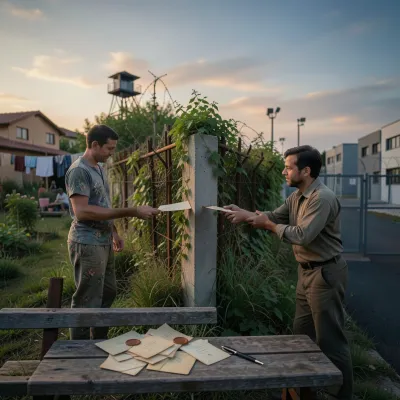
The following is an excerpt from “Letters from the Green Line” by Billy Miller, available on MixCache.com.
Introduction
Between safe zones, where maps are mostly white and rumor fills the blank spaces, the Green Line runs like a live sentence. Not a wall of stone but a braided mass of plants—thorned, flowering, engineered to be both hospitable to insects and inhospitable to microbes—its roots are sunk not only in soil but in policy. Sensors hum in the hedgerow; wind carries both pollen and whispers. Here, checkpoint gates open by schedule and persuasion, and the ground remembers every footprint longer than any of us would. It is a place designed to protect and, like all protections, it has a cost that is paid daily and unevenly.
The letters collected in these pages move along that hedge like ants following a forager’s trail. Ila Morel, a botanist tasked with tending the living barrier, writes in a hand that leans forward, as if each sentence is reaching for the next leaf. Jonas Reza, a quarantine officer posted to the gatehouse, answers with square, careful lines, the script of a man who knows that a smudge can mean a misread, a misread can mean a mistake, and a mistake at the Line can echo for months. What begins as duty-bound correspondence—lists of specimens, incident reports, requests for access—quickly threads into questions about meals and mothers, about how the sky looks just before a particular shift, about the way a certain vine finds its way through a fence no matter how it is trained. Their voices, distinct and stubborn, braid together until the braid itself starts to carry weight.
To read their exchange is to read a social study written from the most human distances: the length of a bench in a gatehouse, a meter of hedge that cannot be crossed, the gap between policy and practice. Committees enter these letters by way of memos and minutes; so do the murmurs from town halls, the pricing board at the co-op, the rumor that a convoy turned back at dusk. We see children mapping safe routes in chalk and elders quilting stories onto masks, merchants counting the cost of lemons against the cost of bleach. We watch how a community learns to perform caution so well it sometimes forgets that caution was meant to serve the living, not the other way around.
The epistolary form refuses the omniscient comfort of hindsight. A letter is written forward, without guarantees, and delivered by the fragile logistics of trust. Ila sketches tendrils in the margins; Jonas affixes incident codes like weather icons. In their disagreements—over pruning schedules, over visitation protocols, over the meaning of risk—we see governance at its most intimate scale: not a headline, but a sentence softened by a thumbprint; not a decree, but a delayed apology; not a model, but a morning. The record of their affection is inseparable from the record of their work, as if care for the hedge and care for one another were forms of the same verb.
This book arranges their letters chronologically to honor the ways cause and effect often walk in disguise. A festival becomes a flare of memory two chapters later; a rumor plants itself and only flowers under interrogation; a breach looks like an accident until it does not. You will find no perfect symmetry here—only the asymmetries of real lives balanced across a boundary. Where context was missing, the silence remains; where the paper was stained by rain, the stain remains too. If there is an argument in this arrangement, it is only that sequence matters, and so does the patience to keep reading even when the news is bad or banal.
Separation, governance, intimacy in crisis: these are the declared themes. But letters, like hedges, conceal more than they announce. In the small economies of their days—seed swaps, shift swaps, the passing of a thermos through a disinfected slot—we witness how people negotiate sacrifice without relinquishing tenderness. We also meet the friction points where the Green Line abrades the green inside them: jealousy, pettiness, fear of a future that never quite arrives. The boundary is technical, yes, but it also runs through hunger and habit, through longing and the legal code, through a body leaning toward another body and stopping, by order.
I offer this collection with the same caution and hope with which Ila and Jonas slid their envelopes into the courier pouches: knowing that words can be both vector and salve. Read it slowly if you can. Let the pauses between letters do their work; notice what grows in the gaps. The Green Line may be a fixture of their world, but as their correspondence teaches, every line we draw is also a question we ask: Where do we end, and where do we meet? If there is an answer here, it is not an instruction. It is an invitation to imagine safety that does not forget to be a home.
Read “Letters from the Green Line” on MixCache.com →
Please log in or create an account to leave a comment.
No comments yet. Be the first to say something.